

 Aug 19, 2026
 6 min read
The Vanishing Imam: Inside Islam's Greatest Unsolved Theological Mystery
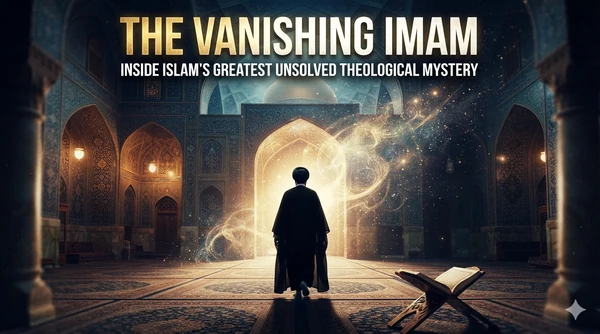
In the garrison city of Samarra, in the year 260 AH (874 CE), a five-year-old boy is said to have led the funeral prayer for his own father — and then disappeared from recorded history entirely.
No grave was ever built for him. No verified sighting was ever confirmed afterward. No death was ever recorded. For well over a thousand years, tens of millions of Twelver Shia Muslims have held to the belief that this child, Muhammad ibn al-Hasan, never died — that he is alive today, hidden from the world, and that he will one day return as al-Mahdi, "the Rightly Guided One," to fill the earth with justice.
It is one of the longest-running mysteries in religious history: a disappearance with no body, no confirmed burial, and no end date. And unlike most historical mysteries, this one is not a dead question confined to old manuscripts — it is a living belief that continues to shape politics, theology, and daily religious practice across the Muslim world.
The Night Samarra Held Its Breath
The story begins with the eleventh Imam of Twelver Shia Islam, Hasan al-Askari, who lived under the close watch of the Abbasid court in Samarra. The Abbasid caliphs had long been wary of the Shia Imams, whose spiritual authority over their followers rivaled the caliph's own political power. Al-Askari lived much of his life under surveillance, and Shia tradition holds that his son's birth was deliberately concealed to protect the child from arrest or worse.
When Hasan al-Askari died in 260 AH at the young age of twenty-eight, the Abbasid state reportedly moved quickly — searching the household, questioning relatives, and even reportedly inspecting the women of the family to determine whether an heir existed at all. Shia sources describe a chaotic scene: agents of the caliph combing through the house in Samarra looking for a child that, according to belief, had already slipped from view.
For mainstream historians, this is where the trouble begins. Outside of Shia religious literature, there is no independent historical record confirming the birth of this son. Sunni and secular historians of the era are largely silent on the matter, and some later Muslim biographers openly doubted that al-Askari had a son at all. This gap between the Shia devotional record and the wider historical record is the first thread of the mystery — and it has never fully unraveled.
The Four Gatekeepers
What happened next is where the story becomes genuinely strange, even by the standards of religious history.
According to Twelver Shia belief, the hidden Imam did not vanish completely. Instead, for the next sixty-nine years, he communicated with his followers through a succession of four trusted deputies, known as al-Nuwwab al-Arba'a — the Four Deputies, or "Gates." This period, from roughly 874 to 941 CE, is called the Minor Occultation, al-Ghaybah al-Sughra.
The first deputy, Uthman ibn Sa'id al-Asadi, had reportedly already served as a trusted agent to the tenth and eleventh Imams before him, making him a natural bridge figure. When he died around 880 CE, his son Abu Ja'far Muhammad ibn Uthman succeeded him. The role then passed to Abu al-Qasim al-Husayn ibn Ruh al-Nawbakhti, a well-connected and politically shrewd figure who served roughly twenty years, and finally to Ali ibn Muhammad al-Samarri, who held the position for only a few years before his death in 941 CE.
Each deputy claimed to carry letters, rulings, and guidance to and from the hidden Imam himself — answering legal questions, resolving disputes, and even, according to tradition, publicly exposing false claimants who tried to impersonate a deputy for status or money. For a Shia community living under suspicion and occasional persecution, this arrangement offered something precious: a functioning, if invisible, chain of leadership.
The Letter That Ended an Era
The mystery deepens with its ending — because the Minor Occultation did not fade away. It stopped on a specific day, with a specific document.
Shortly before his death in 941 CE, the fourth deputy, Ali ibn Muhammad al-Samarri, is said to have received a final letter attributed to the hidden Imam. According to later Shia sources, the letter announced that al-Samarri would die within six days, that no fifth deputy would be appointed after him, and that a second, longer concealment — the Major Occultation, al-Ghaybah al-Kubra — was beginning. From that point forward, the tradition holds, direct contact between the Imam and any single representative would cease. The community was instructed instead to rely on the collective judgment of its religious scholars until the Imam's eventual return.
Al-Samarri reportedly died exactly as the letter predicted. And with his death, the office of deputy was never revived. Nearly eleven centuries later, Twelver Shia Islam still officially regards itself as living inside that Major Occultation — an open-ended waiting period with no announced end date.
A Question That Was Never Settled
Not every Muslim scholar accepted this narrative, and the disagreement is itself part of the mystery's staying power.
Sunni Islam also holds a belief in a coming Mahdi, but generally as a future figure yet to be born, not someone already alive in hiding. Some medieval historians and biographers questioned whether Hasan al-Askari left any son at all, suggesting the office of Imam passed to a brother, Ja'far, whom Twelver sources dismissively nicknamed "al-Kadhdhab" — the Liar — for disputing his nephew's existence. Twelver scholars such as al-Shaykh al-Tusi and Ibn Babawayh al-Saduq wrote extensively to defend the child's birth and the legitimacy of the Four Deputies, while later theologians like al-Nu'mani compiled entire volumes, including his well-known work on the occultation, gathering hadith to support the doctrine.
What makes this different from an ordinary historical dispute is that it was never resolved by the discovery of new evidence. There is no tomb to open, no disputed skeleton to examine, no additional letter to unearth. The entire question rests on trust in chains of narration recorded generations after the events they describe — and on a theological claim that, by its nature, cannot be checked: a living person, hidden by divine will, whose absence is itself the proof of the doctrine.
Why the Mystery Still Matters
Most historical mysteries are curiosities — puzzles we'd like solved out of intellectual interest. This one is different, because it never stopped functioning as a belief with consequences.
The doctrine of occultation reshaped Shia religious authority for a thousand years. Because no living Imam is present to issue direct rulings, religious leadership passed to scholars and jurists — a structural shift that eventually helped produce the clerical institutions still influential in Shia religious and political life today. The expectation of return also feeds a recurring current in Islamic history: the periodic rise of individuals claiming, credibly or not, to be the awaited Mahdi or his herald, from medieval Sudan to twentieth-century Arabia.
And the core question — what actually happened to a child in ninth-century Samarra — remains exactly where it stood over a thousand years ago: unprovable, unresolved, and, for millions of believers, still open.
A Mystery With No Closing Chapter
Most mysteries end when someone finds the missing piece — a body, a document, a confession. The Occultation of Imam al-Mahdi is unusual precisely because it was designed, within its own theology, never to end that way. The absence is the point. The waiting is the doctrine.
Whether read as history, as theology, or simply as one of the most remarkable disappearances ever recorded, the story of the hidden Imam remains what it has always been: a question Islam has carried for eleven centuries without ever being forced to answer it.
Sources consulted include classical Shia works such as al-Shaykh al-Tusi's Kitab al-Ghayba*, al-Nu'mani's* al-Ghayba*, and later hadith compilations, alongside standard biographical and historical references on the Four Deputies and the Minor and Major Occultations.*


Comments (0)
Leave a Reply
Log in to post a comment.