

 Oct 04, 2026
 6 min read
How Time Zones Actually Work (and Why China Has Only One)

Time zones exist because the Earth is a sphere that rotates, and the Sun can only be directly overhead one line of longitude at a time. If every clock on the planet read the same number, "noon" would mean sunrise in one country and midnight in another. Time zones are the patchwork fix for that problem — and the patches are drawn as much by politics as by geography, which is exactly why China, a country wider than the continental United States, runs on a single time zone while the US splits into four.
The underlying math is simple. The Earth turns 360 degrees in roughly 24 hours, so it rotates 15 degrees every hour. If you want local clocks to roughly track the position of the Sun, you divide the globe into 24 wedges of 15 degrees each, and every wedge gets its own hour offset from a reference point. That reference point is Coordinated Universal Time (UTC), a modern descendant of Greenwich Mean Time, measured from the prime meridian running through Greenwich, England.
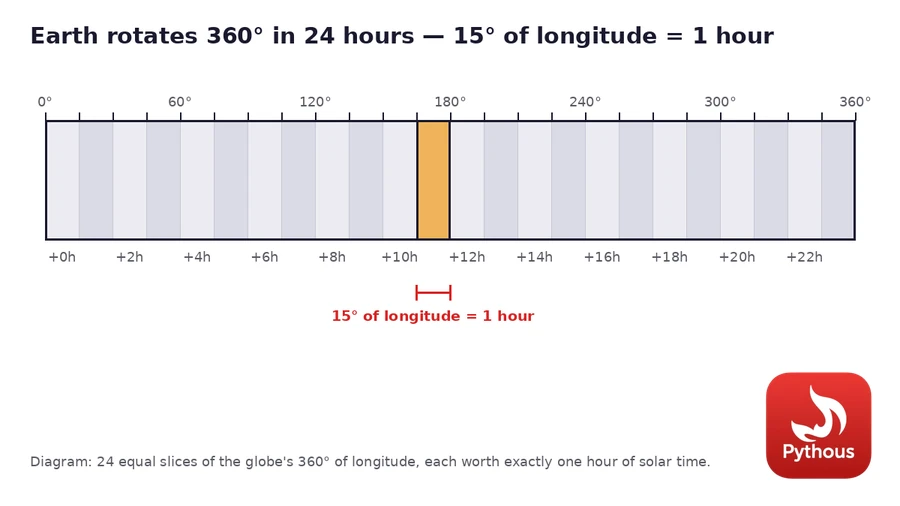
Diagram: 24 equal slices of the globe's 360° of longitude, each worth exactly one hour of solar time.
Why the lines aren't actually straight
If time zones followed longitude exactly, they would be perfectly straight vertical bands running pole to pole, and the border between two zones could cut a small town in half. In practice, almost no country accepts that. Time zone boundaries bend around national borders, state lines, and sometimes even individual towns, so that nobody has to live with one side of the street an hour ahead of the other. The United States' four mainland zones — Eastern, Central, Mountain, and Pacific — roughly track 15-degree bands, but their actual borders zigzag along state lines rather than running due north-south.
Some places go further and offset by a non-whole hour. India runs on UTC+5:30, and Nepal uses UTC+5:45, choices that center the zone more precisely on the country's geographic width rather than snapping to the nearest hour. There is no physical law requiring whole-hour offsets — it's a convenience, not a constraint — so a government is free to split the difference if it suits the country's shape.
China: one country, one clock, five "natural" zones
Geographically, China spans from about 73°E to 135°E — roughly 60 degrees of longitude, which is wide enough to naturally justify four or five separate time zones. Before 1949, China did in fact use five time zones. After the founding of the People's Republic of China, the government unified the entire country onto a single time zone, Beijing Time (UTC+8), based on the meridian running through the capital.
The practical effect is that clocks in Beijing and clocks in Kashgar, nearly 2,500 miles to the west, show the identical time, even though the Sun reaches its highest point in the sky in those two cities more than two hours apart. In far-western China, this means the Sun can still be climbing in the sky at what the clock calls 9 a.m., and sunset in summer can arrive close to 10 p.m. local clock time. Many residents in that region informally run their daily schedules — shops, meals, school start times — two hours "behind" the official clock to stay aligned with actual daylight, without changing what the clock itself says.
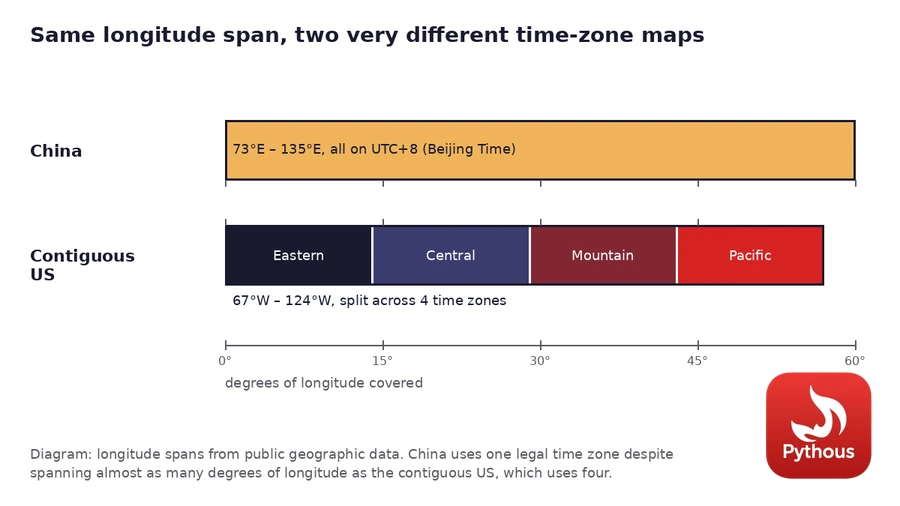
Diagram: longitude spans from public geographic data. China uses one legal time zone despite spanning almost as many degrees of longitude as the contiguous US, which uses four.
What a single time zone buys — and costs
A unified national clock has real administrative advantages: train and flight schedules, business hours, and national broadcasts are simpler to coordinate when there's only one time to keep track of, and it reinforces a sense of national unity across a vast territory. That's precisely why the decision was made in the first place, and similar reasoning — administrative simplicity over astronomical precision — has led other large countries to use fewer time zones than their width would suggest.
The cost falls disproportionately on people far from the reference meridian. Misalignment between clock time and solar time affects sleep schedules, since daylight — the strongest external cue your body uses to regulate its internal clock — arrives at a different clock hour than it would under a geographically "correct" zone. It also affects energy use, school and work schedules, and simple everyday convenience for the millions of people living in China's far west.
Daylight saving time is a different mechanism entirely
It's worth separating time zones from daylight saving time (DST), since they're often confused. A time zone is a fixed offset from UTC tied to a place. Daylight saving time is a temporary, seasonal shift — typically one hour — that some countries apply on top of their normal zone, moving clocks forward in spring and back in autumn to shift an hour of daylight from early morning into the evening. China does not observe DST (it tried it briefly in the 1980s and abandoned it), while many European and North American countries still do, which is part of why the time difference between, say, London and New York isn't constant year-round — it changes depending on which countries are currently observing DST and when.
For anyone who regularly deals with people, meetings, or deadlines across regions, converting between zones by hand is an easy place to make an off-by-one error, especially around DST transition dates. A timezone converter handles the offset and any DST adjustment automatically, and the world clock is a fast way to see what time it currently is in multiple cities side by side without doing the arithmetic yourself.
Frequently asked questions
Why isn't the whole world on UTC?
Local time zones exist so that clock time stays roughly aligned with the position of the Sun — so "noon" is still roughly when the Sun is highest overhead, and most people's waking hours still overlap with daylight. A single global time would be simpler for coordination but would decouple clock time from daylight almost everywhere outside the reference meridian.
Does China's single time zone cause real problems?
Yes, primarily in the far west of the country, where solar noon can be more than two hours later than clock noon. Many people and institutions there informally shift their daily schedules to stay closer to actual daylight hours, even though the official clock doesn't change.
Are time zone boundaries ever changed?
Yes. Countries periodically adjust their time zone boundaries or offsets for economic, political, or practical reasons — Samoa, for example, shifted which side of the International Date Line it sits on in 2011 to align its business week more closely with major trading partners like Australia and New Zealand.



Comments (0)
Leave a Reply
Log in to post a comment.