

 Aug 21, 2026
 19 min read
Imam Ja'far al-Sadiq: The Scholar Who Taught a Generation of Scientists
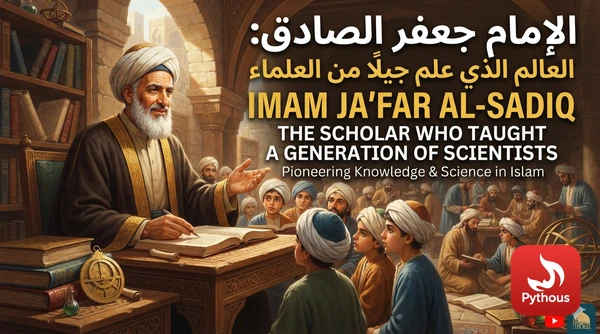
Imam Ja'far al-Sadiq: The Scholar Who Taught a Generation of Scientists
There is a strange gap in how Imam Ja'far al-Sadiq is remembered.
In popular articles he appears as a kind of medieval superhero — a man who allegedly discovered the atom, predicted nuclear energy, mapped the orbits of planets, and invented half of modern chemistry. In academic history books he barely appears at all outside of specialist studies of law and sectarian development.
Both pictures are wrong, and the truth sitting between them is far more interesting.
The real Ja'far ibn Muhammad al-Sadiq was not a man in a laboratory. He was something rarer and, in the long run, more consequential: a teacher whose lecture circle in Medina became the single most crowded intellectual space in the eighth-century Muslim world, and whose students went on to found a school of law, shape Sunni jurisprudence, and — in at least one famous case — write the founding texts of Arabic chemistry.
This article walks through his entire life: the lineage, the political storm he lived inside, the school he built, the science associated with his name, and an honest reckoning with which of the famous claims about him hold up to historical scrutiny.
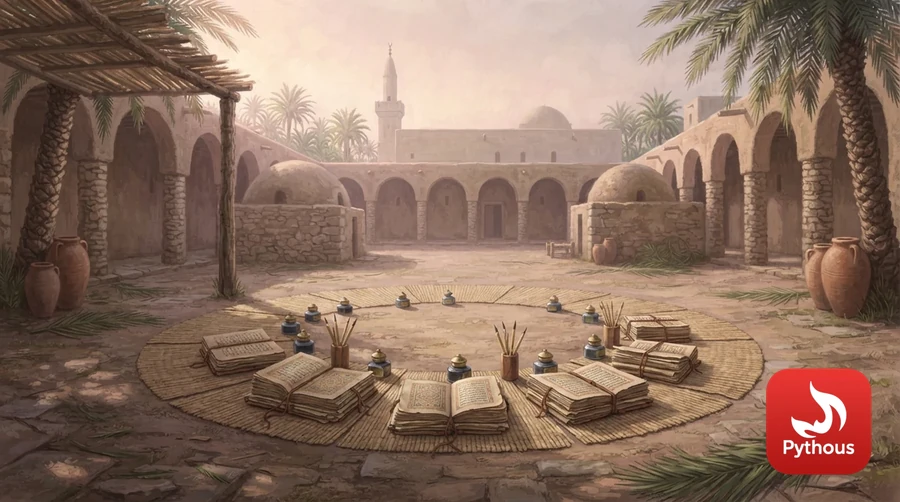
Illustration: an 8th-century teaching circle, set up and waiting for students.
Quick Timeline
| YearEvent | |
| 80 or 83 AH / 699–702 CE | Born in Medina; most Shia sources give 17 Rabi' al-Awwal 83 AH (April 702 CE) |
| c. 705–714 CE | Childhood under his grandfather, Ali Zayn al-Abidin |
| 114 AH / 733 CE | Death of his father, Muhammad al-Baqir; Ja'far assumes leadership of the Medina circle |
| 740 CE | Revolt and death of Zayd ibn Ali — Ja'far declines to join |
| 744–750 CE | Umayyad collapse; civil war; near-total breakdown of central authority |
| 750 CE | Abbasid revolution succeeds; Ja'far is offered the caliphate and refuses |
| 754–775 CE | Reign of al-Mansur; increasing surveillance and pressure on Ja'far |
| 762 CE | Revolt of Muhammad al-Nafs al-Zakiyya in Medina; brutal Abbasid reprisals |
| 148 AH / 765 CE | Dies in Medina, aged about 65; buried in Jannat al-Baqi' |
Part One: Birth and Bloodline
Two rivers meeting
Ja'far ibn Muhammad was born in Medina, in a house that stood at the intersection of the two great political currents of early Islam.
His father was Muhammad al-Baqir, son of Ali Zayn al-Abidin, son of Husayn ibn Ali — the grandson of the Prophet Muhammad who was killed at Karbala in 680 CE. On that side, Ja'far's inheritance was the memory of Karbala, still raw. His grandfather Zayn al-Abidin had been a child at Karbala and survived it; he had watched the aftermath as a captive.
His mother was Umm Farwa bint al-Qasim ibn Muhammad ibn Abi Bakr — a great-granddaughter of Abu Bakr, the first caliph. Her father, al-Qasim, was one of the "Seven Jurists of Medina," the most respected legal scholars of the city.
Ja'far was thus a direct descendant of both Ali ibn Abi Talib and Abu Bakr. He is reported to have remarked on this with a phrase that later scholars quoted often: that Abu Bakr had brought him into being twice over — once through his mother's father, and once through her mother's line.
This detail matters more than it might appear. It is one reason Ja'far al-Sadiq is one of the very few figures in early Islamic history revered across the sectarian divide: Twelver Shia and Isma'ili Shia count him as their sixth Imam, while Sunni hadith scholars list him among the reliable transmitters and major Sufi orders trace their chains of spiritual authority through him.
Growing up in the shadow of a defeat
Ja'far spent his first years in a Medina that had been politically neutered. The Umayyad capital was Damascus. The family of the Prophet was watched, taxed, humiliated in Friday sermons, and periodically imprisoned — but not, for the most part, killed. Medina had become a city of scholars precisely because it had been stripped of power.
His grandfather Zayn al-Abidin died around 713 CE, when Ja'far was a boy of roughly twelve. His father, al-Baqir, then made a decision that would define the next century of Islamic intellectual life.
The decision of al-Baqir
Muhammad al-Baqir — the epithet means roughly "the one who splits open" knowledge — chose deliberate political withdrawal and total intellectual investment. He would not claim the caliphate. He would not lead a revolt. He would teach.
That choice looked like surrender at the time. Ja'far, growing up inside it, absorbed both the method and the reasoning behind it. When al-Baqir died in 733 CE, his son inherited a functioning school and a settled strategy.
Part Two: The Imamate in an Age of Collapse
Ja'far al-Sadiq led his community for roughly thirty-four years, and history handed him an extraordinary gift: a window in which nobody had the attention to spare for him.
The Umayyad implosion
From 744 CE the Umayyad state fell apart. Four caliphs in a single year. Kharijite revolts in Iraq. Berber uprisings in North Africa. Tribal civil war in Syria itself. The state that had spent sixty years monitoring the family of the Prophet suddenly had nothing left to spend on surveillance.
Into that vacuum, Ja'far poured teaching. The years between roughly 744 and 754 CE were the most productive decade of his life — and very possibly the most productive decade in the history of the Medina school.
The offer of the caliphate
In 750 CE the Abbasids took power. Their revolution had been fought under a deliberately vague slogan: al-rida min Al Muhammad — "the agreed-upon one from the family of Muhammad." Vague, because it let both Abbasid and Alid supporters read their own candidate into it.
According to al-Tabari and al-Mas'udi, the revolution's chief organizer in Kufa, Abu Salama al-Khallal, hedged his bets. He sent letters to the leading Alid candidates offering the caliphate — and one of those letters went to Ja'far al-Sadiq in Medina.
Ja'far is reported to have read the letter, held it to the flame of a lamp, and burned it in front of the messenger. His reply, in substance: this man is not my man, and this is not my time.
It was a decision with immense consequences. Had he accepted, he would almost certainly have been killed within the year — as al-Nafs al-Zakiyya was in 762 — and his school would have been dismantled with him. Instead, he traded political claim for institutional survival, and got another fifteen years of teaching out of the bargain.
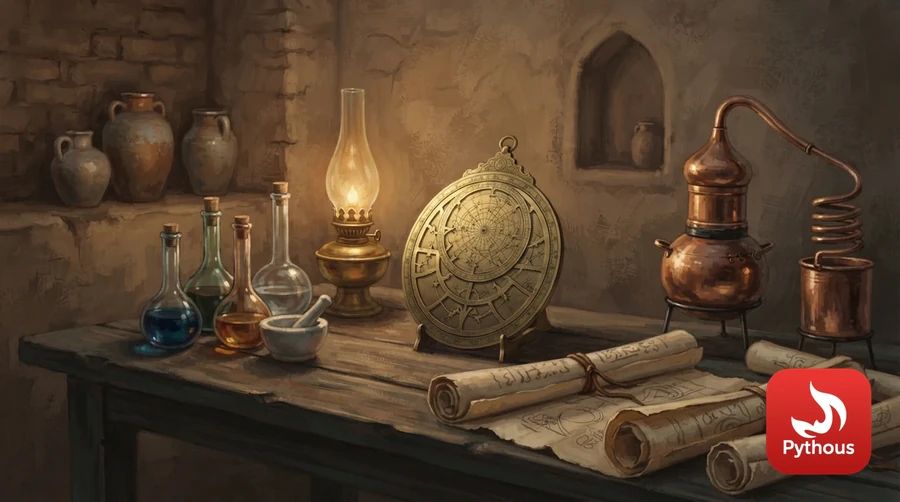
Illustration: astronomy and chemistry instruments of the early Islamic era.
Part Three: The School — The Real Achievement
Four thousand students
The figure most often cited is that around four thousand students passed through his circle. Al-Shaykh al-Mufid gives this number in al-Irshad; al-Tusi's Rijal catalogues over three thousand named transmitters from him.
Even discounting for the way medieval sources round upward, the scale is remarkable — and there is a vivid corroborating detail. The transmitter al-Hasan ibn Ali al-Washsha, quoted in al-Najashi's Rijal, described walking into the great mosque of Kufa and finding nine hundred scholars seated there, every one of them prefacing his lesson with the same words: Ja'far ibn Muhammad narrated to me.
That is not a devotional flourish. That is a description of a transmission network.
What was actually taught
His circle was not a seminary in the narrow sense. The surviving material attributed to him covers:
- Jurisprudence (fiqh) — ritual law, contracts, inheritance, marriage and divorce, criminal penalties
- Hadith and its transmission
- Theology (kalam) — divine attributes, free will and determinism, the nature of God's knowledge
- Quranic exegesis (tafsir)
- Ethics and spiritual discipline
- Natural philosophy — the constitution of bodies, cosmology, medicine, and the design of living things
That last category is the one that matters for this article, and it is also the one most distorted in popular retellings. We will come to it.
His method: an open room
The intellectual signature of the Ja'fari circle was argument. He is repeatedly recorded debating in public with people who rejected his premises outright:
- Ibn Abi al-'Awja' — a materialist who denied a creator entirely. Several long exchanges with him are preserved in al-Kulayni's al-Kafi and al-Tabarsi's al-Ihtijaj. Ja'far does not excommunicate him; he argues with him, at length, in front of an audience.
- Abu Shakir al-Daysani — a dualist working from Manichaean premises.
- An Indian physician, in a debate over whether the world requires a designer or is explained by natural causes.
The consistent pattern is that he meets his opponents on their own ground. He argues from the structure of the human body, from the regularity of the seasons, from causation — not from scripture, which his opponents did not accept anyway. That habit of reasoning from observed nature is the actual bridge between Ja'far al-Sadiq and the history of science.
Part Four: The Sunni Connection
Abu Hanifa
Abu Hanifa al-Nu'man (d. 767 CE), the founder of the Hanafi school — the school followed by the majority of Muslims in South Asia, Turkey, Central Asia and the Balkans — studied with Ja'far al-Sadiq.
The most famous line in the whole biography comes from him: Were it not for those two years, Nu'man would have perished. The two years being the period he spent as Ja'far's student.
A caution worth stating plainly: the chain of transmission for this exact quotation is debated, and some critics regard it as a later embellishment. What is not seriously disputed is that Abu Hanifa knew Ja'far, narrated from him, and debated with him.
Malik ibn Anas
Malik ibn Anas (d. 795 CE), founder of the Maliki school and author of al-Muwatta', was also a student. His praise of Ja'far is preserved by al-Dhahabi and Ibn Hajar: that he never visited him without finding him in one of three states — praying, fasting, or reciting Quran — and that he never heard him narrate anything from the Prophet without a full chain.
The rest of the roll call
Also among his students: Sufyan al-Thawri, Sufyan ibn 'Uyayna, Shu'ba ibn al-Hajjaj, Yahya ibn Sa'id al-Ansari, Ayyub al-Sakhtiyani — a list that reads like an index of the founding generation of Sunni hadith scholarship. On the Shia side: Zurara ibn A'yan, Muhammad ibn Muslim, Hisham ibn al-Hakam, Mu'min al-Taq, Mufaddal ibn Umar.
And one more name, which is why most people arrive at this article in the first place.
Part Five: Ja'far al-Sadiq and the Sciences
Jabir ibn Hayyan
Jabir ibn Hayyan (c. 721 – c. 815 CE), known in Latin Europe as Geber, is the name attached to the foundational corpus of Arabic alchemy and chemistry. Somewhere between two thousand and three thousand treatises circulate under his name.
Throughout that corpus, the author repeatedly identifies himself as the disciple of sayyidi Ja'far ibn Muhammad al-Sadiq — "my master, Ja'far ibn Muhammad." He does not mention this once. He does it constantly, across many books, often framing an idea as something received from his teacher.
What the Jabirian corpus contains is genuinely foundational:
- The insistence on experiment. The texts argue, explicitly and repeatedly, that a claim about matter is worth nothing until it has been tested by hand in the workshop. This is the single most important idea in the collection.
- Laboratory technique. Systematic descriptions of distillation (via the al-inbiq, from which English gets "alembic"), calcination, sublimation, crystallization, filtration, evaporation and reduction — described as reproducible procedures with equipment specifications.
- The classification of substances into three broad groups: "spirits" that vaporize entirely under heat (sulfur, mercury, arsenic compounds, sal ammoniac, camphor), fusible metals, and non-malleable mineral bodies. This is a working taxonomy of matter, arrived at by observed behaviour rather than by philosophical category.
- The science of the balance ('ilm al-mizan). An attempt to assign numerical proportions to the elemental qualities — hot, cold, moist, dry — within a substance, and to predict transformations from those numbers. The underlying theory is wrong. The ambition, that chemistry should be a quantitative discipline rather than a descriptive one, is exactly right, and it is startlingly early.
The honest historical problem
Here I have to be straight with you, because a blog that publishes the legend without the caveat eventually loses its readers' trust.
The Jabirian corpus is very unlikely to be the work of one eighth-century man. The German-Czech scholar Paul Kraus, in a study published in 1942–43 that remains the starting point for all serious work on the subject, demonstrated on linguistic, doctrinal and technical grounds that much of the collection was written later — probably in the late ninth and tenth centuries, by authors within Isma'ili intellectual circles, writing under Jabir's name.
Later scholarship has pushed back in part. Syed Nomanul Haq, in Names, Natures and Things (1994), argued that Kraus went too far and that a genuine eighth-century core survives inside the corpus. The debate is live and unresolved.
So what does that leave us with?
Three defensible statements:
- A historical Jabir ibn Hayyan almost certainly existed in the eighth century and was associated with Ja'far al-Sadiq.
- The corpus bearing his name is composite, and much of its most advanced technical content is later than his lifetime.
- The attribution to Ja'far al-Sadiq is itself a historical fact of major significance — regardless of whether it is a fact about who wrote what. Generations of Muslim natural philosophers chose to place their experimental science under the authority of this particular teacher. That tells you something real about how he was understood: as the figure who made it legitimate to study nature.
Did he "invent" anything?
Directly, personally, in the sense of building a device or discovering a compound — no, and the sources do not really claim that he did.
You will find articles online crediting him with nitric acid, aqua regia, waterproof cloth, rust-proof varnish, the use of manganese dioxide in glassmaking, and gold-substitute ink. Every one of those belongs to the Jabirian corpus, not to Ja'far — and the mineral acids in particular are now generally traced to the Latin pseudo-Geber writings of thirteenth and fourteenth-century Europe, especially the Summa Perfectionis associated with Paul of Taranto. They are three to six centuries too late to belong to anyone in this story.
You will also find the claim that he described the atom and anticipated nuclear energy. What the sources actually preserve is his participation in the eighth-century kalam debate over whether matter is infinitely divisible or resolves into indivisible parts — a genuinely important philosophical argument, and one with a long afterlife in Islamic theology, but not a physical theory and not a prediction of anything.
His contribution was of a different kind, and honestly a larger one: he supplied the intellectual permission. In a period when investigating the natural world could easily have been coded as impious speculation, the most respected teacher in Medina spent his time arguing that the structure of the eye, the mechanics of digestion, the behaviour of the elements and the order of the heavens were fit subjects for close and reasoned study. Students who wanted to open a workshop and test things could point to him.
Tawhid al-Mufaddal
The most substantial surviving text on this theme is Tawhid al-Mufaddal, dictated across four sessions to his student Mufaddal ibn Umar al-Ju'fi.
It is, in modern terms, a work of natural theology — an argument for design running through human anatomy, embryonic development, the senses, animal behaviour and instinct, plant life, minerals, meteorology and cosmology. It contains close observational description: why the eye is constructed as it is, why the infant is born helpless, why bones are jointed the way they are, why some animals migrate.
Its authenticity is debated even within Shia scholarship, because Mufaddal was himself a contested figure. Al-Majlisi included it in Bihar al-Anwar; others have questioned the chain. Present it to your readers as what it is: an early and important text associated with him, not a document with an unbroken pedigree.
Two other works are commonly attributed and should be treated with more caution still: Misbah al-Shari'a, which most major Shia scholars including al-Khu'i regarded as spurious, and al-Risala al-Ahlilajiyya, the debate with an Indian physician, whose attribution is weak.
Part Six: The Ja'fari School
The Ja'fari school of jurisprudence (al-madhhab al-Ja'fari) carries his name and remains the legal school of Twelver Shia Muslims worldwide.
Its distinguishing features, in brief:
- Sources of law: Quran, Sunna (including the transmitted teachings of the Imams), consensus, and reason ('aql) — reason occupying the place that analogy (qiyas) holds in Sunni schools. Ja'far is recorded rejecting qiyas sharply in debate.
- A continuing living authority rather than a closed founding generation, which allowed the school's ijtihad tradition to remain formally open.
- Distinctive rulings on matters including the wording of the call to prayer, combining prayers, temporary marriage, and inheritance shares.
In 1959, Shaykh Mahmud Shaltut, then rector of al-Azhar in Cairo, issued a fatwa recognising the Ja'fari school as a legitimate school of Islamic law which Muslims may follow — a landmark statement in the modern history of Sunni–Shia relations, and one that traced its legitimacy back to this man's classroom.
Part Seven: The Last Years
Under al-Mansur
The second Abbasid caliph, al-Mansur (r. 754–775 CE), was a very different proposition from the collapsing Umayyad state. He was competent, suspicious, and entirely willing to kill relatives.
He understood exactly what Ja'far's four thousand students represented. Sources describe repeated summonses to Iraq — to Kufa, to Hira, to the new capital at Baghdad — where Ja'far was interrogated, kept waiting, and released. Al-Mansur is reported to have said of him something to the effect that he was a bone stuck in the throat: impossible to swallow, impossible to spit out.
In 762 CE, Muhammad al-Nafs al-Zakiyya, a descendant of Hasan ibn Ali, revolted in Medina. His brother Ibrahim rose in Basra. Both were crushed within months and both were killed. The reprisals in Medina were severe, and reports describe Ja'far's house being burned during the governor's response to the unrest.
Ja'far had declined to support the revolt — consistent with the position he had held since 750, and since his father before him. It did not fully protect him, but it kept his school intact through the worst of it.
Death
He died in Medina in 148 AH / 765 CE, aged about sixty-five lunar years.
Twelver Shia tradition holds that he was poisoned on al-Mansur's orders, administered by the governor of Medina. Sunni sources generally record a natural death. The historical evidence does not settle it; report both, and let your readers weigh it.
He was buried in Jannat al-Baqi', the cemetery of Medina, beside his father al-Baqir, his grandfather Zayn al-Abidin, and his great-great-uncle Hasan ibn Ali. The domed structures over those graves were demolished in 1925–26; the site today is a plain field of unmarked stones.
The succession and the split
His death produced the most consequential succession dispute in Shia history.
His eldest son Isma'il had died before him — or, according to those who became the Isma'ilis, had not, or had passed the imamate to his own son Muhammad. The majority followed Musa al-Kazim as the seventh Imam, and became the Twelvers. A third group followed another son, Abdullah al-Aftah, and largely dissolved within a generation.
The Isma'ili line would eventually produce the Fatimid Caliphate in Egypt, the founding of Cairo, and al-Azhar itself. Both of the great surviving branches of Shia Islam therefore run directly through this one household in Medina.
What He Actually Left Behind
Strip away the exaggeration and the picture that remains is still extraordinary.
Ja'far al-Sadiq inherited a family with a legitimate claim to rule and a hundred years of defeat behind it. He made a calculated decision to abandon the political claim permanently, and to invest everything in a classroom instead.
The return on that decision: a school of law followed by hundreds of millions of people; a formative influence on two of the four Sunni legal schools; a transmission network that runs through most early hadith collections; the intellectual lineage claimed by the founding texts of Arabic chemistry; and a reputation solid enough that his name is invoked with respect on both sides of the deepest division in Islamic history.
He built none of it with an army. He built it by sitting in the same place for thirty years and answering questions.
Frequently Asked Questions
Who was Imam Ja'far al-Sadiq? He was an eighth-century scholar of Medina (c. 702–765 CE), a great-great-grandson of the Prophet Muhammad, the sixth Imam of Twelver and Isma'ili Shia Islam, and the teacher after whom the Ja'fari school of law is named.
Was Ja'far al-Sadiq a scientist? Not in the modern sense of an experimenter. He was a teacher and philosopher whose engagement with natural questions — anatomy, cosmology, the constitution of matter, medicine — and whose insistence on reasoned argument helped make the study of nature intellectually legitimate. The experimental work belongs to students and later successors.
Did he teach Jabir ibn Hayyan? The Jabirian corpus repeatedly names Ja'far al-Sadiq as its author's master. Modern scholarship debates how much of that corpus is genuinely eighth-century, but the association between the two men is early and consistent.
Did Abu Hanifa study under him? Yes. Abu Hanifa, founder of the Hanafi school, studied with and narrated from Ja'far al-Sadiq, as did Malik ibn Anas, founder of the Maliki school.
Did he discover the atom? No. He took part in the theological debate of his era over whether matter is infinitely divisible. Claims that he anticipated modern atomic theory or nuclear energy are modern additions with no basis in the sources.
How did he die? He died in Medina in 765 CE at about sixty-five. Shia tradition holds he was poisoned on the orders of the Abbasid caliph al-Mansur; Sunni sources record a natural death.
Sources and Further Reading
Classical Arabic sources
- Al-Tabari, Tarikh al-Rusul wa'l-Muluk — for the Abbasid revolution and the Alid revolts
- Al-Mas'udi, Muruj al-Dhahab — for Abu Salama's letter
- Al-Shaykh al-Mufid, Kitab al-Irshad — the fullest classical biography
- Al-Kulayni, al-Kafi — the theological debates
- Al-Tusi, Rijal and al-Najashi, Rijal — the student network
- Al-Dhahabi, Siyar A'lam al-Nubala' and Ibn Hajar, Tahdhib al-Tahdhib — the Sunni assessments
- Ibn Khallikan, Wafayat al-A'yan — biographical notice
Modern scholarship
- Paul Kraus, Jâbir ibn Hayyân: Contribution à l'histoire des idées scientifiques dans l'Islam (Cairo, 1942–43)
- Syed Nomanul Haq, Names, Natures and Things: The Alchemist Jabir ibn Hayyan and his Kitab al-Ahjar (1994)
- Wilferd Madelung, The Succession to Muhammad and his articles on early Shia thought
- Marshall Hodgson, The Venture of Islam, vol. 1
- Encyclopaedia of Islam (2nd/3rd ed.) and Encyclopaedia Iranica, entries on "Ja'far al-Ṣādeq" and "Jāber b. Ḥayyān"


Comments (0)
Leave a Reply
Log in to post a comment.