

 Oct 09, 2026
 6 min read
Why We Dream: What Science Actually Knows
In 1953 Eugene Aserinsky, a graduate student at the University of Chicago, and his supervisor Nathaniel Kleitman reported something odd in the journal Science. Several times a night, sleepers' eyes darted back and forth under their lids for minutes at a time. When the researchers woke people during these periods, most said they had been dreaming. When woken at other times, far fewer did. That was the discovery of rapid eye movement, or REM, sleep, and the start of the modern science of dreams.
Seventy years on, a good deal is known about when dreams happen and what the brain is doing at the time. Why we dream is still argued over.
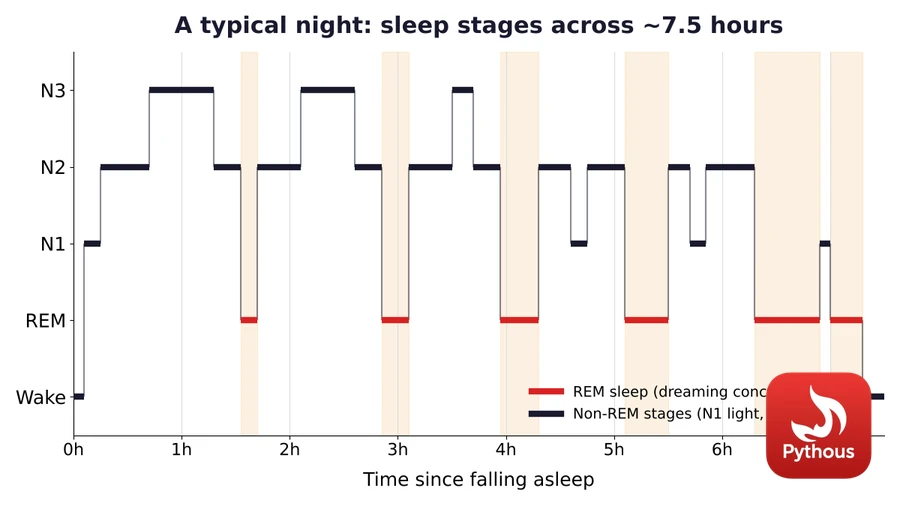
Chart: a stylized hypnogram of a typical adult night, showing the standard pattern of roughly 90-minute cycles through non-REM stages (N1, N2, N3) and REM sleep, with REM periods getting longer and deep N3 sleep becoming rarer as the night goes on.
The state that produces dreams
A night's sleep runs in cycles of roughly 90 minutes. Each one passes from light non-REM sleep (stages N1 and N2) into deep, slow-wave sleep (N3) and then into REM. Early cycles contain most of the deep sleep; later ones have longer REM periods, which is why the most vivid dreams tend to come towards morning. Adults spend about a fifth to a quarter of the night in REM, often around two hours.
In REM, the brain's electrical activity looks a lot like wakefulness, but the body is almost completely paralysed. Circuits in the brainstem block the signals to most muscles, leaving only the eyes and the breathing muscles free. In REM sleep behaviour disorder, that block fails, and people punch, kick or leap out of bed as they act out their dreams. Neurologists now know the disorder is often an early sign of Parkinson's disease or related conditions, sometimes by a decade or more.
Dreams are not confined to REM, though. People woken from non-REM sleep report dreaming perhaps a quarter to a half of the time, usually something shorter and more thought-like. In 2017 Francesca Siclari, Giulio Tononi and colleagues in Wisconsin and Lausanne recorded sleepers' brain activity with 256 electrodes and woke them repeatedly to ask what had been going through their minds. Whether people had been dreaming, in REM or non-REM, could be predicted from reduced slow-wave activity in a "hot zone" towards the back of the brain.
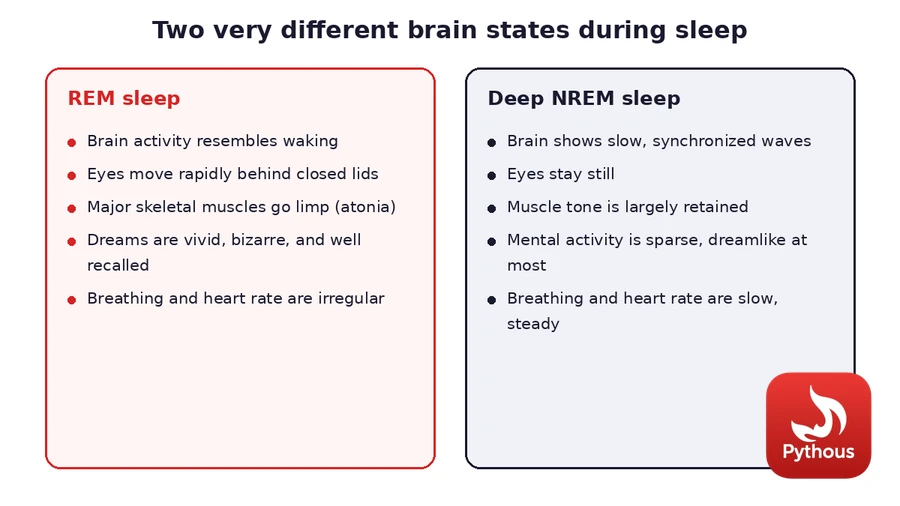
Diagram: the main physiological contrasts between REM sleep, where most vivid dreaming occurs, and deep NREM (N3) sleep, based on established findings in sleep physiology research.
What the dreaming brain looks like
Brain scans taken during REM sleep since the 1990s, beginning with Pierre Maquet's PET studies in Liège, show a consistent pattern. Areas involved in emotion, especially the amygdala, are highly active, as are visual and spatial areas. The dorsolateral prefrontal cortex, which handles planning, logic and keeping track of what is real, is relatively quiet. That pattern fits what dreams are like: vivid, visual and emotional, with the most absurd events accepted without question until you wake up.
Four answers to "why"
In 1977 the Harvard psychiatrists J. Allan Hobson and Robert McCarley proposed the activation-synthesis hypothesis. During REM, they argued, the brainstem fires more or less randomly, and the forebrain does its best to weave the signals into a story. On this view dreams may have no purpose of their own; they are the by-product of a brain state that exists for other reasons. Hobson later softened this, but the idea that dream content need not mean anything remains influential.
A second line of research links sleep to memory. During slow-wave sleep the hippocampus replays patterns of activity from the day, which seems to help move memories into long-term storage in the cortex. Dreams often contain fragments of recent experience mixed with older memories, and some researchers think dreaming reflects this sorting process from the inside.
A third idea concerns emotion. Matthew Walker and Els van der Helm, then at the University of California, Berkeley, argued in 2009 that REM sleep lets the brain reprocess emotional memories while levels of noradrenaline, a stress-related chemical messenger, are at their lowest of the day. The memory is kept, but its emotional sting is reduced. Disturbed REM sleep is common in post-traumatic stress disorder, which fits the idea, though it doesn't prove it.
The fourth is evolutionary. In 2000 the Finnish psychologist Antti Revonsuo proposed that dreaming evolved as a threat simulator, letting the brain rehearse escape and defence in safety. Being chased, falling and being unprepared are among the most common dream themes in every culture surveyed. Critics point out that many dreams are mundane or pleasant, and the theory is hard to test.
Most sleep researchers now treat these as overlapping, not competing. Dreaming may be what a brain doing several jobs at once feels like from the inside.
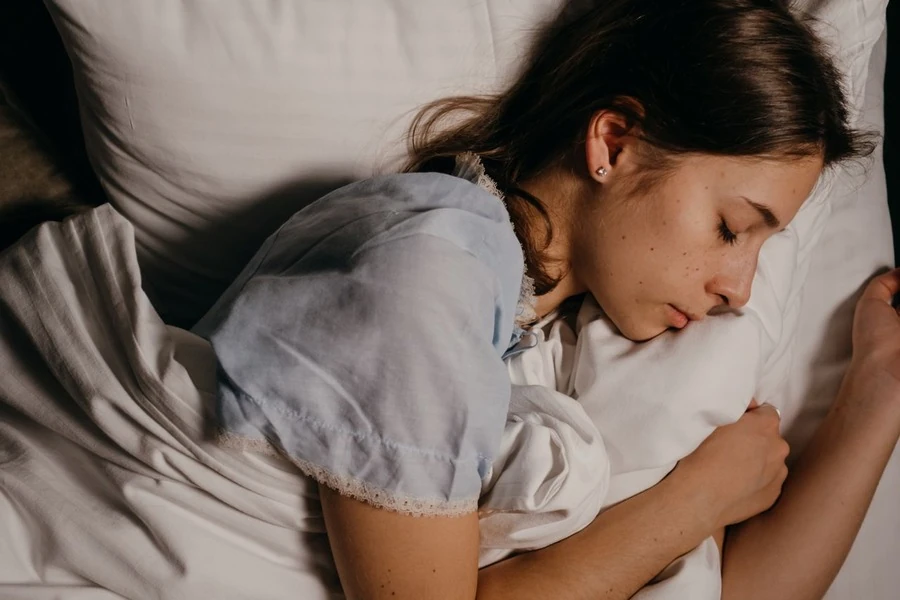
One theory holds that dreams are a by-product of the brain replaying and sorting the day's memories. Photo: Polina / Pexels
Remembering, and talking back
Most dreams are forgotten within minutes of waking, and many are never remembered at all. The memory systems that store waking experience work differently in REM sleep, and a dream is usually only recalled if you wake during or just after it and pay attention to it straight away. Keeping a notebook by the bed and writing dreams down before doing anything else is the most reliable way to remember more of them.
Some people know they are dreaming while still asleep. Lucid dreaming was proved in the laboratory around 1980, when the psychologist Stephen LaBerge at Stanford had lucid dreamers signal with agreed eye movements, which show up on recordings even though the rest of the body is paralysed. In 2021 a team led by Karen Konkoly and Ken Paller at Northwestern University went further. Working with labs in France, Germany and the Netherlands, they asked lucid dreamers simple maths questions through speakers during REM sleep, and several answered correctly with eye movements, without waking up.
What is still missing is agreement on the basic question. It is not known whether dreaming has a function of its own, or whether it is a side effect of the jobs sleep does for the brain.
Sources
- Eugene Aserinsky and Nathaniel Kleitman, "Regularly occurring periods of eye motility, and concomitant phenomena, during sleep", Science 118 (1953): 273–274. https://doi.org/10.1126/science.118.3062.273
- Francesca Siclari, Benjamin Baird, Lampros Perogamvros et al., "The neural correlates of dreaming", Nature Neuroscience 20 (2017): 872–878. https://doi.org/10.1038/nn.4545
- J. Allan Hobson and Robert W. McCarley, "The brain as a dream state generator: an activation-synthesis hypothesis of the dream process", American Journal of Psychiatry 134 (1977): 1335–1348. https://doi.org/10.1176/ajp.134.12.1335
- Matthew P. Walker and Els van der Helm, "Overnight therapy? The role of sleep in emotional brain processing", Psychological Bulletin 135 (2009): 731–748. https://doi.org/10.1037/a0016570
- Antti Revonsuo, "The reinterpretation of dreams: an evolutionary hypothesis of the function of dreaming", Behavioral and Brain Sciences 23 (2000): 877–901. https://doi.org/10.1017/s0140525x00004015
- Karen R. Konkoly, Kristoffer Appel, Emma Chabani et al., "Real-time dialogue between experimenters and dreamers during REM sleep", Current Biology 31 (2021): 1417–1427. https://doi.org/10.1016/j.cub.2021.01.026





Comments (0)
Leave a Reply
Comments are moderated. Please read our Comment Policy before posting.
Log in to post a comment.