

 Oct 06, 2026
 6 min read
Compound Interest: The Math That Quietly Builds Fortunes
Compound interest is often called the eighth wonder of the world, which is a cliché, but the math behind it is genuinely strange: the same small percentage, left alone long enough, can turn a modest sum into a fortune — not because the rate changes, but because the base it's applied to keeps growing. Understanding why requires looking past the headline percentage and into the exponent that drives it.
The formula, and why the exponent matters
Simple interest pays you a fixed amount each period, calculated only on your original deposit. If you put $10,000 into an account paying 7% simple interest, you earn $700 every year, forever, no matter how long you leave it. After 30 years, you'd have $10,000 + (30 × $700) = $31,000.
Compound interest is different because it pays interest on your interest. The formula is:
A = P(1 + r)t
where A is the final amount, P is the principal (your starting deposit), r is the interest rate per period (as a decimal), and t is the number of periods. The principal sits inside a base being raised to a power — and exponents are what make the curve bend upward instead of running in a straight line. You can check your own numbers with a compound interest calculator rather than working the formula by hand.
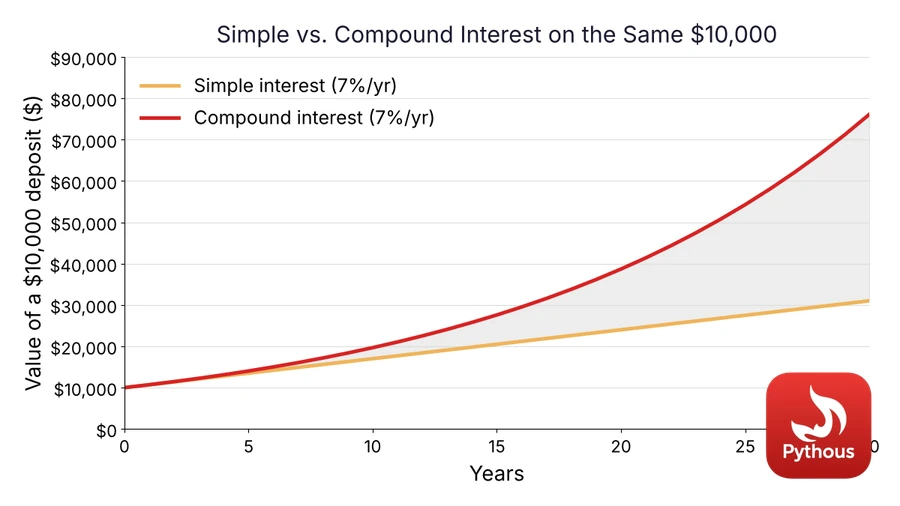
Chart: value of a $10,000 deposit over 30 years at 7% annual interest, comparing simple interest (linear growth) to compound interest (exponential growth), calculated from A = P(1 + r)^t.
At 7% compounded annually, that same $10,000 grows to roughly $76,100 after 30 years — nearly two and a half times what simple interest would produce, with no extra deposits and no change in rate. The gap between the two lines is pure compounding: interest earned on interest that was earned on interest, stacking up year after year.
Why the early years feel slow
One of the most common frustrations with compound interest is that it doesn't feel like much is happening at first. In the first five years of that 7% example, the balance grows from $10,000 to about $14,000 — a modest gain that a determined saver putting money in a mattress could almost match by just adding cash. This is normal, and it's a direct consequence of the math: early on, the "interest on interest" effect has very little base to work with, because the accumulated interest itself is still small.
The payoff comes later. By year 20, the compound balance has more than tripled the simple-interest balance at the same rate. By year 30, it's grown to nearly two and a half times as much. The lesson isn't that compound interest is slow — it's that it's back-loaded, and the people who benefit most from it are the ones who started decades ago, not the ones who started last year.
Rate matters more than most people expect
Because the rate sits inside an exponent, small differences in annual return compound into large differences in outcome. Consider the same $10,000, left for 30 years, at three different annual rates:
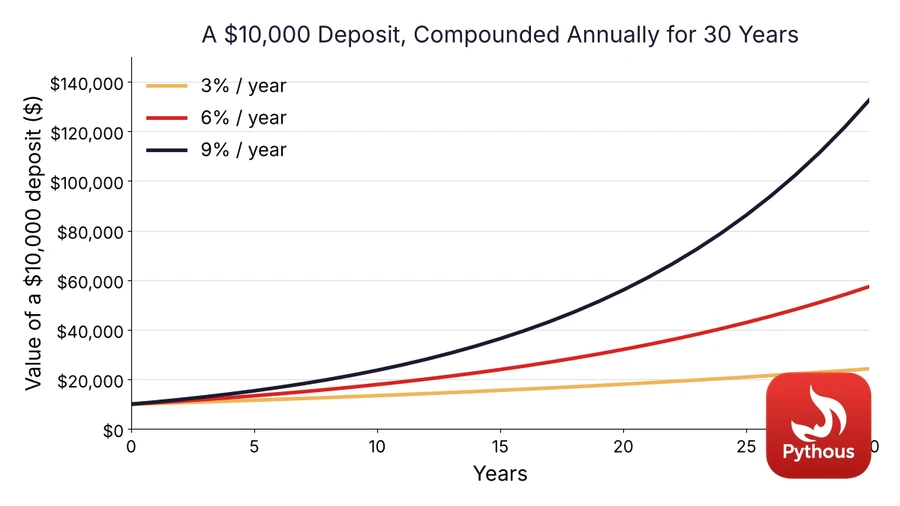
Chart: a $10,000 deposit compounded annually for 30 years at 3%, 6%, and 9%, calculated from A = P(1 + r)^t.
At 3%, the deposit grows to about $24,270. At 6%, it reaches roughly $57,400 — more than double, even though the rate only doubled. At 9%, it balloons to about $132,700 — more than five times the 3% outcome. Doubling the rate doesn't double the result; because of the exponent, it multiplies it by a much larger factor over a long enough time horizon. This is why investors and economists pay close attention to fees and expense ratios that shave even one or two percentage points off an annual return — over decades, that difference compounds into a very different retirement balance.
The Rule of 72
A useful mental shortcut for estimating how compounding behaves: divide 72 by the annual interest rate (as a whole number) to estimate how many years it takes an amount to double. At 6%, that's 72 ÷ 6 = 12 years to double. At 9%, it's 72 ÷ 9 = 8 years. At 3%, it takes 24 years. It's an approximation — the real math uses natural logarithms — but it's accurate enough for quick comparisons, and it illustrates the same point as the chart above: the rate matters enormously, because it's doing exponential, not linear, work.
Compounding frequency: a smaller effect than people assume
Savings accounts and credit cards often advertise interest that compounds daily, monthly, or quarterly rather than annually. This does increase your return slightly, because interest gets added to the balance more often, giving it more opportunities to earn interest on itself. But the effect is much smaller than changing the rate or the time horizon. A 6% annual rate compounded monthly, versus compounded once a year, differs by well under half a percentage point in annual yield. Marketing materials sometimes lean on "daily compounding" language to sound more impressive than the underlying math actually delivers — the number of compounding periods matters far less than the headline rate or how long the money stays invested.
The same math, working against you
Compound interest isn't exclusively a savings phenomenon — it's a mathematical relationship, and it applies with equal force to debt. Credit card balances that aren't paid off compound in exactly the same way a savings account does, except the exponential growth is working against the borrower instead of for them. A balance carried at a high annual percentage rate can grow substantially within a few years if only minimum payments are made, for the identical reason a long-held investment grows: interest accruing on interest, not just on the original balance. The same formula, the same exponent — just pointed in the opposite direction.
Frequently asked questions
Is compound interest always better than simple interest for a borrower?
No — compounding is neutral math, not an inherently good or bad outcome. It's beneficial when you're earning the interest (as in savings or investments) and costly when you're paying it (as with credit cards or some loans), because in both cases it accelerates growth in the direction the interest is already flowing.
Does compound interest require investing in stocks?
No. The formula A = P(1 + r)^t applies to any situation where returns are reinvested rather than withdrawn — savings accounts, bonds, certificates of deposit, and retirement accounts all compound, each with its own typical rate and risk level. Stocks tend to have higher average long-term returns than savings accounts, but they also carry more volatility; the compounding math itself doesn't care which asset is generating the return.
How much does starting early actually matter?
A great deal, because of the exponent t. Someone who invests $10,000 at 7% for 30 years ends up with about $76,100, while the same deposit left for only 20 years grows to roughly $38,700 — barely half, despite losing just a third of the time. The last decade of a long investment horizon typically contributes more growth in dollar terms than the first two combined.



Comments (0)
Leave a Reply
Log in to post a comment.