

 Aug 22, 2026
 5 min read
The Malwiya Minaret of Samarra: The Spiral Tower of the Abbasid Caliphate
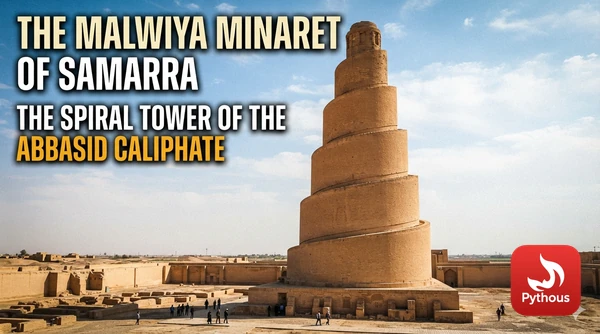
On the flat plain beside the Tigris, about 125 kilometres north of Baghdad, a cone of fired brick rises 52 metres from a square base about 33 metres wide. A single ramp, roughly two metres across and with no railing, winds around the outside, anticlockwise, to a small round pavilion at the top. There is no stair inside. This is the Malwiya, from the Arabic for "twisted" or "coiled", the minaret of the Great Mosque of Samarra, built by the Abbasid caliph al-Mutawakkil in the late 840s and early 850s.
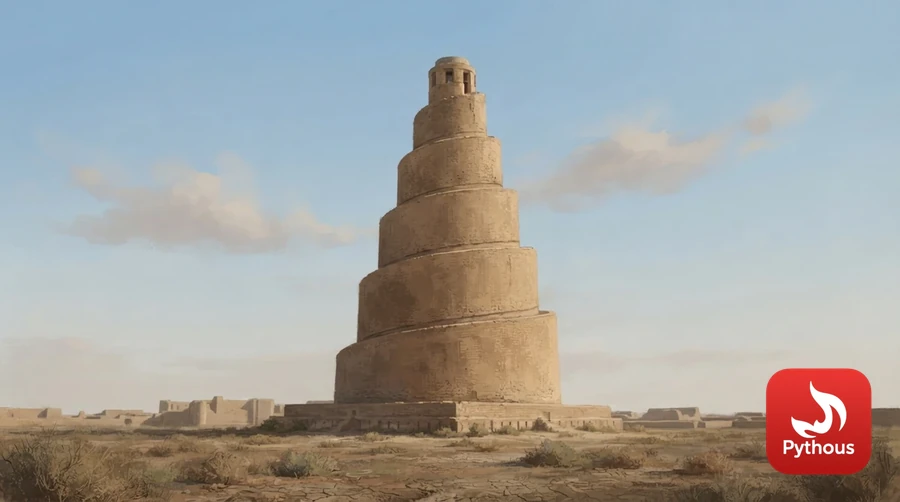
Illustration: the Malwiya, a 52-metre spiral minaret built in the 850s.
Why the caliphs left Baghdad
In the early ninth century, Baghdad was the largest and richest city in the Islamic world, but its caliphs were finding it hard to live there. Al-Mu'tasim, caliph from 833, had built his army around Turkish slave soldiers recruited from Central Asia, loyal to him personally rather than to the Arab and Persian factions of the capital. Clashes between the soldiers and the people of Baghdad grew serious, and in 836 al-Mu'tasim moved his court and army up the Tigris to found a new capital.
He called it Surra Man Ra'a, "whoever sees it is delighted", a courtly pun on the older name of the place, Samarra. The city that grew there was enormous and spread out, with palaces, barracks, racecourses, hunting parks, canals and markets stretching for tens of kilometres along the river. Eight caliphs ruled from it. It was also where the caliphate's crisis played out: the Turkish commanders brought in to protect the caliphs came to control them, and in 861 al-Mutawakkil himself was murdered in his palace by officers of his guard, with his son's knowledge. The years that followed, known as the "anarchy at Samarra", saw four caliphs in nine years.
The largest mosque of its time
Al-Mutawakkil began the Great Mosque in 848, and it was finished by 851 or 852. The prayer hall and courtyard were enclosed by a wall of fired brick about 240 metres long and 156 metres wide, braced by dozens of semicircular towers. Around that lay a much larger outer enclosure, the ziyada. Alastair Northedge, who has spent decades studying the site, gives the whole complex an area of about 166,000 square metres, which made it for centuries the largest mosque in the world. Inside, the prayer hall had a flat wooden roof carried on rows of supports. The roof and interior are long gone. What stands today is the outer wall with its towers and, 27 metres beyond its northern side, the minaret, which was once linked to the mosque by a bridge.
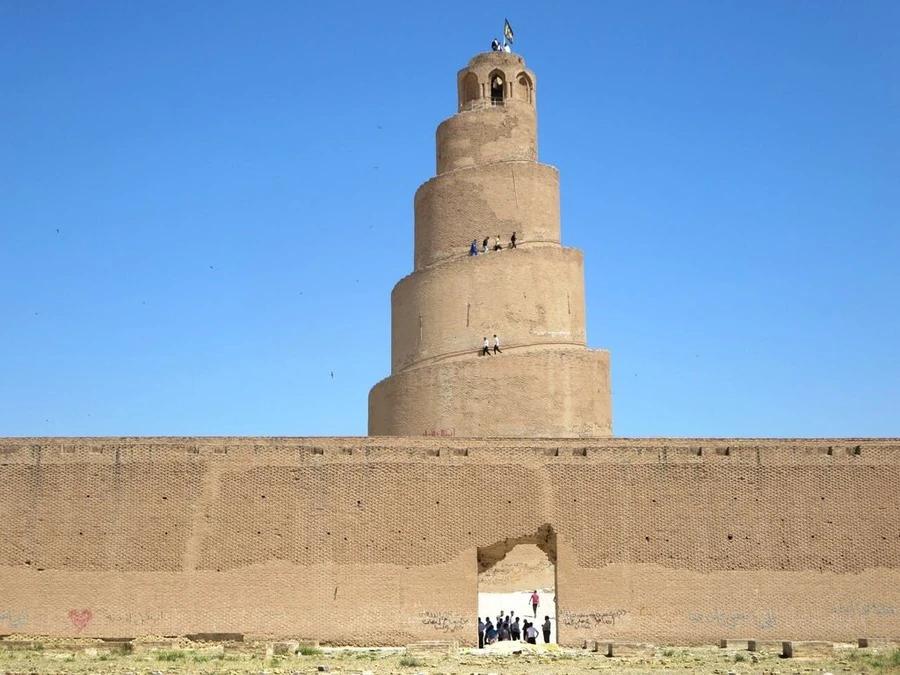
A single ramp about two metres wide winds up through five stages. Photo: David Stanley / Wikimedia Commons, CC BY 2.0
Where the spiral came from
No earlier minaret looks like the Malwiya, and its origin is still argued over. The most common comparison is with the ziggurats, the stepped temple towers of ancient Mesopotamia, whose ruins were visible in Iraq in the ninth century. Ancient writers also described the ziggurat of Babylon with a ramp running around it. Other historians point out that a ziggurat is a stack of terraces, not a continuous spiral, and that the idea may simply have been an Abbasid invention suited to the plain: a tower that could be seen for kilometres across the flat land.
Al-Mutawakkil used the form again. At his new city of al-Mutawakkiliyya, just north of Samarra, the Abu Dulaf mosque, built around 859 to 861, has a smaller spiral minaret about 32 metres high. The spiral was copied once more, about a century later, in the minaret of the mosque of Ibn Tulun in Cairo, built by a governor who had grown up in Samarra. Its present form dates from a later rebuilding, but it still has an outside stair.
Whether a muezzin ever climbed the Malwiya five times a day is doubtful. The climb is long and exposed, and many scholars see the tower above all as a statement of the caliph's power, a landmark announcing the capital to anyone approaching across the plain.
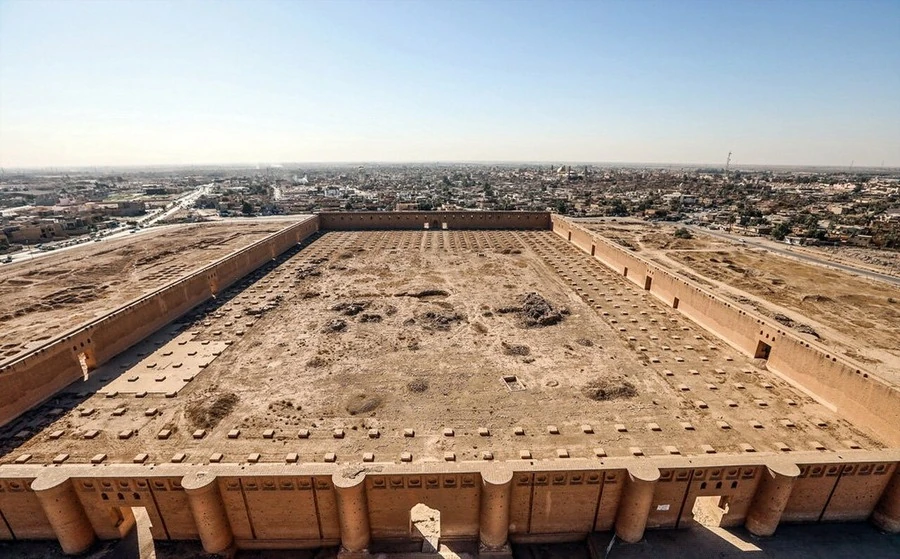
The mosque walls survived because they were built in fired brick, not mud brick. Photo: Mehr News Agency / Wikimedia Commons, CC BY 4.0
Abandonment and survival
In 892 the caliph al-Mu'tamid moved the capital back to Baghdad, and most of Samarra emptied within a few decades. The mud-brick houses and lesser palaces melted back into the ground, which is why aerial photographs of the site still show the outlines of whole districts. What survived was built of fired brick: the mosque walls, the Malwiya, and the foundations of the palaces. The town of Samarra lived on, mainly around the shrine of the tenth and eleventh Imams of the Twelver Shia, Ali al-Hadi and Hasan al-Askari, which is still visited by large numbers of pilgrims; our article on the hidden Imam tells that part of Samarra's story.
The German archaeologist Ernst Herzfeld excavated at Samarra in 1911 to 1913, and his finds of carved stucco, painted walls and imported Chinese ceramics showed how rich the Abbasid court had been. UNESCO inscribed the Samarra Archaeological City as a World Heritage Site in 2007 and, because of the war in Iraq, placed it straight onto its list of sites in danger.
The minaret itself was damaged in that war. American troops used the top as a lookout and sniper position, and on 1 April 2005 an explosion, blamed on insurgents, blew off part of the summit pavilion. The tower still stands. Visits depend on the security situation in Salah al-Din province, and anyone planning to go should check current advice first.
Sources
- UNESCO World Heritage Centre, "Samarra Archaeological City". https://whc.unesco.org/en/list/276
- Archnet, "Jami' al-Mutawakkil (Samarra)", with bibliography including Alastair Northedge, The Historical Topography of Samarra (2005). https://archnet.org/sites/3828
- "Great Mosque of Samarra", Wikipedia (dimensions and area following Northedge, and the 2005 damage, with sources). https://en.wikipedia.org/wiki/Great_Mosque_of_Samarra






Comments (0)
Leave a Reply
Comments are moderated. Please read our Comment Policy before posting.
Log in to post a comment.