

 Aug 20, 2026
 15 min read
The Man Who Could Read It: Why the Indus Script Still Defeats Us

In the Louvre, in the Mesopotamian galleries, there is a small serpentine cylinder seal catalogued as AO 22310. It is under three centimetres tall. Rolled across wet clay, it produces a scene of figures approaching a seated dignitary, and a short line of Old Akkadian cuneiform.
The inscription reads: Shu-ilishu, interpreter of the Meluhhan language.
Shu-ilishu lived in Mesopotamia during the late Akkadian period, around 2020 BCE. Meluhha is the name Mesopotamian scribes used for the lands to the east that sent them carnelian, copper, timber and ivory by sea — almost certainly the Indus Valley Civilization. Cuneiform records indicate there was a Meluhhan settlement in Akkad, with residents identified in the documents as sons of Meluhha. Shu-ilishu was the professional who stood between the two worlds and made them intelligible to each other.
Which means that four thousand years ago, there was a man with a business card who could read the Indus script.
Today there is nobody. Not one person on earth can read a single Harappan inscription. It is the longest-running unsolved reading problem in human history, and the gap between Shu-ilishu and us is the most exact measure of what has been lost.
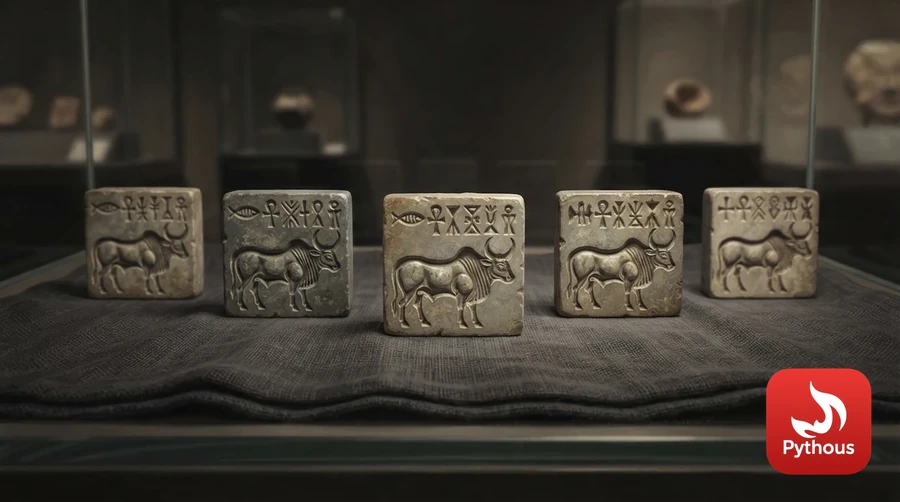
Illustration: Indus seals, whose short inscriptions no one can read.
The civilization we can see but cannot hear
The Indus Valley Civilization was, by area, the largest of the Bronze Age — bigger than Old Kingdom Egypt and Sumer put together. Its mature phase ran roughly 2600 to 1900 BCE across what is now Pakistan and northwest India, with major centres at Harappa in the Punjab, Mohenjo-daro in Sindh, Rakhigarhi in Haryana, Dholavira in Kutch, and Ganweriwala in Cholistan. Around a thousand settlements have been identified.
Archaeologically, we know a great deal. We know their brick sizes were standardised on a 1:2:4 ratio across hundreds of kilometres. We know their weights were cubes of chert calibrated so precisely that a weight from one city can be swapped for one from another. We know they built covered drains, public wells, dockyards, and streets laid out on a grid. We know what they ate, what they wore, and what their children played with.
What we do not know is anything they said.
We do not know the name of a single Harappan person, city, king, god, or river. We do not know what language they spoke. We do not know whether they had kings at all. Every claim ever made about Harappan religion, politics, or social structure is inference from objects — careful inference, often, but inference.
The contrast with their trading partners is brutal. From Mesopotamia we have a merchant's complaint about the grade of copper he was sold, with the buyer's name, the seller's name, and the insult intact. From the Indus we have five signs on a piece of steatite the size of a postage stamp, and no idea what they mean.
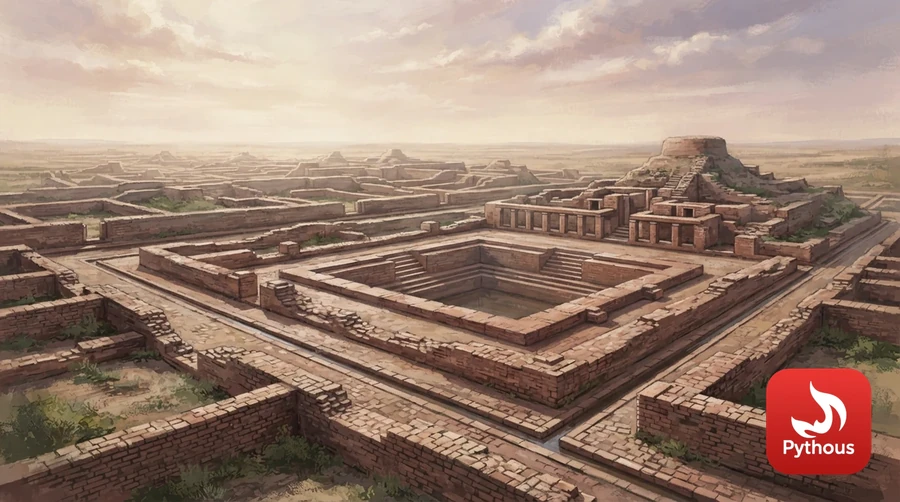
Illustration: Mohenjo-daro, one of the Indus civilization's great cities.
What the corpus actually is
The obstacle is not that the script is intricate. It is that there is almost nothing of it.
Volume. Over four thousand inscribed objects are known — some counts run to about 4,700 depending on what is included. Mahadevan's 1977 concordance, still the field's reference point, catalogued around 3,700 seals and sealings.
Length. This is the killing constraint. Recent statistical work on the deduplicated corpus puts the mean inscription length at 4.4 signs, with a median of 4. The longest continuous text on a single surface is 17 signs. Fewer than ten inscriptions in the entire corpus run past 15 signs. A composite sealing carrying several stamped inscriptions together reaches about 27.
Put differently: the entire written output of the largest civilization of the Bronze Age, laid end to end, is shorter than this article.
Sign inventory. Mahadevan arrived at 417 distinct signs. Parpola's list runs to roughly 398. Broader lists that separate ligatures, rotations, damaged forms and graphic variants approach 700. That range — four to seven hundred — is diagnostically awkward. An alphabet needs twenty to forty signs. A syllabary needs fifty to one hundred and fifty. A fully logographic system needs thousands. Four hundred points to a logo-syllabic system, signs for words plus signs for sounds, as in early cuneiform and Egyptian hieroglyphs. Plausible, not proven.
There is a worse detail buried in the sign counts. Of the roughly 419 signs in one standard analysis, 219 appear fewer than five times, and 113 appear exactly once. More than a quarter of the "alphabet" is attested a single time. You cannot do statistics on a sign you have seen once.
Medium. Most inscriptions are on small square steatite stamp seals, on the clay sealings those seals impressed, on copper tablets, on incised pottery, and on a handful of ivory rods. Seals are labels by nature. Whatever they carry is likely to be a name, a title, a clan, an office, a commodity, or an ownership mark — not narrative.
It is entirely possible the Harappans wrote at length on palm leaf, bark, or cloth, and that a monsoon climate has destroyed all of it. If so, what survives is the least informative fraction of what once existed: the packaging, not the books.
Direction. One thing is settled. Signs bunch and compress at the left-hand end of inscriptions, the way handwriting cramps when you run out of line. Writing ran right to left, with some longer texts apparently running boustrophedon, alternating direction line by line.
The one departure from all this smallness sits at Dholavira. Near the north gate of the citadel, excavators recovered ten large signs made of gypsum inlay, spanning around three metres — apparently mounted above the gateway. It is the only monumental Harappan inscription we have. Ten signs. Unreadable.
How the problem was created
The ruins were noticed long before anyone understood them. Charles Masson described Harappa in 1829. Alexander Cunningham published a drawing of a Harappan seal in 1875 and concluded the signs were foreign to India — he could not place them.
The shock came in the 1920s. Daya Ram Sahni excavated Harappa from 1921; R.D. Banerji began at Mohenjo-daro in 1922. On 20 September 1924, John Marshall announced in the Illustrated London News that an unknown civilization contemporary with Sumer and Egypt had been found in the Indus basin. The response was immediate: Assyriologists wrote in to say that comparable seals had already surfaced in Mesopotamian excavations — establishing the civilization's date and its maritime trade in a single stroke.
Marshall's own view, stated at the outset, was that the Indus civilization was pre-Aryan and its language or languages must therefore have been pre-Aryan too, possibly Dravidian. That opinion, formed in 1924, set the terms of an argument still running a century later.
Four positions, and why the argument is not only academic
The Dravidian hypothesis. The mainstream position among specialists, developed most fully by Asko Parpola and by Iravatham Mahadevan. Dravidian languages are today concentrated in southern India, but Brahui is still spoken in Balochistan, inside the old Harappan zone — plausibly a relic of a wider northern Dravidian presence before Indo-Aryan speech arrived. There are also candidate Dravidian substrate words in early Sanskrit.
Parpola's best-known proposal works by rebus — using a picture to write a different word that sounds the same, as if you drew an eye to write "I". Proto-Dravidian mīn meant both "fish" and "star". The Indus script has a frequent fish sign, often preceded by numeral strokes. Six fish would then be aru-mīn, the Pleiades; seven fish elu-mīn, the Great Bear. It is elegant and internally consistent. With four-sign texts, it is also unfalsifiable.
The Indo-Aryan hypothesis. That the Harappans spoke an early Indo-Aryan language, argued by S.R. Rao and others. It faces a chronology problem: the script stops around 1900 BCE, and the linguistic and archaeological evidence generally places Indo-Aryan speech in the region after that.
Genetics has now entered this argument. In 2019, a team led by Vasant Shinde and Vagheesh Narasimhan published the first genome from an Indus site, in Cell. Of 61 skeletal samples from the Rakhigarhi cemetery, exactly one — individual I6113, a woman — preserved enough authentic DNA to sequence, after more than a hundred attempts. Her genome showed substantial Iranian-related ancestry and an indigenous South Asian component, and no Steppe pastoralist ancestry at all. Steppe ancestry, associated with the spread of Indo-European languages, arrives in the region later. This does not decipher anything. It does constrain who was there.
The Munda or Austroasiatic hypothesis. Occasionally proposed, thinly evidenced, few adherents.
The "it is not writing" thesis. In 2004, Steve Farmer, Richard Sproat and Michael Witzel argued that the Indus signs do not encode language at all — that they are a nonlinguistic symbol system, closer to heraldry or Near Eastern emblem traditions than to script. Their evidence: texts impossibly short even by seal standards, a sign inventory riddled with singletons, and no trace of the abbreviation, standardisation and cursive drift that scribal traditions develop over centuries of use.
The rebuttal came in 2009, when Rajesh Rao and colleagues published an analysis in Science using conditional entropy — a measure of how predictable the next sign in a sequence is. Indus sign sequences, they reported, sit within the range of known linguistic scripts and away from nonlinguistic sign systems. Sproat replied that the method was too coarse to separate the categories it claimed to separate. Neither side conceded. Most working archaeologists continue to treat the signs as writing, but the question is genuinely open, and it is the only debate in the field where a decisive answer would change everything downstream.
It matters that none of this is politically neutral. Whether the Harappans spoke a Dravidian or an Indo-Aryan language is, in contemporary South Asia, a proxy for arguments about indigeneity and cultural inheritance. Positions acquire constituencies whether or not their holders want them.
The horse that wasn't there
One episode explains why specialists are unforgiving about new claims.
In 2000, N. Jha and N.S. Rajaram published The Deciphered Indus Script, reading the signs as Sanskrit. Supporting the case was a seal appearing to show a horse — significant because the domesticated horse is conspicuously absent from mature Harappan remains, and its presence would have bolstered an Indo-Aryan reading.
Michael Witzel and Steve Farmer showed that the image derived from Mackay 453, a broken unicorn-bull seal, with the break obscured and the image "computer enhanced" past the point of recognition. What had been read as a manger was the remains of the standard feeding trough that appears beneath unicorn figures on Harappan seals. Their cover story ran in Frontline on 13 October 2000 under the title "Horseplay in Harappa," alongside a commentary by Romila Thapar, followed by letters from Mahadevan and from the zooarchaeologist Richard Meadow.
The decipherment did not survive. The general lesson did: in Indus studies, a reading that delivers exactly the ancestry some constituency wants should be examined twice as hard, not half as hard.
The million-dollar problem
On 5 January 2025, at a conference in Chennai marking the centenary of Marshall's announcement, the Chief Minister of Tamil Nadu, M.K. Stalin, announced a prize of one million US dollars for anyone — scholar or amateur — who deciphers the script to the satisfaction of archaeological experts. The same announcement funded a research chair named for Iravatham Mahadevan and released a state archaeology study reporting that a large majority of graffiti marks from Tamil Nadu excavation sites have parallels in the Indus corpus.
The prize is real money and the intent is serious. It is also, unavoidably, a move in the argument described above: a southern state government funding the search for a southern answer. Anyone reading the coverage should hold both facts at once.
Well over a hundred decipherments have been published since the 1920s. None has been accepted. The rate at which new ones appear is not falling.
What a real decipherment would have to do
This is the part most claimed solutions skip, and it is why the count of solutions rises while the count of accepted solutions stays at zero.
A decipherment must be predictive. Assigning sound values to signs and producing a plausible sentence from a seal everyone has already seen proves nothing — with 417 signs and four-sign texts, a sufficiently flexible method can extract almost any desired meaning. The system has to be applied to inscriptions the decipherer has never seen, generate readings that make sense in context, and survive the next object out of the ground.
That is the standard Linear B met. Michael Ventris's solution was accepted because tablets excavated at Pylos after he published produced word-and-picture matches his sound values had predicted in advance. There was no arguing with it.
Realistically, three things could break the Indus problem open:
- A bilingual. A Harappan text with a parallel cuneiform version. Given Shu-ilishu's existence, the trading colonies in Akkad, and the volume of Gulf commerce, such a document may well have been written. It would most plausibly surface in Mesopotamia or the Gulf rather than the Indus itself. This is the Rosetta scenario, and it is what everyone quietly hopes for.
- A long text. Anything running to a few hundred signs would transform the statistical picture overnight and settle the writing-versus-symbols question by itself.
- A secure language identification from outside the script — from historical linguistics, or from the expanding ancient-DNA record constraining who lived where and when.
Machine learning has been applied steadily for two decades: sign segmentation, positional statistics, sequence modelling. It has produced genuine results about internal structure — which signs open texts, which close them, which cluster, which never co-occur. What it cannot do is manufacture information the corpus does not contain. A model trained on four-sign inscriptions in an unknown language has nothing external to pull against. The bottleneck is data, not compute, and no amount of clever architecture fixes a corpus of 11,000 sign tokens with no translation anywhere in it.
What is actually at stake
Roughly a fifth of humanity lives in the region this civilization occupied, and its first urban chapter is currently narrated entirely by archaeologists reading objects. Decipherment would replace a great deal of skilled guesswork with testimony.
It would also be disruptive, because deciphered scripts rarely confirm expectations. Linear B was expected to reveal Homeric heroes and instead revealed a palace bureaucracy obsessively inventorying chariot wheels and sheep. Maya glyphs, once read, dismantled the picture of peaceful astronomer-priests and replaced it with warring dynasties keeping meticulous records of each other's defeats. In both cases the decipherment cost the field its favourite theory.
There is no reason to expect the Harappans to be more accommodating. Whatever those four-sign texts say, the odds are good that it is something nobody currently predicts — and mildly humiliating that the most likely candidates are a name, a tax, and a quantity of grain.
For now the seals sit in cases in Karachi, Lahore, Delhi and London. A few thousand short lines in a language nobody speaks, from a civilization that ran cities for seven centuries, traded across an ocean, employed translators abroad, and left nobody able to read its name.
Frequently asked questions
Has the Indus script been deciphered? No. Over a hundred decipherments have been published since the 1920s and none has been accepted by specialists. The core obstacles are the absence of any bilingual text, inscriptions averaging under five signs, and an unidentified underlying language.
What language did the Indus Valley people speak? Unknown. The leading hypothesis is a Dravidian language, argued by Asko Parpola and Iravatham Mahadevan. Indo-Aryan and Austroasiatic alternatives have been proposed. A minority position holds that the signs do not encode language at all.
How many Indus signs are there? Between roughly 400 and 700, depending on how variants, ligatures and damaged forms are counted. Mahadevan's 1977 concordance lists 417.
What is the longest Indus inscription? Seventeen signs on a single surface. The Dholavira signboard, ten large gypsum-inlay signs mounted at a city gate, is the largest physical inscription.
Why does no Indus Rosetta Stone exist? None has been found. One may well have been produced — Mesopotamian records document a professional interpreter of the Meluhhan language around 2020 BCE — but no bilingual document has yet surfaced.
Sources and further reading
- Asko Parpola, Deciphering the Indus Script (Cambridge University Press, 1994)
- Iravatham Mahadevan, The Indus Script: Texts, Concordance and Tables (Archaeological Survey of India, 1977)
- Gregory Possehl, "Shu-ilishu's Cylinder Seal," Expedition (Penn Museum) — on Louvre AO 22310
- Steve Farmer, Richard Sproat and Michael Witzel, "The Collapse of the Indus-Script Thesis," Electronic Journal of Vedic Studies 11 (2004)
- Rajesh P.N. Rao et al., "Entropic Evidence for Linguistic Structure in the Indus Script," Science (2009)
- Michael Witzel and Steve Farmer, "Horseplay in Harappa," Frontline, 13 October 2000
- Vasant Shinde, Vagheesh Narasimhan et al., "An Ancient Harappan Genome Lacks Ancestry from Steppe Pastoralists or Iranian Farmers," Cell 179 (2019)
- Jonathan Mark Kenoyer, Ancient Cities of the Indus Valley Civilisation (Oxford University Press, 1998)
- Andrew Robinson, Lost Languages: The Enigma of the World's Undeciphered Scripts (2002)
Publishing notes
Images to source (all public domain or CC): the Shu-ilishu seal rollout (Louvre AO 22310, Wikimedia Commons, public domain); the Dholavira signboard; a standard unicorn seal with feeding trough; a sign-list chart. Opening with the Shu-ilishu rollout image is strong — it is the hook.
Internal linking: "Bronze Age" and "Mesopotamia" → existing ancient civilizations posts. "Linear B" and "Maya glyphs" → future posts.
Cluster opportunity: this is post one of an Undeciphered Scripts series — Linear A, Rongorongo, Proto-Elamite, the Voynich manuscript, Cypro-Minoan. Five posts, dense internal linking, one pillar page. Strong topical-authority play and each has real search volume.


Comments (0)
Leave a Reply
Log in to post a comment.