

 Sep 11, 2026
 12 min read
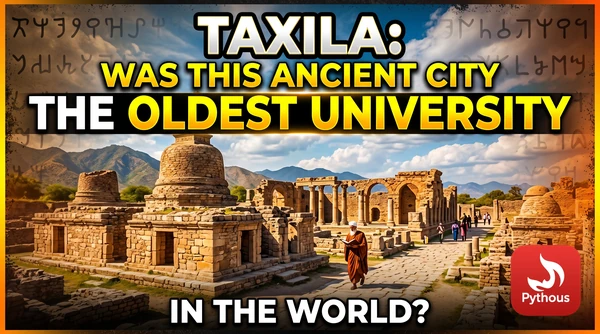
Taxila: Was This Ancient City the Oldest University in the World?
Around 326 BCE, a Greek officer named Onesicritus walked out from the city of Taxila into the hot plains of the Punjab to find a group of naked philosophers his king had heard about. According to the account preserved by Strabo, the sages were sitting motionless on scorching stones, and one of them laughed at the Greek's cloak, boots, and hat before agreeing to talk, on the condition that Onesicritus strip and sit on the stones too (Strabo, Geography 15.1.63–65).
Alexander the Great had come to Taxila as a conqueror. What his men found was a city already famous across the Indian world as a place where people went to learn.
Today the ruins of Taxila lie in a green valley in northern Pakistan, about 22 miles northwest of the capital, Islamabad. The city was famous for training doctors, scholars, and princes roughly 1,500 years before the first lectures at Oxford, and more than 2,000 years before Harvard was founded in 1636. That is why it is often called "the oldest university in the world." That claim is both true and misleading, and the real story is more interesting than the slogan.
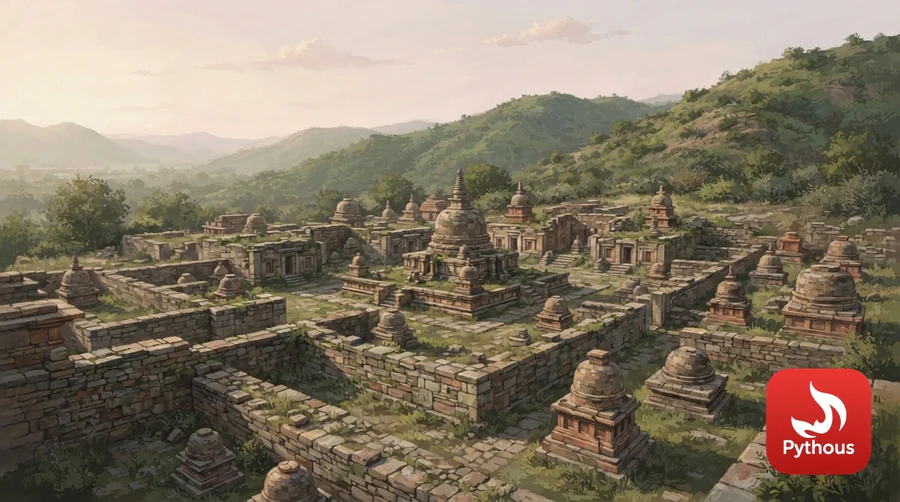
Illustration: the monastery ruins around Taxila, Pakistan.
A City at the Crossroads
Taxila's name in Sanskrit was Takṣaśilā, in Pali Takkasilā; the Greeks turned it into Taxila. Ancient writers explained the name in different ways. Indian tradition connected it to Taksha, a prince in the family of Rama. The Chinese pilgrim Faxian, visiting around 400 CE, reported a Buddhist legend that the name meant "severed head," because the Buddha in a previous life had given away his head as an act of charity on this spot (Faxian, Record of Buddhist Kingdoms, ch. 11).
Whatever the origin, the city's importance came from geography. Taxila sat where the great trade road from the Gangetic plain met the routes running northwest through Gandhara toward Bactria, Afghanistan, and Central Asia. Anyone moving between India and the Iranian world, whether merchant, soldier, pilgrim, or scholar, passed through or near it.
The city even appears in the Mahabharata. Its opening book says the epic was first recited at Takshashila, during the great snake sacrifice held by King Janamejaya. Whatever the historical value of that setting, it shows how deeply the city was woven into the cultural memory of ancient India.
Three Cities, Not One
One reason Taxila confuses visitors is that there is no single "ancient Taxila." Archaeologists have uncovered several cities built one after another across the valley.
Bhir Mound is the oldest major settlement, going back to around the sixth century BCE, when Gandhara was a province of the Persian Achaemenid Empire. Darius I lists Gandhara among his subject lands in his inscriptions. Bhir Mound's streets are irregular and winding, a town that grew organically rather than one that was planned.
Sirkap, a short distance away, was laid out in the second century BCE by the Indo-Greek kings who ruled the region after Alexander's successors. It has a straight main street with side lanes at right angles, a Greek-style grid that still surprises visitors. Later Indo-Scythian and Indo-Parthian rulers rebuilt it, and among its ruins stands the famous Shrine of the Double-Headed Eagle, whose façade mixes Greek columns with Indian architectural motifs.
Sirsukh, the third city, was built by the Kushan dynasty in the first or second century CE.
Around these cities spread dozens of Buddhist stupas and monasteries, including the great Dharmarajika stupa, traditionally attributed to the Mauryan emperor Ashoka, and the monastery complexes of Jaulian and Mohra Moradu high on the surrounding hills. In 1980 the whole landscape was inscribed as a UNESCO World Heritage Site.
Alexander and the King of Taxila
When Alexander crossed the Indus in 326 BCE, the ruler of Taxila, known to the Greeks as Taxiles (his Indian name was probably Ambhi), chose alliance over resistance. He came out to meet the Macedonians with gifts, war elephants, and troops, and he hoped to use Alexander against his rival Porus, who ruled the lands beyond the Jhelum.
Arrian, the most reliable of Alexander's historians, describes Taxila as a large and prosperous city, the greatest between the Indus and the Hydaspes (Arrian, Anabasis 5.8.2). Plutarch adds a story of the two kings trying to outdo each other in generosity, with Alexander eventually giving Taxiles a thousand talents on top of returning his gifts, which reportedly annoyed Alexander's own companions (Plutarch, Life of Alexander 59).
The Greek encounter with Taxila's philosophers left a deeper mark than the diplomacy. One sage, whom the Greeks called Calanus, agreed to join Alexander's army and traveled with it all the way to Persia. When he fell ill there, he chose to die on a funeral pyre in front of the whole army, calmly, while the troops sounded their trumpets and the elephants raised a war cry in his honor (Arrian, Anabasis 7.3; Plutarch, Life of Alexander 69). For Greek writers, Calanus became the defining image of Indian wisdom.
Why People Came to Study
Long before Alexander, and long after him, Taxila's reputation rested on its teachers.
The Buddhist Jataka tales, stories of the Buddha's former lives, return again and again to the same scene: a prince of Benares, at the age of sixteen, is sent by his father to Takkasila to learn from a renowned teacher. In the Tilamuṭṭhi Jātaka (No. 252), the prince travels alone with a fee of a thousand coins, and the story turns on how his teacher disciplines him when he steals a handful of sesame seeds from an old woman. Students who could not pay, other stories say, worked for their teacher instead.
The most famous student in Buddhist tradition was Jivaka, later physician to the Buddha himself. The Pali Vinaya tells that he studied medicine at Taxila for seven years. For his final examination, his teacher sent him out to walk a full day's distance in every direction and bring back any plant that had no medicinal use. Jivaka returned empty-handed, explaining that he had found nothing without value. His teacher declared his training complete (Vinaya Piṭaka, Mahāvagga 8.1).
Later Buddhist and Jain traditions add that Chanakya, the political strategist traditionally credited with the Arthashastra, taught at Taxila, and that his student Chandragupta Maurya, founder of the Mauryan Empire, trained there. These stories were written down centuries after the events, so they are better treated as tradition than as documented fact, but they show that later Indians thought of Taxila as the natural home of a great scholar.
What was taught? The sources mention the Vedas, grammar, medicine, law, archery and military arts, astronomy, and practical skills such as elephant lore. It was, in modern terms, a place for both academic study and professional training.
So, Was It Really the Oldest University in the World?
Here is where the popular claim needs correcting.
The phrase "the world's first university" suggests lecture halls, a campus, a central administration, and degrees. Taxila had none of these, as far as the evidence shows. When the British archaeologist Sir John Marshall excavated the site for more than twenty years, from 1913 to 1934, he found cities, temples, stupas, and monasteries, but no buildings that can be identified as an institutional university.
What the texts actually describe is something looser and in some ways more impressive. Taxila was a city where many independent teachers lived, each taking in private students, usually in their own homes. Students chose their teacher, agreed on a fee or on service, and stayed for years. The city's fame came from the concentration of expert teachers in one place, not from a single institution.
That makes it very different from Nalanda in Bihar, which flourished from the fifth century CE and did have organized monastic buildings, libraries, and an administration. Nalanda has a stronger claim to being an early university in the institutional sense. Taxila is better described as one of the world's earliest great centers of learning, a city of scholars rather than a school.
If you are looking for the oldest university in the world in the modern sense, the usual answers are different. The University of al-Qarawiyyin in Fez, Morocco, founded in 859 CE, is often cited as the oldest institution of higher learning still operating today, and the University of Bologna in Italy, founded in 1088, is generally recognized as the oldest university in the Western world. Taxila came many centuries before all of them, but it was a different kind of place.
The difference matters, but it takes nothing away from Taxila's achievement. For centuries, if you wanted to master a subject anywhere in northern India, this was where you went.
Ashoka, a Blinded Prince, and a Greek Ambassador
Under the Mauryan Empire, Taxila became the capital of the northwestern province. According to the Ashokavadana, a Buddhist text, the young Ashoka was sent there by his father Bindusara to put down a rebellion, and the people welcomed him without a fight. An Aramaic inscription found at Sirkap is widely attributed to Ashoka's reign, a reminder that Persian administrative traditions still lingered in the region.
The same text tells a darker story. Ashoka's son Kunala, sent to govern Taxila, was blinded through the scheming of his stepmother. The Kunala Stupa, on a ridge above Sirkap, is traditionally linked to this legend.
In the Indo-Greek period, Taxila produced one of the most remarkable figures of ancient cultural exchange. Around 110 BCE, a man named Heliodorus, son of Dion, described as a native of Taxila, traveled as ambassador of the Greek king Antialcidas to a court in central India. At Vidisha, he erected a stone pillar dedicated to the Hindu god Vasudeva, describing himself as a devotee. A Greek from Taxila, worshipping an Indian god, recording it in an Indian script: few monuments capture the city's mixed world so neatly.
Kings, Pilgrims, and a Wandering Sage
In the first century CE, the Greek philosopher Apollonius of Tyana is said to have visited Taxila, according to his biographer Philostratus. The account describes a walled city about the size of Nineveh, with narrow, irregular streets, ruled by a king called Phraotes who spoke fluent Greek. Outside the walls stood a temple decorated with bronze panels showing the battle between Alexander and Porus (Philostratus, Life of Apollonius of Tyana, Book 2). Philostratus wrote more than a century later and mixed fact with fiction, but his description matches Sirkap's layout surprisingly well.
This was also the age of the Indo-Parthian king Gondophares, whose court later Christian tradition, in the Acts of Thomas, connected with the apostle Thomas. In 1935 farmers near Sirkap found a small cross-shaped object now known as the Taxila Cross, which is kept at the Cathedral of the Resurrection in Lahore. Its date and meaning are debated, but it has become a treasured symbol for Pakistan's Christian community.
Under the Kushans, Buddhism flourished in the valley as never before. The monasteries of Jaulian and Mohra Moradu were decorated with stucco sculptures in the Gandhara style, where Buddhist subjects were carved with Greco-Roman techniques. At Jaulian, visitors can still see a seated Buddha with a hole at the navel; pilgrims, tradition says, placed their finger there when praying for healing.
The Long Decline
By the time Faxian arrived around 400 CE, Taxila was still a Buddhist pilgrimage center, but its greatness was fading. In the fifth century, the Hephthalites, often called the White Huns, swept into Gandhara, and the destruction of several of Taxila's monasteries is commonly attributed to them.
When the Chinese monk Xuanzang passed through in the 630s, he found the region under the control of Kashmir, its many monasteries mostly ruined and deserted, with only a handful of monks remaining (Xuanzang, Great Tang Records on the Western Regions, Book 3). The city of scholars had become a landscape of ruins.
The site was forgotten by the wider world until 1863–64, when Alexander Cunningham of the Archaeological Survey of India identified the ruins with the Taxila of Greek and Indian texts. Marshall's excavations that followed revealed its full extent, and the Taxila Museum beside the ruins now holds one of the finest collections of Gandhara art in the world.
Why Taxila Still Matters
Taxila tells us that the northwest of the subcontinent, the land that is now Pakistan, was not a frontier at the edge of civilization. It was a center. Persian administrators, Greek kings, Indian philosophers, Buddhist monks, Central Asian dynasties, and Chinese pilgrims all passed through the same valley, and each left something behind.
It also offers a useful lesson in reading history carefully. "The world's first university" makes a good headline, but the truth, a city where knowledge itself was the great export, is the more remarkable story.
Frequently Asked Questions
Where is Taxila located? Taxila is in northern Pakistan, about 22 miles (35 km) northwest of the capital, Islamabad, near the modern town of the same name. Its ruins are a UNESCO World Heritage Site.
Was Taxila the oldest university in the world? Not in the institutional sense. Taxila had no known campus or central administration; it was a city where many independent teachers took private students. It was, however, one of the oldest and most famous centers of higher learning in the ancient world. Institutions such as al-Qarawiyyin (859 CE) and Bologna (1088) are usually named as the oldest universities in the modern sense.
How old is Taxila compared to Oxford and Harvard? Taxila was already a famous center of learning by around the fifth century BCE. That is roughly 1,500 years before teaching began at Oxford and more than 2,000 years before Harvard was founded in 1636.
Who studied at Taxila? Buddhist texts name Jivaka, the Buddha's physician, as a student there. Later traditions associate Chanakya and Chandragupta Maurya with the city, and the Jataka tales describe many princes being sent there to study.
What are the main sites to see at Taxila? The main sites include the city ruins of Bhir Mound, Sirkap, and Sirsukh; the Dharmarajika stupa; the Jaulian and Mohra Moradu monasteries; the Jandial temple; and the Taxila Museum.
Who destroyed Taxila? Taxila declined gradually. Its monasteries suffered heavily during the Hephthalite (White Hun) invasions of the fifth century CE, and by the seventh century Xuanzang found the area largely in ruins.
Sources and Further Reading
Primary sources
- Arrian, Anabasis of Alexander 5.3, 5.8, 7.3
- Strabo, Geography 15.1.28, 15.1.61–65
- Plutarch, Life of Alexander 59, 64–65, 69
- Philostratus, Life of Apollonius of Tyana, Book 2
- Vinaya Piṭaka, Mahāvagga 8 (story of Jivaka)
- Tilamuṭṭhi Jātaka (No. 252)
- Ashokavadana
- Faxian, Record of Buddhist Kingdoms, ch. 11
- Xuanzang, Great Tang Records on the Western Regions, Book 3
Modern studies
- Sir John Marshall, Taxila: An Illustrated Account of Archaeological Excavations (3 vols., 1951)
- Ahmad Hasan Dani, The Historic City of Taxila (1986)




Comments (0)
Leave a Reply
Log in to post a comment.