

 Aug 17, 2026
 6 min read
The Bronze Age Collapse: How Five Empires Fell in a Single Century
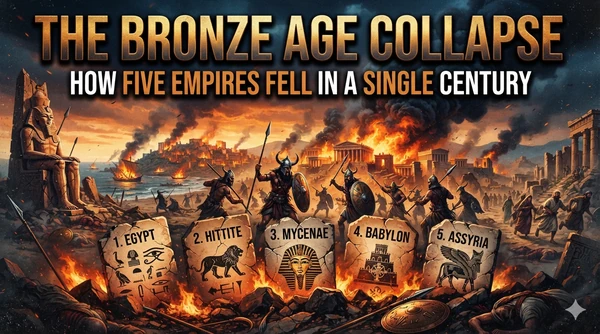
Around 1200 BCE, the eastern Mediterranean was home to the most interconnected, prosperous network of kingdoms the ancient world had yet seen. Egypt's pharaohs exchanged gold and diplomatic letters with the kings of Hatti. Cyprus shipped copper to Ugarit, where merchants stockpiled tin from as far away as Afghanistan to make bronze. Mycenaean Greece built fortified palaces and traded pottery across the sea. It was, in every meaningful sense, the first globalized economy in human history.
Fifty years later, almost all of it was gone.
The Hittite Empire had vanished so completely that even its capital, Hattusa, was forgotten for three thousand years. The Mycenaean palaces of Greece were burned to the ground, their writing system lost. Ugarit's last king wrote a desperate letter begging for help against ships he could see approaching — and the city was destroyed before a reply ever came. Egypt survived, but only barely, and never regained its former power. Historians call this event the Bronze Age Collapse, and it remains one of the greatest unsolved mysteries in ancient history.
A World Built on Bronze — and on Each Other
To understand why the collapse mattered so much, it helps to understand what was collapsing. The Late Bronze Age (roughly 1550–1200 BCE) was not a scattering of isolated kingdoms. It was a genuine system, held together by three things: royal diplomacy, long-distance trade, and bronze itself.
Bronze is an alloy of copper and tin, and tin was rare — most of it had to be shipped enormous distances, likely from sources in Central Asia or western Europe, through a relay of middlemen kingdoms. A war or famine that disrupted trade in one corner of this network could starve armies of weapons a thousand miles away.
Royal correspondence backs this up. The Amarna Letters, a cache of clay tablets found in Egypt, show pharaohs addressing the kings of Babylon, Assyria, and Hatti as "brother" — equals in a shared diplomatic order, exchanging gifts, marriage proposals, and requests for gold. This was a world of treaties and trade routes, not isolated civilizations. Which is exactly why, when the system broke, it broke almost everywhere at once.
The Collapse, City by City
The archaeological record for the collapse is unusually vivid, because so many of the destroyed cities were never resettled — they were simply abandoned, leaving their final moments frozen in the ash.
Ugarit, a wealthy trading port in modern Syria, left behind some of the most haunting evidence. Clay tablets found in its ruins include a letter from the king of Alashiya (Cyprus) warning of enemy ships, and an unsent reply from Ugarit's own king describing his fleet as away at sea and his cities burning. The tablets were still in the kiln, being fired, when the city fell — meaning the destruction came suddenly, with no time even to finish routine administrative work.
Hattusa, capital of the Hittite Empire, was abandoned and largely burned. The Hittite state, which had rivaled Egypt for control of the Levant a century earlier, disappears from the historical record so thoroughly that later Greek and Hebrew writers had no memory it had existed at all.
Mycenaean Greece saw its palace centers — Pylos, Mycenae, Tiryns — destroyed within a few decades of one another. With the palaces went Linear B writing, monumental architecture, and long-distance trade. Greece entered several centuries of reduced population, smaller settlements, and no writing at all, a period historians still call the Greek Dark Age.
Egypt endured repeated invasions by a coalition of raiders the Egyptians called the "Sea Peoples." Pharaoh Ramesses III recorded a massive land and sea battle against them around 1175 BCE on the walls of his mortuary temple at Medinet Habu, boasting of victory — but the cost was severe, and the New Kingdom never recovered its former reach into the Levant.
So What Actually Caused It?
This is where historians still argue. No single explanation fully accounts for the scale and speed of the collapse, and the leading theory today is that it wasn't one cause but several, arriving together.
The Sea Peoples. Egyptian inscriptions blame a confederation of seaborne raiders — groups with names like the Peleset, Sherden, and Denyen — for widespread destruction. Some may later be linked to the Philistines of the biblical narrative. But historians increasingly see the Sea Peoples less as a single invading army and more as a symptom: displaced populations set in motion by a crisis already underway elsewhere.
Climate change and drought. Pollen and sediment studies from the eastern Mediterranean point to a sustained period of drought beginning in the late 13th century BCE. Poor harvests would have strained the grain-dependent economies of Hatti and Greece alike — Hittite records even show desperate requests for Egyptian grain shipments in the years before the collapse.
Earthquakes. Several of the destroyed sites show damage consistent with seismic activity, and the region sits on active fault lines. Some archaeologists argue a cluster of major earthquakes over a few decades — an "earthquake storm" — weakened cities right as other pressures mounted.
Systems collapse. Perhaps the most compelling modern explanation, associated with archaeologist Eric Cline, treats the Bronze Age network itself as the vulnerability. A system this interdependent — where a palace economy needed steady trade in tin, grain, and diplomatic goodwill to function — had no redundancy. Remove enough of its supports at once (drought, raiders, earthquakes, internal revolt) and the whole structure fails, even if no single blow was fatal on its own.
What Rose From the Ruins
The collapse wasn't only an ending. It reshaped the ancient world in ways still felt today.
With palace bureaucracies gone and bronze-making networks disrupted, ironworking spread rapidly — iron ore, unlike tin, didn't require exotic trade routes. This shift helped usher in the Iron Age.
In the Levant, the vacuum left by Egyptian and Hittite retreat created space for smaller kingdoms to emerge, including early Israel and the Phoenician city-states — whose alphabet, simplified for trade rather than royal record-keeping, would eventually become the ancestor of the Greek and Latin scripts.
And in Greece, the centuries of silence that followed the collapse gave rise, eventually, to the world of Homer — a poet composing centuries later about a glittering Bronze Age world his own audience could barely imagine, because its cities had been ash for generations before he was born.
Why It Still Matters
The Bronze Age Collapse is a rare case where archaeology lets us watch a highly sophisticated, interconnected civilization fail — not gradually, but within a single human lifetime. It's a reminder that complexity and prosperity are not the same as resilience, and that the mightiest kingdoms of an age can vanish so completely that later peoples forget they ever ruled at all.
Suggested further reading: Eric H. Cline's "1177 B.C.: The Year Civilization Collapsed" remains the standard popular account. Primary evidence includes the Amarna Letters, the Ugarit archive tablets, and the Medinet Habu inscriptions of Ramesses III.


Comments (0)
Leave a Reply
Log in to post a comment.