

 Sep 02, 2026
 8 min read
How Paper Remade the Abbasid World
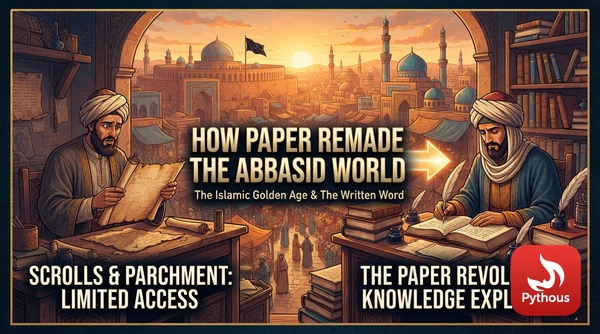
There is a story that gets repeated in almost every account of how paper reached the Islamic world. In the summer of 751 CE, an Abbasid army met a Tang Chinese force on the Talas River, somewhere near the modern border of Kyrgyzstan and Kazakhstan. The Tang commander, Gao Xianzhi, was defeated when his Karluk Turkish allies changed sides mid-battle. Among the prisoners marched back to Samarkand, the story goes, were craftsmen who knew how to make paper. They were put to work. Within a generation the secret had spread to Baghdad, and from there to Cairo, Fez, and eventually Europe.
It is a wonderful story. A single battle in an obscure river valley, and the written culture of half the world changes. The problem is that it is almost certainly not true — or at least, not true in the way it is usually told. And what actually happened is more interesting.
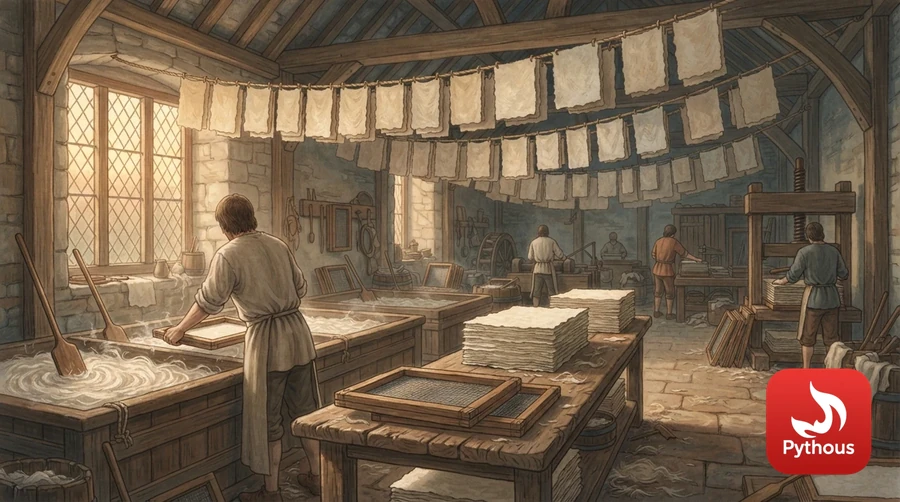
Illustration: a medieval paper workshop, like those that spread from Baghdad.
What the sources actually say
The earliest surviving account linking Talas to papermaking comes from al-Tha'alibi, a Persian writer who died in 1038. In his Lata'if al-ma'arif, a collection of curiosities and regional specialities, he notes that Samarkand paper was among the finest in the world and connects its manufacture to Chinese prisoners taken in the campaign.
That is roughly 287 years after the battle. Al-Tha'alibi was not a military historian working from campaign records; he was compiling notable facts about places, and the anecdote has the shape of an etiological tale — a neat explanation attached after the fact to something already famous. Samarkand paper was famous by his lifetime. A story explaining why would have been welcome.
More decisively, paper was already circulating in Central Asia long before 751. The Sogdian "Ancient Letters," a cache of correspondence found in a watchtower near Dunhuang and generally dated to the early fourth century, were written on paper by Sogdian merchants — the same commercial network centred on Samarkand. Paper fragments have turned up at sites across the Tarim Basin and Transoxiana from the pre-Islamic centuries. Sogdian traders had been handling Chinese paper for four hundred years.
What likely changed in the later eighth century was not knowledge but scale. Samarkand had abundant water, flax and hemp fibre, and now sat inside a single vast political and commercial system with an enormous appetite for writing material. The historian Jonathan Bloom, whose Paper Before Print remains the standard treatment, argues for exactly this: not a transfer of a secret, but the industrialisation of a technique already known at the edges.
What paper replaced, and why it won
To understand why this mattered, it helps to know what scribes in the eighth-century Middle East were writing on.
There were two main options. The first was papyrus — qirtas in Arabic — manufactured in Egypt, as it had been for three millennia. It was relatively cheap and the Egyptian industry was well organised, but papyrus is brittle, it does not fold well, and it does not survive damp. The second was parchment, raqq, made from treated animal skin. Parchment is superb: durable, flexible, and it takes ink beautifully. It is also extraordinarily expensive. A single substantial codex could consume the skins of an entire flock. Parchment was reserved for what mattered most, which is why the earliest Qur'anic manuscripts are written on it.
Paper sat between them and undercut both. It could be made from rags, hemp, flax, and linen waste — materials any city produced in quantity. It did not require a herd. Unlike papyrus, it was not tied to a single province's climate, so it could be manufactured wherever there was clean water and a supply of fibre. And it folded, which meant it could be gathered into quires and bound into codices cheaply.
A paper mill is said to have been established in Baghdad in the 790s, under Harun al-Rashid, with the Barmakid family credited in the later sources for encouraging it. The chronology here is also softer than it is usually presented — the attribution comes from writers working centuries afterward — but the broad picture is not in doubt. By the early ninth century, paper was being made in Iraq, and by the tenth it had effectively displaced papyrus. Egypt's papyrus industry, having survived the pharaohs, the Ptolemies, Rome, and Byzantium, quietly died out.
Paper and the machinery of the state
The first institution to take paper seriously was the government.
The Abbasid caliphate ran on paperwork: tax registers, land surveys, army payrolls, postal intelligence reports from the barid, correspondence between the caliph's chancery and provincial governors from Ifriqiya to Khurasan. This was an administration attempting to govern a territory that took months to cross, and it did so through documents.
Later chancery manuals — al-Qalqashandi's fifteenth-century Subh al-A'sha is the fullest — preserve a revealing argument for the switch. Parchment could be scraped clean and rewritten; that is precisely how palimpsests were made. Paper could not be altered without visible damage to the surface. For a fiscal record or a caliphal order, that was not a drawback but the entire point. A document that cannot be quietly edited is a document you can rely on.
Whether or not the specific attributions in these late sources are accurate, the underlying logic held. Cheap, tamper-evident writing material is an administrative technology, and the Abbasid bureaucracy adopted it with enthusiasm.
The warraqun and the Baghdad book market
The more visible transformation was commercial. Baghdad developed a stationers' quarter, the Suq al-Warraqin, and with it a profession that barely had an equivalent in the parchment world: the warraq.
A warraq was a paper-seller, copyist, and bookseller at once — someone who could take a commission, produce a fair copy, and sell finished volumes from a shop. This was a livelihood built on the assumption that books could be produced speculatively, for a market, rather than only on commission from a patron wealthy enough to fund the parchment.
We know a great deal about this world because one of its members left us a catalogue. Ibn al-Nadim, working in Baghdad in the late tenth century, was a warraq himself, and his Fihrist is an attempt to list the books available in Arabic — by subject, by author, with notes on what had been translated and what had been lost. It is an index compiled by a bookseller, and it describes a literary marketplace of astonishing range: Greek philosophy and medicine, Persian and Indian material, grammar, law, hadith, poetry, theology, alchemy, and works by authors whose names survive only because he wrote them down.
This is also the period in which the great compilations were assembled — the canonical hadith collections, the encyclopaedic histories of al-Tabari and al-Mas'udi, the systematic legal literature of the developing madhhabs. Al-Tabari's history runs to many thousands of pages in modern editions. Such projects are conceivable on parchment. They are practical on paper.
What paper did not do
It is worth resisting the temptation to make paper the cause of everything.
The Graeco-Arabic translation movement — the systematic rendering of Greek scientific and philosophical works into Arabic, under caliphal patronage from al-Mansur through al-Ma'mun — was already underway before paper became common. Dimitri Gutas has argued persuasively that its drivers were political and ideological: an Abbasid dynasty legitimating itself, in part, as the inheritor of ancient learning. Paper did not start that project. It made its output reproducible and cheap enough to reach a reading public well beyond the court.
The distinction matters. Technologies rarely originate intellectual movements. They determine how far those movements travel.
Westward
From Iraq, paper manufacture moved along the trade routes it had arrived on, in reverse. Mills appeared in Damascus, in Fustat, in Fez. By the twelfth century the technique had crossed into al-Andalus: the geographer al-Idrisi, writing around 1154, singles out Játiva — Xàtiva, in modern Valencia — for the quality of its paper, sold across the Mediterranean.
From al-Andalus and Sicily it entered Italy, where mills at Fabriano were operating by the thirteenth century and adding refinements of their own. When Gutenberg set up his press in Mainz in the 1450s, the cheap, abundant material that made movable type economically viable had already been travelling west for seven centuries.
The Talas legend, then, gets the direction right and everything else wrong. Paper did come from the east, and it did transform the Islamic world and then Europe. But it did not arrive as loot in the baggage train of one victorious army. It arrived the way most technologies do — slowly, commercially, through the hands of merchants, and then all at once, when someone worked out how to make it at scale.
Sources
- Al-Tha'alibi, Lata'if al-ma'arif
- Ibn al-Nadim, Kitab al-Fihrist
- Al-Qalqashandi, Subh al-A'sha fi Sina'at al-Insha
- Al-Idrisi, Nuzhat al-Mushtaq
- Jonathan M. Bloom, Paper Before Print: The History and Impact of Paper in the Islamic World (Yale, 2001)
- Dimitri Gutas, Greek Thought, Arabic Culture (Routledge, 1998)



Comments (0)
Leave a Reply
Log in to post a comment.