

 Jun 15, 2026
 5 min read
Will AI Take Our Jobs? What the Evidence Shows So Far
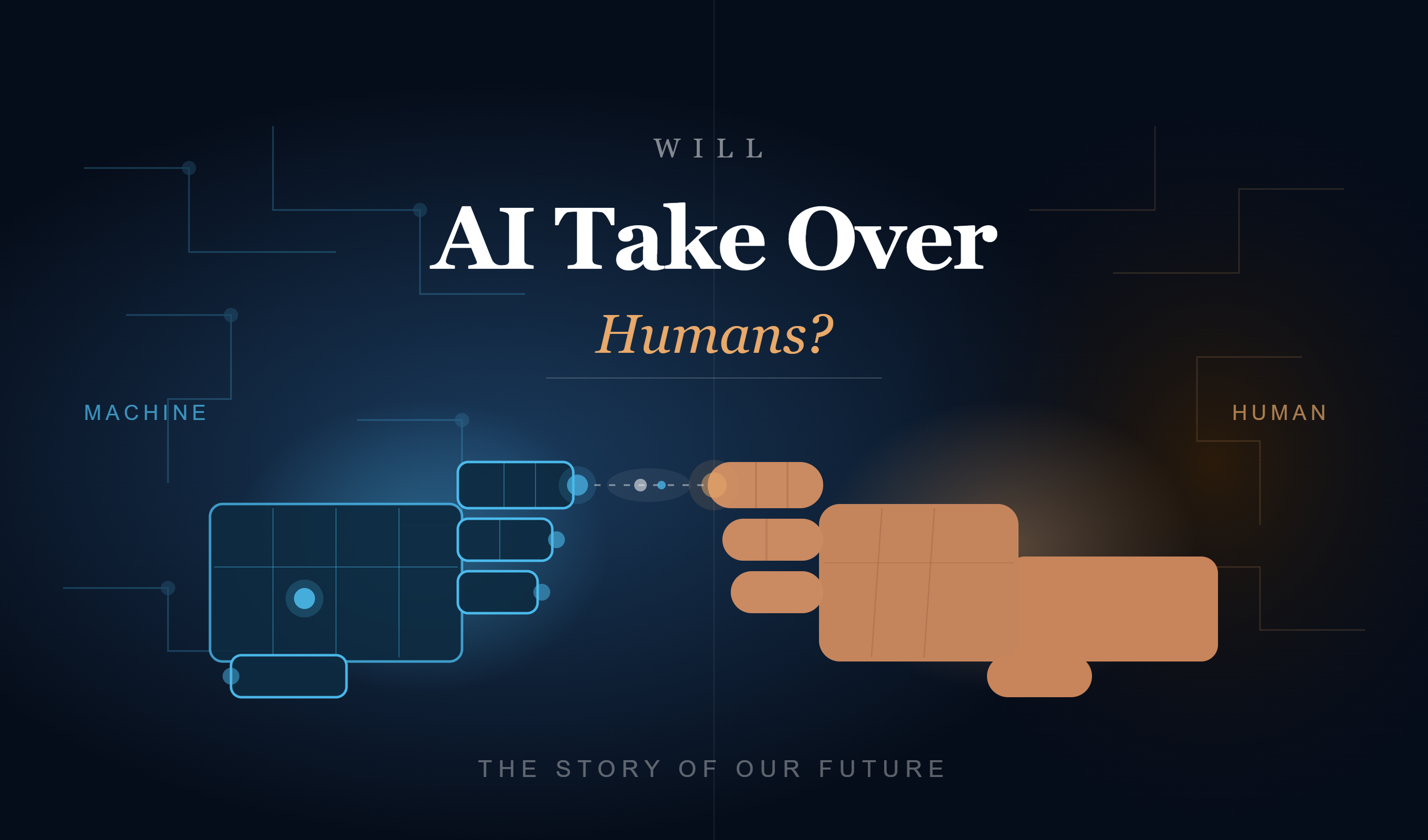
In March 2023, two Goldman Sachs economists, Joseph Briggs and Devesh Kodnani, published an estimate that generative AI could expose the equivalent of 300 million full-time jobs around the world to automation. The number went everywhere, usually rounded into a headline about AI "taking" 300 million jobs. That isn't what the report said. It estimated that about two thirds of US occupations had some tasks AI could do, and that for those jobs between a quarter and a half of the workload might be automated. Exposure to automation is not the same as losing a job, and the gap between the two is where most of the real argument about AI and work sits.

Illustration: the feeling of being watched by the software you work with.
We have had this fear before
Between 1811 and 1816, textile workers in the English Midlands and the North, the Luddites, smashed the new knitting frames and power looms that were undercutting skilled weavers. They were right that the machines would destroy their trade. Hand-loom weaving collapsed over the following decades, and many of the people who had done it never recovered their incomes. They were wrong only in the long run and in aggregate: the industrial economy that followed employed far more people than before.
The economist David Autor has spent much of his career on why this keeps happening. In a 2015 paper titled "Why are there still so many jobs?" he argued that automation tends to replace particular tasks, not whole jobs, and that the remaining tasks often become more valuable. Automated teller machines spread through US banks from the 1970s, yet the number of bank tellers grew for decades afterwards, because cheaper branches meant more branches, and tellers moved towards selling and advising. In a later study published in 2024, Autor and his colleagues found that about six in ten Americans employed in 2018 worked in job titles that did not exist in 1940.
Why this round could be different
Earlier waves of automation mostly took over physical work and routine paperwork, the kind of task that can be written down as a fixed set of rules. Large language models reach into work that was supposed to be safe: writing, summarising, coding, answering customers' questions, drafting legal and medical text. In 2023, researchers at OpenAI and the University of Pennsylvania, led by Tyna Eloundou, estimated that about 80 per cent of the US workforce had at least a tenth of their tasks exposed to these models, and about one in five had at least half. Unusually, the exposure was higher for better-paid, more educated jobs.
The early evidence on what happens inside companies is more mixed than either the optimists or the pessimists claim. Erik Brynjolfsson, Danielle Li and Lindsey Raymond studied more than 5,000 customer-support agents at a software firm that introduced an AI assistant. On average the agents resolved 14 per cent more issues per hour. The least experienced gained the most, about 34 per cent, while the most skilled agents gained almost nothing. In that case the tool narrowed the gap between new and experienced staff. It did not replace them, though it is easy to see how a company might hire fewer of them in future.
Exposure is not the same as loss
Whether a task that AI can do turns into a job that disappears depends on things the technology doesn't decide: whether the output is reliable enough to use without checking, whether customers want a person, whether the law requires one, what it costs to change how a business works, and whether cheaper output creates more demand. Translation is a useful example. Machine translation has been good enough for everyday use for years, yet professional translators still work, increasingly by editing machine output. Their rates and conditions have come under pressure, which is a real cost even when the job survives.
The choices that matter most here are not technical. Who owns the systems, who captures the productivity gains, how quickly retraining and support reach people whose work changes, and which decisions about loans, benefits or sentences are handed to software that people cannot question: these will decide whether AI's effect on work looks more like the ATM or more like the power loom.
For individuals, the evidence so far points in a fairly practical direction. The tasks most exposed are those that can be fully specified in text and checked easily. The work that holds up best is the work around those tasks: judging whether an answer is right, dealing with people, taking responsibility for a decision. Learning to use the tools well is part of that. The customer-support study suggests that, at least for now, people using AI do better than both the people without it and the AI on its own.
Sources
- Goldman Sachs, "Generative AI could raise global GDP by 7%" (summary of Briggs and Kodnani, 2023). https://www.goldmansachs.com/insights/articles/generative-ai-could-raise-global-gdp-by-7-percent
- David H. Autor, "Why are there still so many jobs? The history and future of workplace automation", Journal of Economic Perspectives 29, no. 3 (2015): 3–30. https://doi.org/10.1257/jep.29.3.3
- David Autor, Caroline Chin, Anna Salomons and Bryan Seegmiller, "New frontiers: the origins and content of new work, 1940–2018", Quarterly Journal of Economics 139 (2024). https://doi.org/10.1093/qje/qjae008
- Tyna Eloundou, Sam Manning, Pamela Mishkin and Daniel Rock, "GPTs are GPTs: labor market impact potential of LLMs", Science 384 (2024). https://doi.org/10.1126/science.adj0998
- Erik Brynjolfsson, Danielle Li and Lindsey Raymond, "Generative AI at work", Quarterly Journal of Economics 140 (2025). https://doi.org/10.1093/qje/qjae044



Comments (0)
Leave a Reply
Comments are moderated. Please read our Comment Policy before posting.
Log in to post a comment.