

 Aug 19, 2026
 7 min read
What Was on Earth Before Humans: Science and Faith
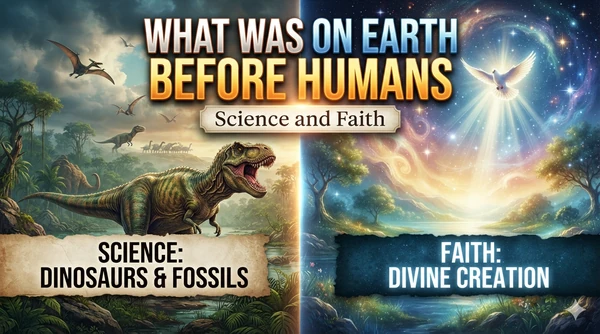
Long before the first human being ever opened their eyes, Earth was already an old and restless world. Mountains rose and wore away, oceans filled and emptied, and countless creatures lived and vanished without anyone ever recording their names. Two very different traditions have tried to make sense of that vast stretch of time — the modern scientific record, built from rock, fossil, and radioactive decay, and the world's religious traditions, built from revelation, scripture, and sacred story. Both agree on one striking point: humans were latecomers to this planet. How they describe everything that came before differs enormously.
The Scientific Account
A Molten, Violent Beginning
According to geology and astrophysics, Earth formed about 4.6 billion years ago out of the same swirling cloud of dust and gas that produced the sun and the rest of the solar system. For its first several hundred million years — a period scientists call the Hadean eon — the planet was a hostile place: a surface of molten rock, constant volcanic activity, and relentless bombardment by asteroids and comets. One of these early collisions, with a Mars-sized body, is thought to have blasted debris into orbit that eventually formed the Moon.
The First Life
As Earth cooled, water condensed and the first oceans formed. Somewhere in those ancient seas, roughly 3.8 to 3.5 billion years ago, chemistry crossed into biology. The earliest confirmed life was microscopic — single-celled organisms related to modern bacteria and archaea. Fossilized mats of these microbes, called stromatolites, are among the oldest direct evidence of life on Earth. For an immense span of time, these simple organisms were the only living things on the planet. Some of them, cyanobacteria, eventually began performing photosynthesis, gradually filling the atmosphere with oxygen in an event geologists call the Great Oxidation Event.
Complex Life Emerges
Billions of years passed before life became more elaborate. Around 1.5 billion years ago, the first complex cells with nuclei appeared, and later, the first true multicellular organisms. Then, around 541 million years ago, came the Cambrian Explosion — a relatively rapid diversification in which most of the major animal body plans we recognize today first appeared in the fossil record: creatures with shells, legs, eyes, and segmented bodies filled the ancient seas.
Life then moved onto land. Plants colonized the continents, followed by insects, then amphibians that could live both in water and on land. Forests spread, and by around 320 million years ago, the first reptiles had evolved, laying eggs that no longer needed water to survive.
The Age of Dinosaurs
From roughly 230 to 66 million years ago, during the Mesozoic Era, dinosaurs dominated the land, while giant marine reptiles ruled the seas and pterosaurs took to the skies. The very first small mammals also appeared during this era, scurrying in the shadows of far larger creatures, and the first birds evolved from a branch of feathered dinosaurs.
This age ended abruptly around 66 million years ago, when an asteroid roughly ten kilometers wide struck what is now the Gulf of Mexico. The resulting catastrophe wiped out the non-avian dinosaurs and roughly three-quarters of all species on Earth, closing the Mesozoic and opening the door for a new group of animals to flourish.
The Rise of Mammals — and Finally, Humans
With the dinosaurs gone, mammals diversified rapidly, filling ecological niches once occupied by reptiles. Over tens of millions of years, one lineage of mammals gave rise to primates, and within that group, to apes. The ancestors of humans and chimpanzees diverged from a common ancestor somewhere around 6 to 7 million years ago. From there, a long and branching family tree of hominins emerged — species such as Australopithecus, then early members of the genus Homo, including Homo erectus and Homo neanderthalensis. Our own species, Homo sapiens, appears in the fossil record roughly 300,000 years ago — a tiny sliver of time compared to Earth's 4.6-billion-year history. If Earth's entire history were compressed into a single 24-hour day, humans would appear in only the last few seconds before midnight.
Religious and Spiritual Accounts
Abrahamic Traditions: Judaism, Christianity, and Islam
In the Genesis creation narrative, shared in broad outline across Judaism and Christianity, God creates the world in six days: light and darkness, sky and sea, dry land and vegetation, sun, moon, and stars, and then the creatures of the sea and sky, followed by land animals. Only after all of this — on the sixth day, alongside the animals — are humans created, formed in the image of God and given stewardship over the rest of creation. Many Jewish and Christian thinkers read the "days" literally as six 24-hour periods; others, including many contemporary theologians and clergy, read them symbolically or poetically, representing long ages rather than literal days, allowing for compatibility with an old Earth and biological evolution.
The Quran likewise describes a world created in stages — often rendered as six periods (ayyam) — with the heavens, the earth, and living things brought into being before humankind. Adam is described as formed from clay and given life by God's breath, with angels commanded to bow before him. As in Jewish and Christian thought, humans are described as arriving after the rest of creation and are given a special role as trustees (khalifah) of the earth.
Hindu Cosmology
Hindu tradition offers a very different sense of scale. Rather than a single act of creation, many Hindu texts describe time as cyclical, unfolding across immense periods called kalpas, each lasting billions of years and containing further cycles of four ages, or yugas. In some accounts, the god Brahma creates the universe at the start of each cycle, and the world passes through ages of gods, sages, and mythic beings — including epochs populated by other kinds of creatures and semi-divine beings — long before the current age of ordinary humans. Some later Puranic accounts even describe successive Manus, primal human ancestors, each presiding over a different era, with much of the world's animal and plant life already established before humanity's age begins.
Buddhist Cosmology
Buddhism generally sets aside the question of an ultimate first cause, focusing instead on liberation from suffering rather than a creation narrative. Still, traditional Buddhist cosmology describes an ancient universe cycling endlessly through vast eras of expansion and contraction, populated by many realms of beings — heavenly, animal, and otherwise — that long precede human beings as we know them. Existence, in this view, has no clearly defined beginning at all.
Indigenous and Other Traditions
Many Indigenous and traditional cultures around the world have their own rich creation stories, often describing a primordial world of animals, spirits, or ancestral beings who shaped the land, waters, and skies before human beings appeared or were formed from the earth itself. These stories vary enormously by culture, but they frequently share the idea that humans arrived into a world already alive with other beings and forces, and that humans bear responsibilities to that pre-existing world.
Two Ways of Seeing an Old World
Set side by side, science and religious traditions differ enormously in their methods, their timescales, and their purposes. Science reconstructs the past from physical evidence, arriving at a picture of a 4.6-billion-year-old Earth on which humans are astonishingly recent arrivals, emerging through a long unguided process of evolution. Religious traditions instead offer accounts rooted in scripture and sacred narrative, generally agreeing that humans were not the first beings on Earth, but often describing far shorter timescales — or, as in Hindu and Buddhist thought, timescales so vast and cyclical that they resist simple comparison — and framing the arrival of humans as significant or intentional rather than incidental.
Many people today hold these accounts in tension in various ways: some read scripture literally and reject the scientific timeline outright, some see scripture as speaking to meaning and purpose rather than mechanism and see no conflict with evolutionary science, and others draw on both without feeling a need to fully reconcile them. Across nearly all of these views, though, one theme recurs: before humans stood on Earth to ask where they came from, the world was already old, already full of life, and already telling a very long story.


Comments (0)
Leave a Reply
Log in to post a comment.