

 Aug 17, 2026
 4 min read
Does Man Become Monkey, or Monkey Become Man? Clearing Up a Popular Misconception
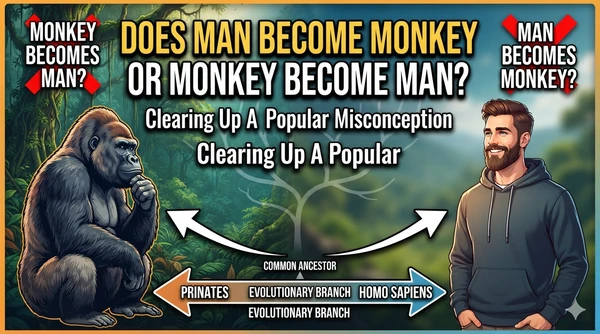
"So did man come from monkeys, or did monkeys come from man?" The question comes up whenever evolution is mentioned, sometimes as a joke and sometimes in earnest. Biology's answer is neither. Humans are not descended from any monkey alive today, and monkeys are not descended from humans. Both are descended from much older species that no longer exist, in the way that two cousins share grandparents without either being descended from the other.
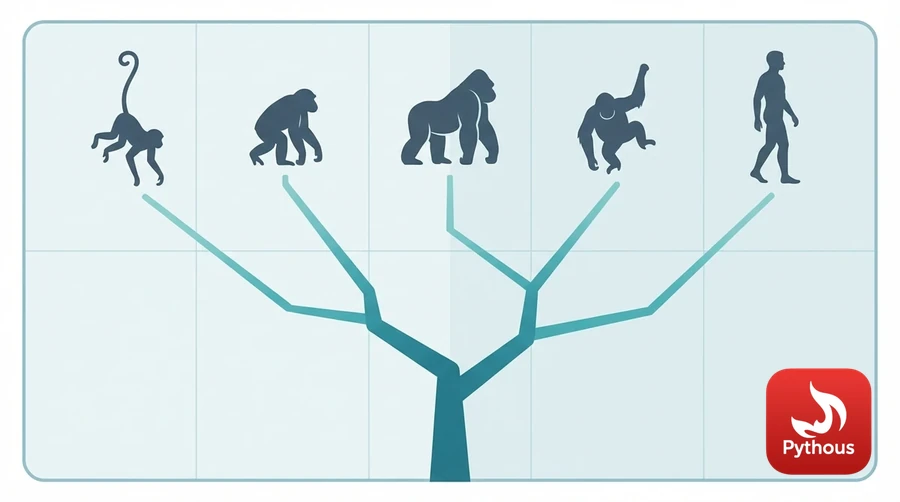
Illustration: humans and other primates are branches of one family tree, not steps on a ladder.
A tree, not a ladder
The misunderstanding comes mostly from a famous kind of picture: a row of figures walking left to right, from a crouching ape to an upright man. It suggests evolution is a ladder with humans at the top. It is closer to a bushy tree. A population of one species splits, the parts adapt to different places and ways of life, and over long periods they become separate species. Each of those can split again. The species living today are the tips of the branches, and their common ancestors sit at the forks further down.
Charles Darwin made this point in The Descent of Man in 1871. He argued that humans and the living apes share ancestors, and warned explicitly against the idea that humans came from any existing ape or monkey.
Apes, not monkeys, and not today's apes either
Biologists sort primates into groups. Monkeys and apes are separate branches. The apes include gibbons, orangutans, gorillas, chimpanzees and bonobos, and, by ancestry, humans. Our closest living relatives are chimpanzees and bonobos. Comparing DNA and fossils, scientists estimate that the human line split from the line leading to chimpanzees roughly 6 to 7 million years ago. The ancestors that apes share with the Old World monkeys of Africa and Asia lived much earlier, around 25 to 30 million years ago.
The DNA evidence is direct. When the chimpanzee genome was published in Nature in 2005, it showed that in the stretches of DNA that can be lined up letter by letter, humans and chimpanzees differ by only about 1.2 per cent. The fossil evidence fills in the branch. Sahelanthropus tchadensis, a skull found in Chad and described in 2002, dates from about 7 million years ago, close to the split. The famous "Lucy" skeleton from Ethiopia, an Australopithecus afarensis about 3.2 million years old, walked upright but had a brain about the size of a chimpanzee's. Neither is a monkey, and neither is a modern ape.
Why are there still monkeys?
This is usually the next question, and it rests on the same ladder picture. If humans evolved from the same ancestors as monkeys, why didn't all of them become human? Because evolution isn't heading anywhere in particular. When a population splits, each branch adapts to its own circumstances. The ancestors of today's monkeys did well in their forests and grasslands and are still doing well. Another branch, living in changing African landscapes, eventually gave rise to humans. One branch is not "ahead" of the other. A monkey alive today has exactly as long an evolutionary history as you do.
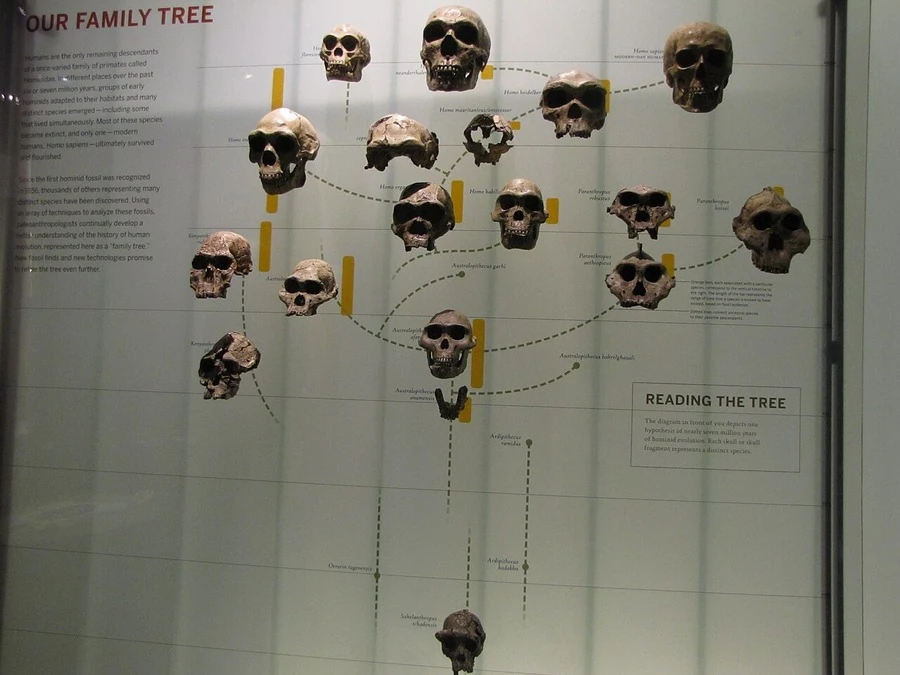
Fossils, anatomy and genetics all point to common descent. Photo: Cathrotterdam / Wikimedia Commons, CC BY-SA 4.0
Science and belief
In biology, common descent is not a matter of debate. Fossils, anatomy and genetics, studied independently, all point to the same family tree. Where people do disagree is about meaning: how this account fits with the accounts of human origins in religious traditions, including Islamic teaching on the creation of Adam. Muslim scholars and scientists hold a range of views on that question, from rejecting human evolution to accepting it as the way God's creation unfolded. That is a real and serious conversation, but it is a different one from the biological question here, which has a clear answer: humans and monkeys are relatives with shared ancestors, not ancestors and descendants of each other.
Sources
- Charles Darwin, The Descent of Man, and Selection in Relation to Sex (1871), Project Gutenberg. https://www.gutenberg.org/ebooks/2300
- The Chimpanzee Sequencing and Analysis Consortium, "Initial sequence of the chimpanzee genome and comparison with the human genome", Nature 437 (2005): 69–87. https://doi.org/10.1038/nature04072
- Michel Brunet, Franck Guy, David Pilbeam et al., "A new hominid from the Upper Miocene of Chad, Central Africa", Nature 418 (2002): 145–151. https://doi.org/10.1038/nature00879
- Smithsonian Institution Human Origins Program, "Introduction to human evolution". https://humanorigins.si.edu/education/introduction-human-evolution
- Smithsonian Institution Human Origins Program, "Sahelanthropus tchadensis". https://humanorigins.si.edu/evidence/human-fossils/species/sahelanthropus-tchadensis



Comments (0)
Leave a Reply
Comments are moderated. Please read our Comment Policy before posting.
Log in to post a comment.