

 Aug 18, 2026
 3 min read
Types of Human Nails: A Complete Guide
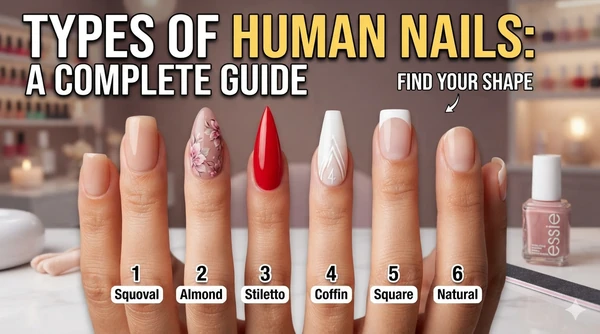
Nails are more than just a canvas for polish — they're a hard, protective covering made of keratin that grows from the nail bed at the tips of our fingers and toes. While every nail shares the same basic structure (nail plate, nail bed, cuticle, and matrix), nails vary quite a bit from person to person in shape, texture, and even health. Understanding these variations can help with everything from choosing a manicure style to spotting early signs of a health issue.
This article breaks down human nails into three practical categories: natural nail shapes, styled (manicure) nail shapes, and nail types related to health and appearance.
1. Natural Nail Shapes
Every person is born with a nail shape largely determined by the shape of the underlying nail bed and finger. The most common natural shapes are:
- Oval Nails — Rounded at the tip with slightly tapered sides. Considered one of the more versatile and low-maintenance shapes.
- Square Nails — A flat, straight edge with sharp corners. Common on people with wider nail beds.
- Round Nails — Similar to oval but shorter, following the natural curve of the fingertip. Tends to be the strongest shape since there's less nail edge to catch or break.
- Square-Oval (Squoval) Nails — A hybrid shape with a flat top and softly rounded corners, combining the strength of square nails with the softer look of oval ones.
- Pointed/Narrow Nails — Nail beds that taper more sharply, producing a naturally narrower nail plate.
2. Styled (Manicure) Nail Shapes
Beyond natural shape, many people file or extend their nails into deliberate shapes for aesthetic reasons. These are popular in nail art and salon culture:
- Almond — Tapered sides with a rounded peak, resembling an almond. Elongates the finger visually.
- Stiletto — A dramatic, sharply pointed shape inspired by stiletto heels. Requires longer nails and more upkeep.
- Coffin/Ballerina — A tapered shape with a flat, squared-off tip, resembling a ballet shoe or coffin outline. Popular in modern nail art.
- Squoval — As above, but often intentionally filed this way for both durability and style.
- Lipstick — An angled tip cut diagonally, resembling the slanted top of a lipstick tube. A bold, less common choice.
- Edge/Flare — Nails that widen slightly at the tip rather than tapering, giving a flared silhouette.
3. Nail Types Based on Health and Appearance
Nails can also be classified by their texture, thickness, and growth patterns, which often reflect genetics, aging, or general health:
- Normal Nails — Smooth, slightly pink, and uniformly curved with no ridges or discoloration.
- Brittle Nails — Prone to splitting, peeling, or breaking easily, often linked to frequent water exposure, harsh chemicals, or nutritional factors.
- Ridged Nails — Vertical ridges are common with aging and are usually harmless; horizontal ridges (called Beau's lines) can indicate the nail experienced a temporary disruption in growth.
- Thick Nails — Nails that thicken over time, more common in toenails and often associated with aging or repeated minor trauma.
- Spoon Nails (Koilonychia) — Nails that curve inward like a spoon instead of outward, sometimes associated with iron levels or other underlying factors.
- Clubbed Nails — Nails that curve significantly around enlarged fingertips, which can be linked to long-term oxygen or circulation-related conditions.
- Pitted Nails — Small depressions or pits in the nail surface, often associated with certain skin conditions.
Note: Nail changes like clubbing, spooning, or persistent pitting can sometimes signal an underlying health condition. If you notice sudden or unexplained changes in your nails, it's worth checking with a healthcare provider rather than self-diagnosing.
Nail Care Basics
Regardless of shape or type, healthy nails generally benefit from a few consistent habits:
- Keeping nails clean and dry to prevent fungal growth
- Trimming and filing in one direction to avoid splitting
- Moisturizing the cuticles regularly
- Avoiding harsh chemicals or excessive water exposure without protection
- Eating a balanced diet, since nail health often reflects overall nutrition
Conclusion
From the natural curve of your nail bed to the trendy coffin shape you might request at the salon, human nails come in a wide variety of forms. Some differences are purely cosmetic, shaped by filing and styling choices, while others can offer subtle clues about your body's overall health. Paying attention to both the shape and condition of your nails is a simple but often overlooked part of personal care.



Comments (0)
Leave a Reply
Log in to post a comment.