

 Aug 16, 2026
 4 min read
How Many Elements Are in the Human Body?
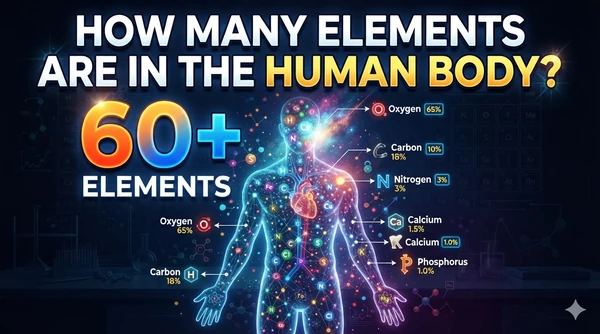
A 70-kilogram adult is made of roughly 7 × 1027 atoms, a seven followed by 27 zeros. Sensitive analysis can find traces of about 60 different chemical elements among them. Around 25 to 30 of those are thought to do a useful job in the body; the rest are passengers picked up from food, water and air.
Illustration: four elements make up about 96% of your body.
By weight: mostly oxygen
Four elements make up about 96 per cent of body mass. In a 70 kg person, standard reference figures give roughly:
- oxygen, about 45 kg (around 65 per cent)
- carbon, about 13 kg (18 per cent)
- hydrogen, about 7 kg (10 per cent)
- nitrogen, about 1.8 kg (3 per cent)
Oxygen comes first because the body is about 60 per cent water, and by mass water is almost 89 per cent oxygen. Carbon is the backbone of every protein, fat, sugar and strand of DNA. Nitrogen is in every amino acid and in the bases of DNA and RNA.
Count atoms instead of weighing them, and the order changes. Hydrogen atoms are so light that, although they account for only a tenth of your weight, they make up about 63 per cent of the atoms in your body. Oxygen is about 26 per cent of the atoms, carbon about 9.5 and nitrogen about 1. Most of your atoms are hydrogen, and almost all of that hydrogen was made in the first few minutes after the Big Bang.
The next seven
Seven more elements, sometimes called macrominerals because we need them in amounts of a gram or so a day, account for most of the remaining 4 per cent. Calcium, about 1 kg, sits almost entirely in bones and teeth, though the small amount dissolved in blood controls muscle contraction and the heartbeat. Phosphorus, about 780 g, is also mostly in bone, and is part of DNA and of ATP, the molecule cells use to store energy. Then come smaller amounts of potassium and sulfur (about 140 g each), sodium (about 100 g), chlorine (about 95 g) and magnesium (about 20 g). Sodium and potassium carry the electrical signals in nerves; sulfur holds the shapes of many proteins together, which is why burning hair smells the way it does.

Calcium, phosphorus, potassium and the other macrominerals come from everyday foods. Photo: Towfiqu barbhuiya / Pexels
Trace elements
The last fraction of a per cent is made up of elements needed in milligrams or micrograms a day. Small as they are, a shortage of some of them causes serious disease. Iron is at the centre of haemoglobin, which carries oxygen in red blood cells; an adult has only about 4 grams of it, yet iron deficiency is the leading cause of anaemia, which the World Health Organization estimates affects about 40 per cent of children under five worldwide. Iodine is needed to make thyroid hormone, and too little in pregnancy harms a baby's brain development, which is why many countries add it to salt. Zinc is used by hundreds of enzymes. Copper, selenium, manganese and molybdenum are all parts of particular enzymes. Cobalt is needed only as part of vitamin B12, so people must get it already built into that vitamin.
The list of essential elements is not completely settled. Chromium was long counted as essential for handling blood sugar, but in 2014 the European Food Safety Authority concluded that there was no convincing evidence it is essential, and set no recommended intake. Fluorine strengthens tooth enamel but is usually classed as beneficial, not essential. Silicon and boron may have small roles in bone and connective tissue that are still being studied.
The ones that don't belong
Everyone also carries small amounts of elements with no known use, such as aluminium, strontium, barium and arsenic, and of harmful heavy metals like lead, mercury and cadmium. Some of these are dangerous because they imitate useful elements. Lead takes the place of calcium and zinc in proteins and is stored in bone, which is why there is no safe level of lead in the blood for children. Strontium, chemically similar to calcium, also ends up in bone, which is what made radioactive strontium-90 from nuclear weapons tests such a concern in the 1950s and 1960s.
Put together, the chemistry is surprisingly ordinary. Nearly all of you is four of the most common elements in the universe, arranged with great precision, plus a few dozen others, most of them present in grams or less.
Sources
- "Composition of the human body", Wikipedia (table of mass, mass fraction and atom fraction for a 70 kg adult, with its cited sources). https://en.wikipedia.org/wiki/Composition_of_the_human_body
- Maria Antonietta Zoroddu, Jan Aaseth, Guido Crisponi, Serenella Medici et al., "The essential metals for humans: a brief overview", Journal of Inorganic Biochemistry 195 (2019): 120–129. https://doi.org/10.1016/j.jinorgbio.2019.03.013
- EFSA Panel on Dietetic Products, Nutrition and Allergies, "Scientific opinion on dietary reference values for chromium", EFSA Journal 12 (2014): 3845. https://doi.org/10.2903/j.efsa.2014.3845
- World Health Organization, "Anaemia" fact sheet. https://www.who.int/news-room/fact-sheets/detail/anaemia
- World Health Organization, "Micronutrients". https://www.who.int/health-topics/micronutrients


Comments (0)
Leave a Reply
Comments are moderated. Please read our Comment Policy before posting.
Log in to post a comment.