

 Aug 27, 2026
 7 min read
The Mystery of Cyrus the Great: What We Actually Know About History's Most Elusive Conqueror
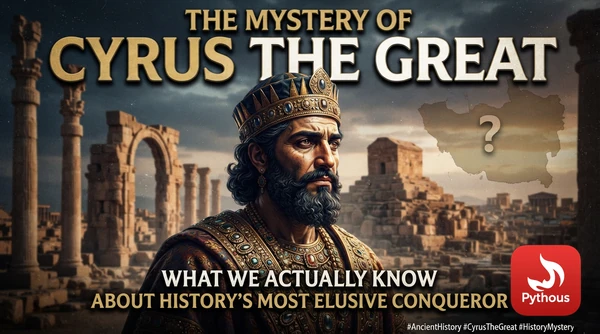
He built the largest empire the world had yet seen, stretching from the Aegean coast to the edge of India. He is praised in the Hebrew Bible as the anointed of God, celebrated by Greek writers who had every reason to hate Persians, and honoured in modern Iran as the founder of the nation. And yet, for a figure of such enormous consequence, Cyrus II of Persia — Cyrus the Great — remains strangely out of focus.
We do not know for certain where his family came from. We do not know how he died. We do not know what he believed. Almost every detail of his life reaches us through the hands of people writing decades or centuries later, in foreign languages, for their own purposes. What follows is an attempt to separate the man from the legend, and to be honest about where the evidence runs out.
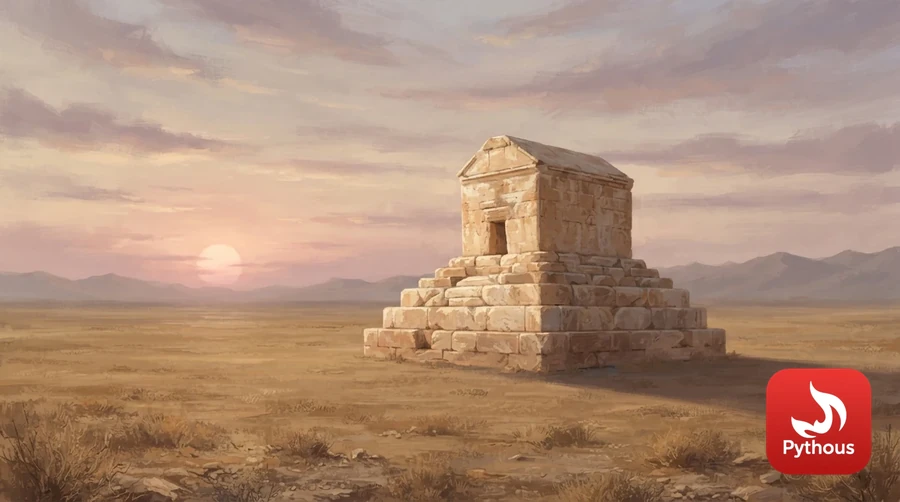
Illustration: the tomb of Cyrus the Great at Pasargadae, Iran.
The Problem With the Sources
Cyrus left remarkably little written testimony of his own. There is no Persian court history from his reign, no annals of the kind Assyrian kings compiled obsessively. What survives falls into three uneven categories.
First, contemporary Babylonian documents: the Cyrus Cylinder, a clay foundation deposit inscribed in Akkadian after his capture of Babylon in 539 BCE, and the Nabonidus Chronicle, a terse year-by-year record of events. These are close to the man in time, but they are official documents in a Mesopotamian idiom, not biography.
Second, Greek accounts written a century or more later. Herodotus gives us the fullest narrative, but openly admits he knows several competing versions of Cyrus's origins and chooses one. Xenophon's Cyropaedia is explicitly a work of political philosophy dressed as biography — an idealised portrait of the perfect ruler. Ctesias, a Greek physician at the Persian court, offers a third and largely incompatible story.
Third, Hebrew scripture: the books of Ezra, Isaiah and Chronicles, which present Cyrus as an instrument of divine will.
None of these sources agree on the essentials. That disagreement is the mystery.
Mystery One: Was Cyrus Even an Achaemenid?
The standard story says Cyrus founded the Achaemenid dynasty, named for an ancestor called Achaemenes. But there is a problem, and it is a large one.
On the Cyrus Cylinder, Cyrus traces his own lineage carefully: he is son of Cambyses, grandson of Cyrus, great-grandson of Teispes, "king of Anshan." Four generations, and Achaemenes appears nowhere. The claim that the family descended from Achaemenes comes from Darius I, who seized the throne after Cyrus's son died — and who had an obvious motive for inventing a shared ancestor that made him a legitimate cousin rather than a usurper.
Then there is the title itself. Cyrus calls himself king of Anshan, not king of Persia. Anshan was an ancient Elamite centre in the highlands of Fars, and Elam was a civilisation older than Persia with its own language, gods and administrative traditions. A number of scholars — Daniel Potts and Matt Waters among the more prominent — have argued that Cyrus's dynasty was substantially Elamite in its culture and self-presentation, and that the thoroughly "Persian" Cyrus of later tradition is a retrospective construction.
The founder of the Persian Empire may not have thought of himself as Persian in the way we assume.
Mystery Two: The Legend of His Birth
Herodotus tells a memorable story. Astyages, king of the Medes, dreams that his daughter's child will overthrow him. He marries her off to a Persian of modest standing, and when the boy is born he orders his courtier Harpagus to kill him. Harpagus passes the job to a herdsman, whose wife — named Spako, from the Median word for dog — has just delivered a stillborn child. The infant Cyrus is raised in secret, is recognised years later by his bearing, and eventually fulfils the prophecy.
Anyone who has read widely in ancient literature will recognise the shape of this immediately. The exposed royal infant, the substitution, the animal-associated foster mother, the inevitable prophecy: the same architecture supports the birth legends of Sargon of Akkad, Moses, Romulus and Remus, and Oedipus. Herodotus himself notes that at least four different accounts of Cyrus's upbringing circulated in his day.
This is not evidence that Cyrus was fictional. It is evidence that within a century of his death, his life had been reshaped into the standard mythological template for a founder-king. The historical childhood is simply gone.
Mystery Three: How Media Actually Fell
Herodotus describes a war of conquest in which Cyrus rises against his Median overlord and defeats him. The Nabonidus Chronicle, written much closer to the event, says something different and considerably more interesting: the Median army mutinied against Astyages and handed him over to Cyrus in chains.
That is a coup, not a conquest. It suggests that the transfer of power from Media to Persia was at least partly an internal affair among an interlinked highland aristocracy — which would help explain why Medes retained such prominent positions in the Persian imperial administration afterwards, something a straightforward conquest narrative struggles to account for.
The same pattern repeats at Babylon. Herodotus and Xenophon give us a dramatic siege in which Persian engineers divert the Euphrates and wade into the city along the drained riverbed at night. The Babylonian sources describe the city opening its gates without a fight, following a genuine battle at Opis to the north. Political groundwork, not military spectacle.
Mystery Four: What Did He Believe?
There is no direct evidence that Cyrus was a Zoroastrian. His inscriptions do not invoke Ahura Mazda — that begins with Darius. In Babylon he presents himself as chosen by Marduk, the city's chief god, and restores Marduk's neglected cult. In the Hebrew Bible, Isaiah calls him mashiach, the anointed one of YHWH, the only non-Israelite in scripture to receive that title.
Two readings are possible. The generous one holds that Cyrus practised a genuine policy of religious tolerance unusual in the ancient Near East. The sceptical one holds that he was an exceptionally skilled propagandist who spoke each conquered people's religious language back to them, and that the Cylinder is simply a competent piece of Babylonian court literature in a genre with centuries of precedent.
This bears directly on the Cyrus Cylinder's modern reputation as "the first charter of human rights." That description does not survive close reading. The Cylinder is a foundation text in the standard Mesopotamian style: the previous king is denounced as impious, the new king is chosen by the offended god, temples are restored and displaced people are returned home. Assyrian kings had been issuing documents of this shape for generations. It is a remarkable object and it does record acts of restoration — but it is a royal press release, not a declaration of universal rights, and it says nothing about Jews or Jerusalem.
Mystery Five: His Death
Here the sources collapse entirely.
Herodotus has Cyrus killed campaigning against the Massagetae, a nomadic people east of the Caspian, whose queen Tomyris takes revenge for her son by dropping the dead king's head into a skin filled with blood, telling him to drink his fill. Ctesias has him die fighting the Derbices. Berossus places the fatal campaign against the Dahae. Xenophon, characteristically, gives him a serene death in bed surrounded by his sons, delivering a philosophical address on virtue and mortality.
A violent death on the northeastern frontier around 530 BCE is the most likely reconstruction, since three independent traditions place him there. Beyond that, we are guessing.
The Tomb That Survived by Mistake
At Pasargadae, in the plain of Fars, stands a modest limestone structure: a gabled chamber on a stepped platform, austere to the point of severity for the resting place of a man who ruled from the Aegean to the Hindu Kush. Alexander's officers visited it and reported it plundered, and Greek writers preserve a version of an inscription — a request from Cyrus that the passer-by not grudge him the little earth that covers his body. No such inscription survives on the monument today.
The tomb outlasted the empire for an accidental reason. In the Islamic centuries it came to be known locally as the tomb of the mother of Solomon, and that identification protected it. A misattribution kept standing what accurate memory might not have.
It is a fitting monument. The building is real, solid, dated and visible — and what it is actually telling us has been contested for two thousand years. That is Cyrus in miniature: an empire's worth of consequence, resting on a foundation we can no longer fully read.
Primary sources: Cyrus Cylinder (British Museum, BM 90920); Nabonidus Chronicle (BM 35382); Herodotus, Histories I; Xenophon, Cyropaedia; Ctesias, Persica (fragments); Ezra 1 and 6; Isaiah 44–45; Arrian, Anabasis VI; Strabo, Geography XV.



Comments (0)
Leave a Reply
Log in to post a comment.