

 Aug 23, 2026
 8 min read
Iram of the Pillars: The Lost City Buried Beneath the Sands of Arabia
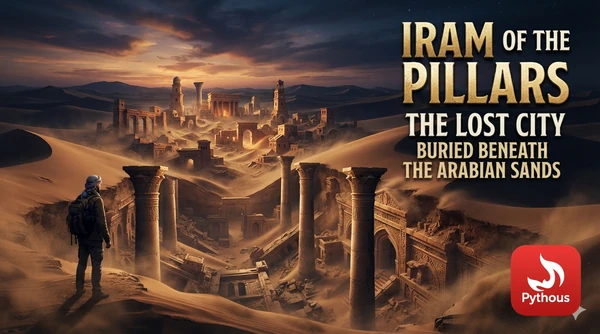
There is a stretch of desert in southern Arabia where the dunes run for six hundred kilometres without a village, a well, or a road. The Bedouin call it the Rub' al-Khali — the Empty Quarter. It is the largest continuous body of sand on earth, and for most of recorded history it has been treated as a blank space on the map.
But the blank space has a rumour attached to it. The rumour says that somewhere beneath those dunes lies a city that was swallowed whole: towers, gardens, pillars, and all. The Qur'an names it. Classical geographers argued about it. Explorers went looking for it and did not come back. And in 1992, a team using satellite imagery announced they had found it — a claim that has been fought over ever since.
This is the story of Iram of the Pillars, and of what is actually buried at a place called Shisr.
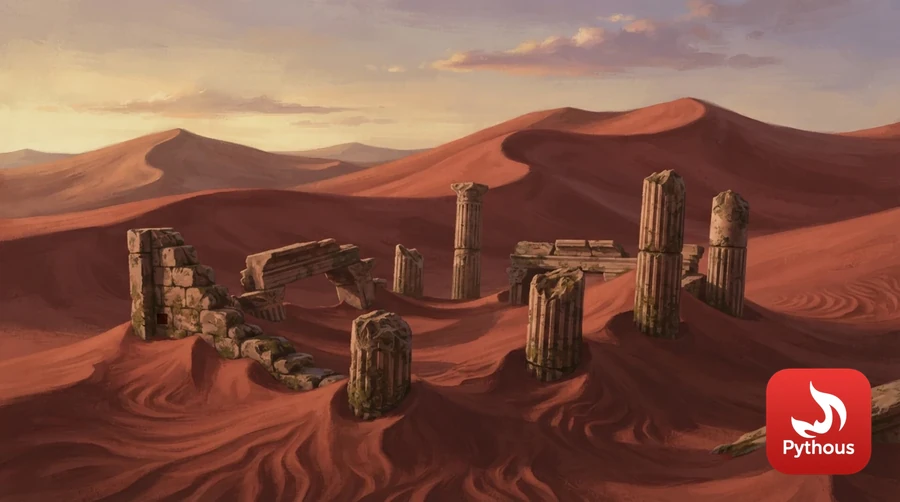
Illustration: the legend of a city of pillars lost under the sands.
What the Qur'an says
The account is brief and severe. In Sūrat al-Fajr (89:6–8), the reader is asked to consider what became of ʿĀd — of Iram dhāt al-ʿimād, "Iram of the pillars" — the like of which, it says, had never been created in the lands. A few verses later the passage moves on: the peoples who transgressed were struck with a scourge of punishment.
Elsewhere the picture fills in. The people of ʿĀd are placed in al-Aḥqāf, the sand dunes (46:21), and warned by the prophet Hūd. They are described as physically imposing, as builders of monuments on high ground, and as confident that no force could overcome them. Their end comes as wind: a cold, roaring gale that blows for seven nights and eight days, after which nothing is left standing (69:6–7).
Two details matter for anyone hunting the city. First, the location — al-Aḥqāf points to the sand country of southern Arabia, the region straddling modern Oman, Yemen, and the Saudi frontier. Second, the manner of destruction. It is not an earthquake or a flood. It is sand and wind, which is exactly the mechanism that erases a settlement without demolishing it — burial rather than collapse.
What the classical historians made of it
Medieval Muslim scholars were not unanimous, and it is worth being honest about that, because the disagreement is more interesting than the legend.
Yāqūt al-Ḥamawī, in his geographical dictionary Muʿjam al-Buldān, collects the competing readings of "Iram": some authorities take it as the name of a city, others as the name of a tribe or an ancestor, others as a description of tent-poles rather than architectural columns. Al-Ṭabarī and Ibn Kathīr both preserve the ʿĀd narrative in their histories, drawing on earlier storytelling traditions.
Attached to it is the tale of ʿAbdullāh ibn Qilāba, a man of the early Islamic period who is said to have wandered after a lost camel and stumbled onto a city of gold and silver and pearl-studded pillars, empty of people — then failed ever to find it again. The story travelled well; a version of it reached the Thousand and One Nights.
Ibn Khaldūn had no patience for it. In the Muqaddimah he treats the golden-city account as the sort of tale that survives because it is repeated, not because it is verified, pointing out that a metropolis of that scale could not vanish from geography and memory so cleanly. He is doing source criticism, in the fourteenth century, on precisely the grounds a modern historian would use.
So by the time European explorers arrived, the tradition already contained both the legend and its rebuttal.
"The Atlantis of the Sands"
The phrase belongs to T. E. Lawrence, who never went looking for the place but repeated what he had heard: a lost city out in the sands, driven into the ground for its wickedness.
Others did go. Bertram Thomas made the first recorded crossing of the Empty Quarter by a European in 1930–31 and reported that his guides had shown him well-worn caravan tracks running north into the dunes, telling him they led to a place called Ubar. Wilfred Thesiger crossed the same desert in the 1940s and came back with the greatest travel book written about it — and no city.
Two names, then, circling the same rumour. Iram, from scripture. Ubar, from the mouths of the tribes who actually lived on the desert's edge. Whether they refer to the same thing is still unresolved.
The satellites
In the 1980s an American documentary filmmaker, Nicholas Clapp, became convinced the caravan tracks could be recovered from the air. Sand is transparent to radar at certain wavelengths; buried features leave signatures that the human eye on the ground cannot detect.
Clapp assembled an unusual team: the explorer Ranulph Fiennes, the lawyer George Hedges, and the archaeologist Juris Zarins, a specialist in Arabian prehistory. Working with imagery from Landsat, the French SPOT satellite, and shuttle-borne imaging radar, they traced faint linear traces converging on a single point in the Dhofar region of Oman — a spot called Shisr, where there was a modest ruin and a water hole that had been in use for as long as anyone could remember.
They dug. Under a later settlement they found a fortified structure: a walled enclosure with towers at the corners, built over a limestone cavern. The site had been a caravan station on the frankincense route, in use across a very long span — pottery and other finds indicated activity reaching back into the Bronze Age and continuing into Islamic times.
And then the detail that made headlines around the world. The limestone cavern beneath the fort had collapsed. Part of the structure had fallen into the sinkhole and been buried.
A city that fell into the earth. In February 1992 the discovery was announced to the international press as the finding of Ubar, the lost city of the Arabian sands.
Why it isn't settled
The excitement outran the evidence, and the archaeologists said so almost immediately — Zarins among them.
Shisr is not a metropolis. The excavated fort is a substantial and important caravanserai, but it is measured in tens of metres, not in the scale the legend demands. There are no colonnaded avenues, no towering pillars, no city walls enclosing a population.
Zarins' own considered position has been that "Ubar" was most plausibly a region or a people rather than a single settlement — a name for the frankincense-trading network of the interior, of which Shisr was one node. He has pointed to Ptolemy's second-century Geography, which lists a people in southern Arabia whose name has been read as Iobaritae, as a possible classical echo of that same regional term.
The collapse, too, is less dramatic than it sounded. Sinkhole formation in limestone is ordinary geology, accelerated where groundwater is drawn down. It explains an abandoned fort. It does not require a divine wind.
And the link back to scripture remains an inference rather than a finding. Nothing excavated at Shisr carries the name Iram or ʿĀd. Meanwhile, the name Iram appears independently in Nabataean and early Arabic inscriptions in Wadi Rum in southern Jordan — over a thousand kilometres north — which is a genuine attestation of the name, but attaches it to a different landscape entirely. A once-popular claim that "Iram" appears in the third-millennium tablets from Ebla in Syria has been quietly abandoned by Assyriologists; the reading did not hold up.
What is actually true
Strip away the gold and the pearls and a solid historical core remains, and it is more interesting than the legend.
Southern Arabia in antiquity was not empty. It was the source of frankincense, one of the most valuable commodities in the ancient world, moving north by camel caravan to Egypt, the Levant, and Rome. That trade supported real cities and real wealth, and it required desert stations with water — places exactly like Shisr. When the trade collapsed, as Roman demand fell away and sea routes displaced the overland tracks, the stations were abandoned, and the sand took them at its own pace.
A culture that vanished into the dunes after its prosperity ended is not a myth. It is documented economic history. The question is only whether one particular vanished place is the one scripture names — and on that, the evidence is silent.
Which is, in the end, the honest position. Shisr is a real site with a real excavation record. Iram is a real name in a real text. The line drawn between them in 1992 was drawn by a press release, not by a stratum.
The Empty Quarter is 650,000 square kilometres. Fewer than one percent of it has ever been surveyed archaeologically. Whatever else is under there has not been asked yet.
Sources and further reading
- Qur'an 89:6–8 (Sūrat al-Fajr); 46:21–25 (Sūrat al-Aḥqāf); 69:6–7 (Sūrat al-Ḥāqqa); 7:65–72 (Sūrat al-Aʿrāf).
- Yāqūt al-Ḥamawī, Muʿjam al-Buldān — entries on Iram and ʿĀd, preserving the competing classical readings.
- Ibn Khaldūn, Muqaddimah, Chapter I — critique of the transmitted tale of the golden city.
- Ibn Kathīr, Al-Bidāya wa'l-Nihāya — the narrative of Hūd and ʿĀd.
- Ptolemy, Geography, Book VI — southern Arabian peoples, including the reading Iobaritae.
- Bertram Thomas, Arabia Felix (1932) — the first recorded European crossing of the Empty Quarter and the report of tracks leading to "Ubar".
- Wilfred Thesiger, Arabian Sands (1959).
- Nicholas Clapp, The Road to Ubar: Finding the Atlantis of the Sands (1998) — the expedition's own account.
- Juris Zarins, published work on Shisr and the frankincense trade of Dhofar — the archaeological counterweight to the popular narrative.



Comments (0)
Leave a Reply
Log in to post a comment.