

 Aug 26, 2026
 4 min read
How the Nabataeans Built a City Where There Was No Water
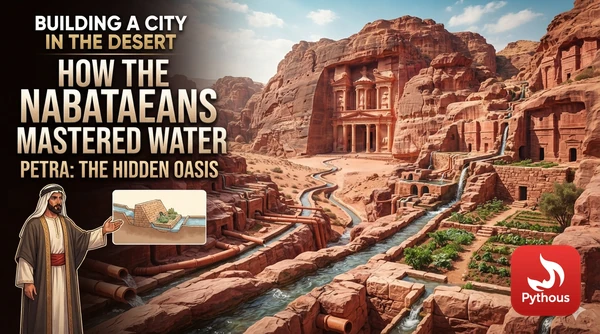
Petra is usually sold as a facade. The photograph everyone knows is the Treasury seen through the narrow slot of the Siq — rose sandstone, Hellenistic columns, a monument carved directly into a cliff.
It is a good photograph. It is also the least interesting thing about the place.
The real achievement at Petra is invisible in that image, because it is buried in the rock: a water system so precisely engineered that it turned a canyon receiving barely 150 millimetres of rain a year into a city of perhaps twenty to thirty thousand people. Without it, there is no Petra. There is just a gorge.
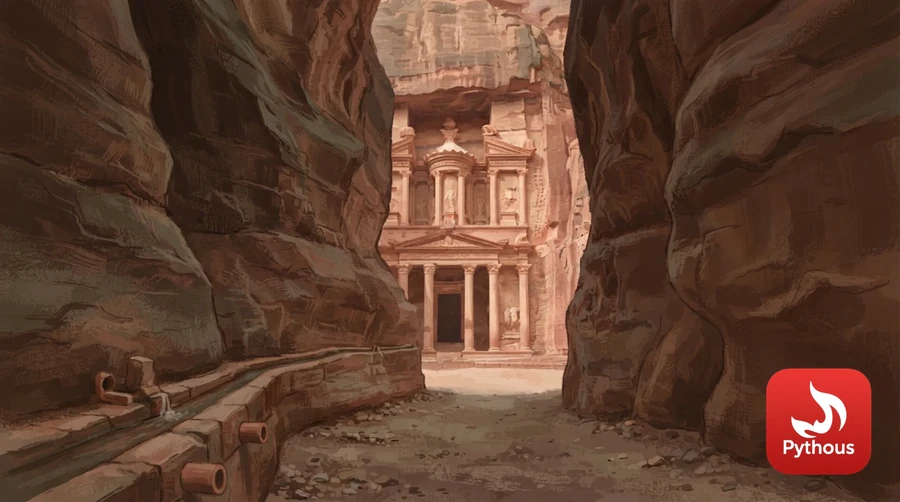
Illustration: Petra's Treasury, with a carved channel that carried water through the canyon.
Nomads Who Refused to Settle
The Nabataeans enter the historical record in 312 BCE, and they enter it winning.
Antigonus I, one of Alexander's successors carving up the empire, sent an expedition against them. The Greek historian Diodorus Siculus — drawing on Hieronymus of Cardia, who was actually there — describes what the Greeks found: a people with no fields, no houses, no vineyards, no grain. Diodorus reports it as law rather than circumstance. Anyone who built a house was punished.
The logic was defensive. A people with nothing to burn and nowhere to besiege cannot be conquered by an army that depends on burning and besieging. The Greeks marched into the desert, could not resupply, and were cut apart.
Diodorus also records the detail that matters most. The Nabataeans, he writes, cut hidden cisterns into the rock, sealed them, and disguised the openings so that only they knew where the water was. They could disappear into terrain that would kill anyone following them.
That was not a survival trick. It was the beginning of a technology.
From Hidden Cisterns to Urban Hydraulics
Over the next three centuries the Nabataeans grew rich on the incense trade — frankincense and myrrh moving north out of southern Arabia toward Gaza and the Mediterranean — and Petra became the hinge of that route. A caravan city needs water on a scale a hidden cistern cannot provide. So they scaled up.
Archaeologists have identified more than two hundred cisterns and reservoirs in and around the Petra basin. Spring water was brought in from Ain Musa, several kilometres away, through channels and ceramic pipelines cut along the canyon walls. Dams caught seasonal runoff. Terracing slowed water down long enough for it to soak in rather than sheet away.
The sophistication shows up in the pipes. Studies of Nabataean hydraulics — notably by the engineer Charles Ortloff — have shown that the pipeline segments were sized to keep water flowing at partial capacity rather than full. That sounds like an inefficiency. It isn't. A full pressurised pipe running down a steep gradient develops turbulence and hydraulic jumps that hammer the joints and destroy the line. Running it partly full keeps the flow smooth and the system intact.
Somebody worked that out by observation, in the first century BCE, and then built to it.
Engineering Against the Flood
The other half of the problem was the opposite of drought.
Petra sits at the mouth of a wadi. When rain does come to that landscape, it comes all at once, and the Siq — a slot canyon a few metres wide with vertical walls — is exactly the wrong place to be standing. Floodwater funnels into it and accelerates.
The Nabataean answer was to stop the water before it ever entered. They dammed the entrance to the Siq and cut a tunnel through solid rock to divert the flood into an adjacent wadi, Wadi Muthlim. The main approach to the city stayed dry.
The system's effectiveness is best demonstrated by what happened when it stopped working. In 1963, a flash flood swept through the Siq and killed more than twenty visitors. The Jordanian authorities responded by rebuilding the Nabataean dam. The ancient design was reinstated because it was the correct one.
What Came After
Rome annexed the kingdom in 106 CE, folding it into the new province of Arabia. Petra did not collapse — it kept going for centuries — but the reason for it slowly evaporated. Trade shifted to Red Sea shipping and to northern routes through Palmyra. A severe earthquake in 363 CE wrecked much of the city. The water system, which needed constant maintenance, degraded along with the population that maintained it.
One inheritance outlasted all of it. The Nabataeans wrote in an Aramaic-derived script that, over the following centuries, evolved into the Arabic alphabet. Everything else they built was local. That one thing spread across half the world.
Which is a fitting legacy for a people whose real genius was never the carved facades tourists come for — it was knowing exactly where the water was.



Comments (0)
Leave a Reply
Log in to post a comment.