

 Sep 16, 2026
 4 min read
What Causes the Northern Lights? The Science Behind Auroras
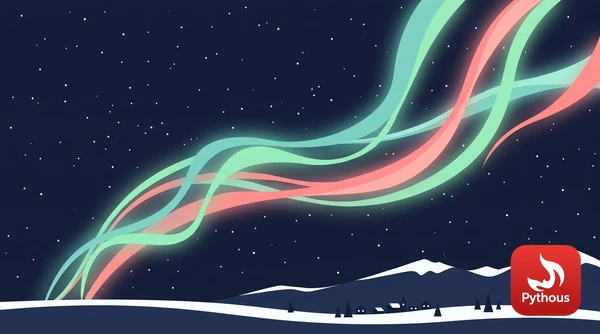
Ghostly curtains of green and red light rippling silently across a polar sky have inspired mythology on every continent that can see them — spirits, omens, bridges to other worlds. The real explanation swaps none of the wonder for mechanism: it's still, genuinely, the sun touching the Earth's atmosphere directly.
It starts 93 million miles away
The sun constantly emits the solar wind — a continuous stream of charged particles, mostly electrons and protons, flung outward by the sun's extreme heat and magnetic activity. When that stream reaches Earth, it collides with our planet's magnetic field, the magnetosphere, which acts as a shield deflecting the vast majority of those particles around the planet entirely. Without it, that charged particle stream would strip away the atmosphere over geological time, the way it did to Mars.
Why the light shows up at the poles
The magnetosphere isn't a uniform bubble — its field lines converge at the north and south magnetic poles, funneling some of the charged particles down into the upper atmosphere specifically in oval-shaped regions around each pole, called the auroral ovals. That's why auroras are a polar phenomenon under normal conditions: it's not that the light only happens near the poles, it's that the particles causing it are only being funneled down to Earth's surface region in those specific zones.
The actual light-producing collision
As those charged particles funnel down, they collide with oxygen and nitrogen atoms and molecules in the upper atmosphere, roughly 100 to 300 kilometers up. Each collision transfers energy into the atmospheric atom, briefly kicking one of its electrons into a higher energy state. That's an unstable, temporary condition — the electron quickly drops back down to its normal energy level, and when it does, it releases the extra energy as a photon of light. Multiply that by an enormous number of simultaneous collisions across the upper atmosphere, and you get a visible glow.
Why auroras come in different colors
The color depends on which gas is being hit and at what altitude:
- Green — the most common aurora color, produced by oxygen atoms at around 100–300 km altitude.
- Red — oxygen again, but at higher altitudes (above roughly 300 km), where oxygen is sparser and takes longer to emit after excitation, producing a different, redder wavelength; typically fainter and seen during stronger events.
- Blue and purple — nitrogen molecules, usually at lower altitudes, often appearing along the lower fringes of a strong display.
Why some nights the aurora reaches much further south (or north)
The strength of the incoming particle stream isn't constant. Coronal mass ejections (CMEs) — huge eruptions of plasma and magnetic field from the sun's surface — send a much denser, faster burst of particles toward Earth than the ordinary solar wind. When a strong CME hits Earth's magnetosphere, it triggers a geomagnetic storm, temporarily overwhelming and distorting the magnetosphere enough to push the auroral oval much further from the poles than usual. During major geomagnetic storms, aurora has been photographed as far south as the Gulf Coast of the United States and southern Europe — regions that essentially never see it under normal conditions.
This is also why aurora activity roughly tracks the sun's 11-year solar cycle: during solar maximum, the sun produces CMEs and strong solar flares far more frequently, meaning stronger and more frequent geomagnetic storms, meaning more frequent and more widespread auroral displays.
Not just a northern phenomenon
Everything described above happens symmetrically at the south magnetic pole too, producing the aurora australis (southern lights) — mechanically identical to the aurora borealis, just far less witnessed simply because the southern auroral oval sits mostly over Antarctica and the surrounding ocean, with far fewer people around to see it.
Frequently Asked Questions
Can you predict when an aurora will be visible? To a useful degree — space weather agencies track solar flares and CMEs and issue geomagnetic storm forecasts, typically with anywhere from under an hour to a few days of warning depending on the event, since CME travel time to Earth is usually one to three days.
Do auroras make sound? Extremely faint crackling or hissing sounds have been reported by observers and some have been scientifically recorded, thought to be linked to electrical discharges much closer to the ground than the auroral light itself, though this remains an active and only partially resolved area of atmospheric research.
Do other planets have auroras? Yes — any planet with both a magnetic field and an atmosphere can have them. Jupiter and Saturn both have auroras far more powerful than Earth's, driven by their much stronger magnetic fields, observed in ultraviolet by space telescopes.


Comments (0)
Leave a Reply
Log in to post a comment.