

 Sep 16, 2026
 5 min read
The Voynich Manuscript: The 600-Year-Old Book No One Can Read
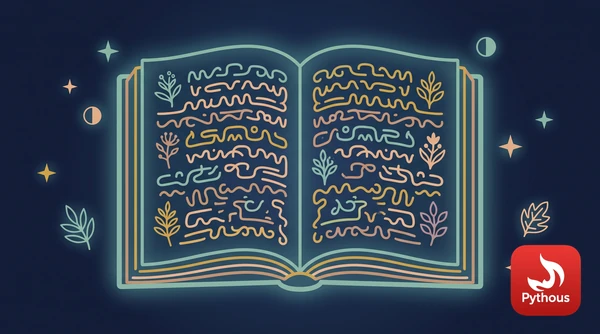
It's roughly 240 pages of vellum, covered in flowing, confident handwriting in a script nobody has ever identified, illustrated with drawings of plants that don't match any known species, star charts that don't match any known sky, and small nude women bathing in networks of green pools connected by tubes. It has survived for over 600 years. In all that time, not one word of it has been reliably translated.
The basics of what we actually know
The manuscript takes its name from Wilfrid Voynich, a Polish-American antiquarian book dealer who acquired it in 1912. Radiocarbon dating conducted in 2009 on the vellum itself dated it confidently to between 1404 and 1438, placing its origin firmly in the early 15th century — genuinely medieval, not a later forgery using old material, which had been a standing theory before the dating settled the question of age. It's currently held at Yale University's Beinecke Rare Book & Manuscript Library, and the entire manuscript has been digitized and made freely available online.
What's actually written in it
The text is written in an unknown script — now generally called "Voynichese" — using a consistent set of roughly 20–25 distinct characters, written left to right in a fluent, unhesitating hand, with no corrections or crossing-out, suggesting the writer either knew exactly what they were writing or was copying an existing text rather than composing on the fly.
Crucially, the text isn't random gibberish by any statistical measure. It follows patterns real languages tend to follow — word lengths cluster in a narrow range, certain characters strongly prefer certain positions within words, and the overall word-frequency distribution roughly follows Zipf's law, the same statistical pattern found in every natural human language ever analyzed. Whatever it is, it was built (deliberately or as an emergent property of a real language) to look and behave structurally like language.
The manuscript is informally divided by scholars into sections based on illustration themes, since the text itself gives no such labels: a "botanical" section with plant drawings, an "astronomical" section with star charts and zodiac-like diagrams, a "biological" section with the recurring bathing figures and pool/tube networks, a "pharmaceutical" section pairing plant parts with small labeled containers, and a final densely-written, unillustrated section informally called "recipes" or "stars," given the small star-like markers running down its margins.
A century of failed decipherment, by people who don't usually fail
The Voynich manuscript hasn't just resisted amateur enthusiasts — it has defeated professional cryptanalysts, including some of the same people who broke actual wartime ciphers. William Friedman, one of the most accomplished American cryptologists of the 20th century (central to breaking Japanese diplomatic codes before World War II), spent years studying the manuscript across his career and never cracked it. British and American codebreakers examined it during and after World War II with similarly no success. Modern computational linguistics and machine learning analysis have found intriguing statistical patterns but nothing that has produced a scholarly accepted translation.
The leading theories
- An unknown natural language, written in an invented script. Some researchers argue Voynichese encodes a real historical language — possibly a poorly documented regional or extinct one — using a wholly invented alphabet, which would explain the natural-language statistical properties without requiring a solved cipher.
- A sophisticated cipher of a known language. Under this view, it's an encrypted text — Latin or another European language run through an elaborate substitution or transposition system — though centuries of cryptographic effort against exactly this possibility have not produced a working key.
- A constructed language. An artificial language built from scratch, predating other known constructed languages by centuries, created for reasons (esoteric, religious, or otherwise) lost to history.
- An elaborate hoax. In 2003, researcher Gordon Rugg demonstrated that a simple mechanical technique using a grille and tables of syllable fragments — plausible tools available in the medieval period — could rapidly generate meaningless text that reproduces several of Voynichese's key statistical properties, including Zipf's-law-like word distribution. This doesn't prove the manuscript is a hoax, but it does prove that the statistical "language-like" properties often cited as evidence of real meaning aren't, by themselves, sufficient proof that the text carries any decodable content at all.
Why it keeps resisting modern tools too
Every few years, a new claimed "solution" reaches mainstream media — a research paper or an independent researcher announcing they've cracked it. Without exception so far, each has failed to hold up once other specialists examine the method, typically because the proposed "translation" doesn't consistently apply the same decoding rule across the full manuscript, or produces results vague enough to be argued into meaning almost anything. The manuscript's genuine, still-unresolved status is precisely that: genuinely unresolved, not secretly solved and merely uncredited.
Frequently Asked Questions
Could it just be nonsense with no real content at all? It's a live, seriously considered possibility among researchers — Rugg's hoax-method findings specifically support it — though it hasn't been proven either, and the sheer effort apparent in the manuscript's production makes some scholars skeptical that it was created purely as a meaningless hoax.
Has AI been used to try to translate it? Yes, extensively — modern natural language processing and machine translation techniques have been applied to Voynichese, identifying interesting statistical structure but so far producing no output accepted by manuscript scholars as an actual, consistent translation.
Can anyone view the original? Yale's Beinecke Library has published complete high-resolution scans of every page online, freely accessible to anyone who wants to examine it directly.
Comments (0)
Leave a Reply
Log in to post a comment.