

 Aug 06, 2026
 6 min read
Before He Was "Hitler": Ambition, War, and the Making of a Dictator
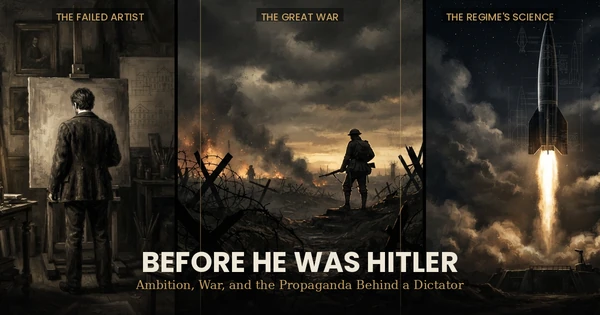
In the autumn of 1907, an 18-year-old from Linz sat the entrance examination for the painting school of the Academy of Fine Arts in Vienna and failed. He tried again the following year and was not even admitted to the test. For the next five years Adolf Hitler drifted through the city, living for a time in a hostel for homeless men and making a modest living by copying postcards of Viennese landmarks in watercolour, which a fellow lodger sold for him. Nothing about him at 24 suggested a future head of state.
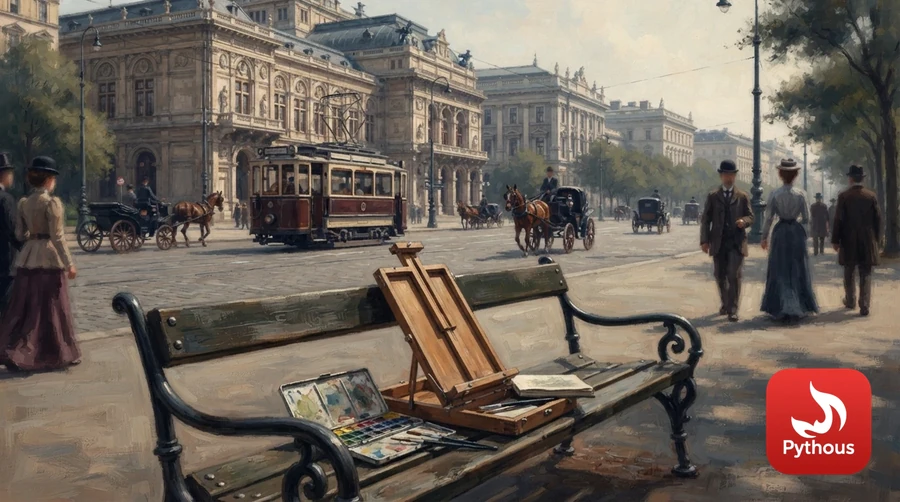
Illustration: Vienna around 1910, where the young Hitler failed to get into art school.
Linz and Vienna
Hitler was born on 20 April 1889 in Braunau am Inn, an Austrian town on the border with Bavaria. His father, Alois, was a customs official, harsh and often absent; his mother, Klara, was devoted to him. The family settled near Linz, where at school he was drawn to the German nationalism popular among Austrian Germans, and left without a qualification. His mother died of breast cancer in December 1907. Her doctor, Eduard Bloch, was Jewish, and Hitler sent him grateful cards for years afterwards.
In Mein Kampf, written in the 1920s, Hitler claimed that Vienna made him an antisemite. Historians treat that account with caution. Vienna's mayor, Karl Lueger, ran the city on openly antisemitic politics, and Hitler absorbed the pan-German and racist press of the time. But the historian Brigitte Hamann, who reconstructed his Vienna years in detail, found that he had Jewish acquaintances and dealers who sold his paintings, and the US Holocaust Memorial Museum notes that his comprehensive antisemitic worldview seems to have taken shape only after he left the city. In May 1913 he moved to Munich, partly to avoid military service in the Austro-Hungarian army.
The war
When war broke out in August 1914, Hitler volunteered for a Bavarian regiment and spent most of the next four years as a dispatch runner, carrying messages between regimental headquarters and the front behind it. It was dangerous work. He was wounded in the leg at the Somme in October 1916 and temporarily blinded by a British gas attack in October 1918. He received the Iron Cross First Class that August, on the recommendation of his regiment's adjutant, Hugo Gutmann, a Jewish officer. He was never promoted beyond lance corporal.
He learned of Germany's surrender in a military hospital in Pasewalk. Like many on the nationalist right, he accepted the "stab in the back" story: that the army had not been beaten in the field but betrayed at home by socialists, revolutionaries and Jews. It was false. The German army's own commanders had told the government in September 1918 that the war was lost; the Allied blockade had caused severe hunger; and by the summer of 1918 more than a million American soldiers had reached France. But the myth gave a humiliated country someone to blame, and Hitler made it central to everything he said afterwards.
Munich and the party
Still in the army after the war, Hitler was trained by its political department in Munich to lecture soldiers against socialism, and in September 1919 he was sent to observe a small group called the German Workers' Party. He joined it. He turned out to be a gifted speaker, and within two years he was the party's leader. It had been renamed the National Socialist German Workers' Party, the NSDAP or Nazi party, in 1920.
On 8 and 9 November 1923, Hitler tried to seize power in Bavaria in what became known as the Beer Hall Putsch. Police fire broke up the march through Munich, killing four policemen and sixteen of his followers. At his trial for treason the following spring, he used the courtroom as a platform, and the sympathetic judges sentenced him to the minimum of five years, of which he served about nine months in comfortable conditions at Landsberg prison. There he began dictating Mein Kampf, setting out his demands for "living space" in the east, a racial hierarchy, and the removal of Jews from German life.
The Great Depression made the Nazis a mass party. Unemployment in Germany passed six million in early 1932, and in the July 1932 elections the Nazis won 37 per cent of the vote, the most of any party. On 30 January 1933 President Paul von Hindenburg appointed Hitler chancellor, on the advice of conservative politicians who believed they could control him. Within two months the Reichstag fire and the Enabling Act had given him power to rule by decree, and by the end of 1933 Germany was a one-party state.

Printed propaganda spread old prejudices to a mass audience. Photo: Antoni Shkraba / Pexels
Attempts to stop him
The historian Roger Moorhouse has counted more than forty plots against Hitler's life. Two came close. On 8 November 1939, a carpenter from Württemberg named Georg Elser, working entirely alone, exploded a time bomb he had spent weeks hiding in a pillar of the Bürgerbräukeller in Munich, where Hitler spoke every year on the anniversary of the putsch. Fog had grounded Hitler's flight home, so he cut his speech short to catch a train, and left 13 minutes before the bomb went off. It killed eight people. Elser was arrested trying to cross into Switzerland, held for five years, and shot at Dachau on 9 April 1945.
On 20 July 1944, Colonel Claus Schenk von Stauffenberg, part of a network of officers and civilians who wanted to end the war and the regime, left a briefcase bomb under the map table at Hitler's headquarters in East Prussia, the Wolf's Lair. Someone moved the briefcase behind a heavy table support, and Hitler survived with burns and burst eardrums. Stauffenberg and three others were shot in Berlin that night. In the months that followed, the Gestapo arrested more than 7,000 people, and about 200 of those executed were directly involved in the plot.
The regime and its end
Once in power, Hitler turned the hatred he had preached into law and then into murder: exclusion of Jews from public life under the Nuremberg Laws of 1935, the violence of Kristallnacht in 1938, and, during the war, the systematic killing of about six million Jews in the Holocaust, together with millions of others, including Roma, disabled people, Soviet prisoners of war and Poles.
The regime also spent heavily on weapons research, often built on forced labour. Wernher von Braun's team at Peenemünde developed the V-2, the first long-range ballistic missile. It was built in underground tunnels at Mittelbau-Dora, where around 20,000 prisoners died, more than the number of people killed by V-2s in attacks. The SS's Ahnenerbe institute sponsored pseudo-scientific expeditions meant to prove Nazi racial theories, and some of its staff were involved in murderous experiments on concentration camp prisoners.
In April 1945, with Soviet troops fighting their way into Berlin, Hitler married his partner, Eva Braun, in the bunker beneath the Reich Chancellery. The next day, 30 April, they killed themselves. The "thousand-year Reich" had lasted twelve years and left tens of millions dead.
Sources
- United States Holocaust Memorial Museum, Holocaust Encyclopedia, "Adolf Hitler: early years, 1889–1921". https://encyclopedia.ushmm.org/content/en/article/adolf-hitler-early-years-1889-1921
- United States Holocaust Memorial Museum, Holocaust Encyclopedia, "Adolf Hitler and the Nazi rise to power, 1918–1933". https://encyclopedia.ushmm.org/content/en/article/the-nazi-rise-to-power
- United States Holocaust Memorial Museum, Holocaust Encyclopedia, "Mein Kampf: Hitler's manifesto". https://encyclopedia.ushmm.org/content/en/article/mein-kampf
- German Resistance Memorial Center, "Georg Elser and the assassination attempt of November 8, 1939". https://www.gdw-berlin.de/en/recess/topics/7-georg-elser-and-the-assassination-attempt-of-november-8-1939
- "20 July plot", Wikipedia (arrests and executions after the attempt, with sources). https://en.wikipedia.org/wiki/20_July_plot
- Mittelbau-Dora Concentration Camp Memorial. https://www.dora.de/en/
- Ian Kershaw, Hitler: 1889–1936, Hubris (London, 1998) and Brigitte Hamann, Hitler's Vienna: A Dictator's Apprenticeship (Oxford, 1999).




Comments (0)
Leave a Reply
Comments are moderated. Please read our Comment Policy before posting.
Log in to post a comment.