

 Sep 16, 2026
 4 min read
Ball Lightning: The Real Phenomenon Science Still Can't Fully Explain
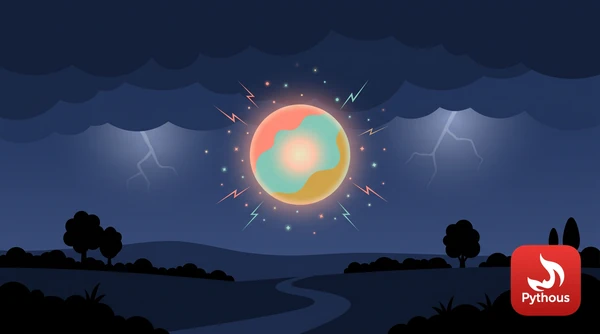
Reports describe it consistently across centuries and cultures: during a thunderstorm, a glowing sphere — usually the size of a grapefruit to a beach ball, often reddish or bluish-white — appears out of nowhere, drifts silently or erratically through the air (sometimes indoors, sometimes reportedly passing straight through closed windows), lasts a few seconds to as long as a minute, and then either fades quietly or vanishes with a small explosion. For most of scientific history, it was treated as folklore, dismissed alongside sea monsters and will-o'-the-wisps. It wasn't folklore. It's real, rare, and even now, only partially explained.
Why science took so long to take it seriously
Ball lightning's problem, from a research standpoint, is that it's rare, unpredictable, brief, and — until recently — never reliably captured with scientific instruments. Eyewitness accounts, no matter how numerous or consistent, aren't data a physicist can analyze. For decades, that left ball lightning in an awkward scientific limbo: too consistently and credibly reported by pilots, farmers, and physicists themselves to dismiss outright, but with no hard physical evidence to actually study.
The 2014 breakthrough nobody was trying to make
That changed by accident in July 2012, in a discovery published in 2014. A team of Chinese researchers — Jianyong Cen, Ping Yuan, and Simin Xue — were conducting a planned field study on ordinary lightning on the Qinghai grassland of the Tibetan Plateau, using high-speed cameras and spectrographs to record natural lightning strikes for unrelated research. During one recording, a ball lightning event happened to occur within their instruments' field of view — the first time a natural ball lightning event had ever been captured with both video and, crucially, a spectrograph capable of reading the exact chemical composition of the light it emitted.
The spectral data showed emission lines matching silicon, iron, and calcium — elements consistent with soil composition at the strike site — glowing for roughly 1.3 seconds over a horizontal distance of about 15 meters before fading. It was the first real physical evidence directly tying a ball lightning event to a specific, testable mechanism, rather than relying purely on eyewitness description.
The leading scientific explanation it supports
That silicon signature lines up closely with a theory proposed years earlier, in 2000, by physicists John Abrahamson and James Dinniss: when lightning strikes soil, it can vaporize silicon compounds in the ground. As that vaporized silicon cools rapidly in the air, it's theorized to condense into an aerosol of extremely fine nanoparticles, which remain suspended together as a coherent cloud and continue slowly oxidizing — a chemical reaction that releases both heat and light — for as long as fuel and oxygen are available, which would explain the light, the rough size, the persistence over several seconds, and the eventual fade or small pop as the reaction runs out of material.
It's a compelling and now spectroscopically supported explanation for at least some reported ball lightning — but researchers are cautious about calling it the complete answer, since the silicon-vaporization theory doesn't obviously explain some of the more extreme reported behaviors, like a ball reportedly moving against the wind or passing through a closed glass window without breaking it.
Competing and complementary theories
- Microwave cavity theory. Proposes that a powerful lightning discharge can generate a trapped pocket of high-energy microwave radiation, forming a self-contained plasma ball held together by the microwaves themselves — a mechanism some laboratory experiments have partially reproduced as short-lived glowing plasma spheres, though far more short-lived than many reported real-world sightings.
- Electrical discharge / plasma theories. Broader models proposing ball lightning is a standalone, self-sustaining plasma phenomenon, structurally distinct from a standard lightning bolt, though the physics of how such a plasma ball could remain stable for multiple seconds in open air remains genuinely difficult to model.
Why "what is ball lightning" may be the wrong question
A growing view among researchers is that "ball lightning" may not be one single phenomenon at all, but a folk label loosely covering several genuinely different atmospheric electrical events that happen to look broadly similar to an observer — which would explain why witness accounts, while individually consistent, vary so much in reported behavior between different sightings. Under that framing, the 2012 spectroscopic event may have captured one real mechanism (silicon nanoparticle combustion) without that being the full explanation for every historical report filed under the same name.
Frequently Asked Questions
Is ball lightning dangerous? Documented accounts include cases of burns, property damage, and a small number of reported fatalities, though most encounters described in the historical record involve the phenomenon simply drifting past without contact.
Has anyone created real ball lightning in a lab? Several experiments have produced short-lived glowing plasma spheres using techniques like arc discharges through water or silicon, lasting a fraction of a second to a couple of seconds — suggestive and consistent with parts of the leading theories, but none have yet fully reproduced the multi-second duration and stability reported in the strongest natural eyewitness accounts.
Why don't we have more video of it if it's real? Its rarity and total unpredictability are the core obstacles — there's no way to know when or where it will occur, so almost all footage that exists is incidental, captured by chance rather than by researchers deliberately trying to record it, exactly as happened in the 2012 case.



Comments (0)
Leave a Reply
Log in to post a comment.