

 Sep 16, 2026
 4 min read
Why Is the Sky Blue (and the Sunset Red)? The Real Physics of Rayleigh Scattering
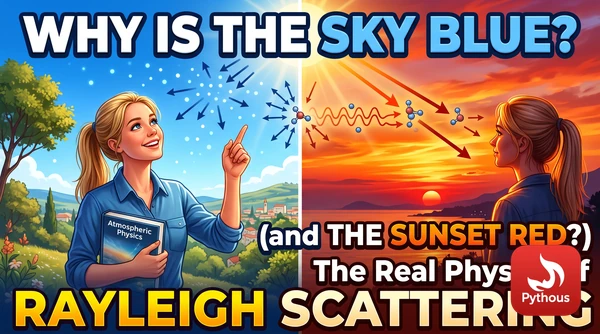
It's one of the first questions kids ask and one of the last ones adults can actually answer. "Why is the sky blue" sounds like it should have a one-sentence answer. It doesn't quite — but the real explanation is more interesting than "because it reflects the ocean," which is a myth that refuses to die.
Sunlight is already every color at once
What looks like plain white sunlight is actually the full visible spectrum mixed together — every wavelength from red through violet, all arriving from the sun simultaneously. A prism (or a raindrop, which is how rainbows happen) doesn't create those colors; it just separates colors that were already there, because different wavelengths bend by different amounts passing through glass or water.
Why air scatters blue light so much more than red
The atmosphere is mostly nitrogen and oxygen molecules — particles far smaller than the wavelength of visible light. When light hits particles that much smaller than its own wavelength, it scatters in a very specific, wavelength-dependent way known as Rayleigh scattering, named after the 19th-century physicist Lord Rayleigh, who worked out the math.
The key result: scattering intensity is proportional to the inverse fourth power of wavelength (1/λ⁴). Shorter wavelengths scatter dramatically more than longer ones. Blue light has a shorter wavelength than red light, so it gets scattered roughly 5–10 times more strongly by the same air molecules. Sunlight arrives from one direction (the sun), but by the time blue light has bounced repeatedly off air molecules across the sky, it's coming at your eyes from every direction at once — which is exactly what "the sky is blue" looks like: a diffuse blue glow spread across the entire dome above you, not a beam from one spot.
So why isn't the sky violet?
Violet light has an even shorter wavelength than blue, and by the 1/λ⁴ rule it should scatter even more intensely — and it does. The sky isn't violet for three compounding reasons: the sun emits somewhat less violet light than blue to begin with; the upper atmosphere absorbs a portion of what violet does arrive; and — the biggest factor — human eyes have three types of color receptor cones, and the ones sensitive to violet are also less sensitive overall, while our blue-sensitive cones respond strongly. The net result your visual system reconstructs from that mix reads as blue, not violet.
Sunsets: same physics, longer path
At midday, sunlight travels through a relatively thin, direct slice of atmosphere to reach you. At sunrise and sunset, the sun sits near the horizon, so its light has to travel through a much longer path of atmosphere at a shallow angle to reach your eyes. Over that much longer path, most of the blue and violet light gets scattered away long before it arrives — scattered off in other directions, away from your line of sight entirely. What's left, dominating the light that actually makes it straight to your eyes, is the longer wavelengths: red, orange, and yellow. That's the entire mechanism behind a red sunset — it's the blue being removed, not red being added.
Dust, smoke, and pollution particles in the air add extra scattering material and can make sunsets even more dramatically red or orange — which is why sunsets near wildfires or heavy pollution are often strikingly vivid.
Why clouds are white, not blue
Rayleigh scattering only works cleanly for particles much smaller than light's wavelength — which describes air molecules, but not water droplets in clouds, which are far larger. Larger particles scatter light through a different regime called Mie scattering, which scatters all visible wavelengths roughly equally rather than favoring blue. Equal scattering of every color, recombined, looks white — which is exactly why clouds (made of countless water droplets) appear white or grey rather than blue, even though they're sitting in the same blue sky.
Other worlds, different skies
The sky's color is really a story about what's doing the scattering. Mars has a thin atmosphere dominated by suspended dust particles rather than clean Rayleigh-scattering gas, which is large enough to fall into Mie-scattering territory and absorbs/scatters more toward the red-orange range — giving Mars's daytime sky a butterscotch, dusty tone instead of blue, with the curious exception that Martian sunsets can appear bluish, the near-inverse of Earth's, because the same fine dust that reddens the daytime sky scatters blue light preferentially near the sun at sunset.
Frequently Asked Questions
Does the sky reflect the ocean's color? No — this is a persistent myth. The ocean actually appears blue partly *because* it reflects the sky, and partly because water itself very weakly absorbs red light more than blue, but the sky's blue color has nothing to do with reflecting water; the causality runs the other way.
Why is the sky sometimes white or hazy instead of deep blue? Excess water vapor, pollution, or fine dust particles add larger-particle Mie scattering into the mix, which — like in clouds — scatters all wavelengths more evenly and washes out the pure blue toward white or grey.
Why does the sky look darker blue at high altitude or from an airplane? Less atmosphere above you means less total air to scatter light, so the effect weakens and the sky shifts toward the deep blue-black seen from high altitude and eventually the black of space.


Comments (0)
Leave a Reply
Log in to post a comment.