

 Aug 31, 2026
 7 min read
Zenobia of Palmyra: The Desert Queen Who Took on Rome
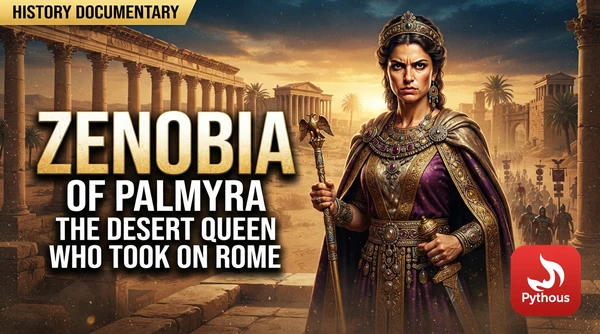
In the summer of 270 CE, a Palmyrene army marched into Alexandria and took Egypt — the granary of the Roman world — from an empire that had ruled it for three centuries. The army did not belong to Persia, Rome's great rival in the east. It belonged to a caravan city in the Syrian desert, and it acted in the name of a woman who was, on paper, still a loyal client of Rome.
Her name was Septimia Zenobia. In her own Palmyrene Aramaic she was Bat-Zabbai, "daughter of Zabbai." Within four years she would build the largest breakaway state the Roman East had ever seen, and within four more she would lose it entirely.
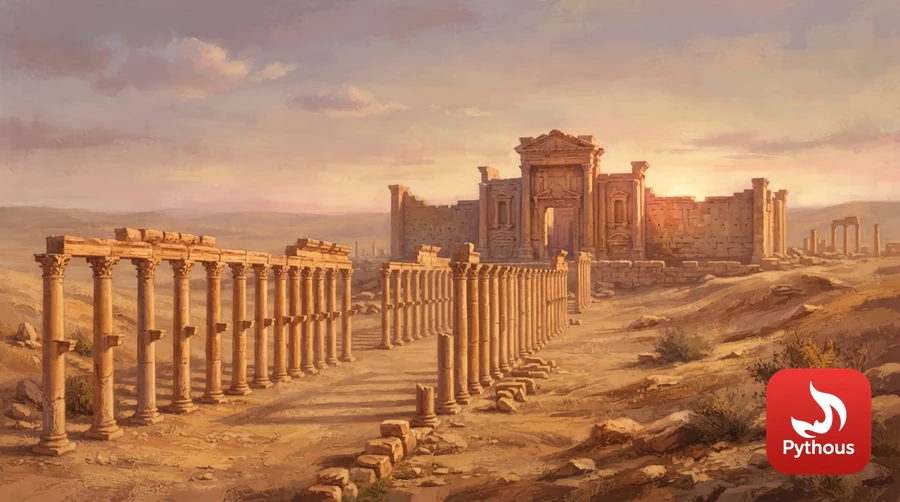
Illustration: Palmyra, Zenobia's desert city.
A city built on distance
To understand Zenobia, you have to understand the strange city that produced her.
Palmyra — Tadmor in Aramaic — sat in an oasis roughly halfway between the Mediterranean coast and the Euphrates. It had no farmland worth fighting over and no strategic pass to guard. What it had was water and position. Caravans moving silk, spices, pearls and Indian cotton from the Persian Gulf toward Antioch stopped there because there was nowhere else to stop. Palmyrene merchants ran their own trading colonies as far as Spasinou Charax at the head of the Gulf, and Palmyrene archers escorted the goods.
That commerce made Palmyra rich enough to build colonnaded streets and temples that would still stagger visitors seventeen centuries later. It also made the city something Rome had few of: a semi-autonomous ally with real military capability, a functioning aristocracy, and its own language and gods sitting comfortably alongside Greek civic forms and Roman citizenship.
Zenobia was born into that aristocracy around 240 CE. Almost nothing certain survives about her childhood. Later writers gave her a genealogy connecting her to the Ptolemies and to Cleopatra, which tells us more about how Romans wanted to frame her than about her actual ancestry.
Odaenathus and the collapse of Roman power
The 250s and 260s were the worst decades Rome had yet experienced. Emperors rose and fell in months. Plague moved through the provinces. And in 260, at Edessa, the Sasanian king Shapur I defeated a Roman army and captured the emperor Valerian alive — an act Shapur commemorated in rock reliefs at Naqsh-e Rustam that survive to this day.
Into that vacuum stepped Zenobia's husband, Septimius Odaenathus, the leading man of Palmyra. He raised Palmyrene forces, pushed the Persians back across the Euphrates, and twice campaigned as far as the walls of Ctesiphon. Rome, in no position to object, ratified what it could not prevent: Odaenathus was granted extraordinary authority over the eastern provinces, appearing in the sources with titles such as corrector totius Orientis. In Palmyrene inscriptions he went further and called himself King of Kings — a deliberate borrowing of Persian royal language.
Around 267 or 268, Odaenathus and his eldest son Herodianus were assassinated. The sources disagree bitterly about who was responsible: a family quarrel, a disgruntled relative, a Roman hand. The one thing they agree on is the outcome. Power passed to Odaenathus's young son by Zenobia — Vaballathus, or Wahballat in Aramaic — and Vaballathus was a child. His mother ruled.
The careful fiction
What Zenobia did next was not a revolt. It was something more interesting: a slow, deliberate test of how much Rome could still enforce.
For roughly three years she governed the east in her son's name while insisting, in every public medium available, that Palmyra remained loyal. Coins minted at Antioch and Alexandria carried the portrait of the Roman emperor Aurelian on one side and Vaballathus on the other, with Vaballathus holding his father's Roman titles rather than a royal one. Officially, Palmyra was administering the east on Rome's behalf.
Under cover of that fiction, Palmyrene armies expanded steadily. In 270 her general Zabdas invaded Egypt and defeated the Roman prefect Tenagino Probus, who died in the campaign. Other forces moved north and west through Syria and into Anatolia, reaching as far as Ankyra and, according to some accounts, the shore opposite Byzantium. At its height Zenobia's authority covered Egypt, Syria, Palestine, Arabia and much of Asia Minor.
Her court reflected the same blend of ambition and legitimacy-seeking. The Greek philosopher and critic Cassius Longinus is described as her advisor. She appears in connection with Paul of Samosata, the controversial bishop of Antioch, whose opponents accused him of relying on Palmyrene backing. Whether she was personally interested in Greek philosophy or Christian doctrine is unknowable; that she cultivated the people who mattered in her territories is clear enough.
In late 271 or early 272, the fiction ended. Vaballathus was proclaimed Augustus and Zenobia Augusta. Coins now omitted the Roman emperor altogether. It was a formal declaration that the east had its own imperial house.
Aurelian
Aurelian was not the kind of emperor the previous twenty years had produced. A career soldier from the Danube, he had already begun the grinding work of pulling the empire back together, and he moved east in 272 with a clear objective.
The campaign was decided in two battles. At Immae, near Antioch, Aurelian's cavalry drew the heavily armoured Palmyrene cataphracts into a long pursuit, then turned on them once they were exhausted — a tactic he repeated with similar success at Emesa. Antioch fell. Emesa fell. Zenobia withdrew to Palmyra itself and Aurelian besieged the city across the desert, a march his own troops found brutal.
When the city could not hold, Zenobia rode east toward the Euphrates, apparently seeking Persian help. Roman horsemen caught her at or near the river. Palmyra surrendered. Aurelian treated the city with initial restraint — until it rebelled again in 273, at which point he returned and destroyed it. Palmyra never recovered its position on the caravan routes.
What happened to her
Here the sources fracture, and it is worth being honest about how thin the ground is.
The Historia Augusta, a late and notoriously unreliable collection of imperial biographies, describes Zenobia walking in Aurelian's triumph at Rome in 274, weighed down by golden chains and jewels, and afterwards being given an estate at Tibur — modern Tivoli — where she lived out her life as a Roman matron, her daughters marrying into the aristocracy. The Greek historian Zosimus offers a different ending: that she died before reaching Rome, of illness or by refusing food. Later Byzantine writers add further variants.
Almost everything vivid about Zenobia — her beauty, her chastity, her hunting, her habit of drinking with her officers, her claimed descent from Cleopatra — comes from this same unreliable tradition. It is enjoyable material and very poor evidence. What is solid comes from elsewhere: coins, milestones, and Palmyrene and Greek inscriptions, which confirm the titles, the chronology, the extent of her territory and the moment of open break. The personality is largely a Roman literary construction; the state was real.
Why she still matters
Zenobia is often filed under "warrior queens," alongside Boudica and Cleopatra, which flattens her into a type. The more useful way to see her is as a symptom and a test.
Her rise measured exactly how far Roman authority in the east had decayed by the 260s — far enough that a client city could annex Egypt while still claiming to act on Rome's behalf. Her fall measured how quickly a competent emperor could reverse it. Aurelian recovered the entire eastern half of her territory in a single campaigning season and went on to reabsorb the breakaway Gallic Empire in the west the following year, earning the title restitutor orbis, restorer of the world.
Palmyra paid the higher price. The trade that had made the city possible shifted to routes it no longer controlled, and the desert metropolis faded into a garrison town. What Zenobia built lasted less than five years. What she revealed — that the empire's periphery could act on its own initiative, in its own name, when the centre faltered — outlasted her by centuries.
Primary sources: Historia Augusta (Tyranni Triginta; Divus Aurelianus), Zosimus, Historia Nova; Zonaras; Palmyrene and Greek epigraphy; the coinage of Vaballathus and Zenobia.



Comments (0)
Leave a Reply
Log in to post a comment.