

 Aug 26, 2026
 8 min read
The Constitution of Medina: The Document That Founded a Community
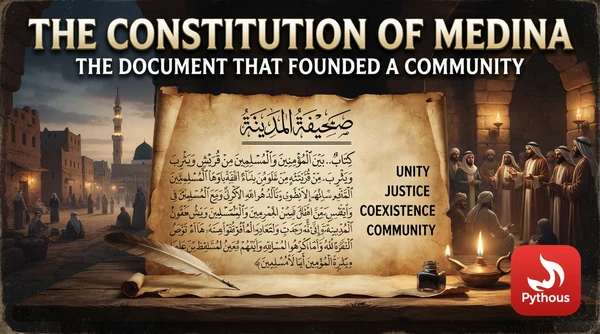
In 622 CE a group of migrants from Mecca arrived in an oasis town four hundred kilometres to the north. They had no land, no tribal protection where they were going, and no obvious claim on the settlement that received them. Within a short time of their arrival, a written agreement was drawn up between them, the local Arab clans, and the Jewish groups attached to those clans. That agreement survives. It is the oldest surviving document of Islamic political history, and historians have argued about it for more than a century.
It is usually called the Constitution of Medina, though the Arabic sources call it simply the sahifa — the sheet, the writing. That gap between the plain Arabic word and the grand English translation is worth keeping in mind, because much of the modern argument about the document turns on how much weight the word "constitution" can bear.
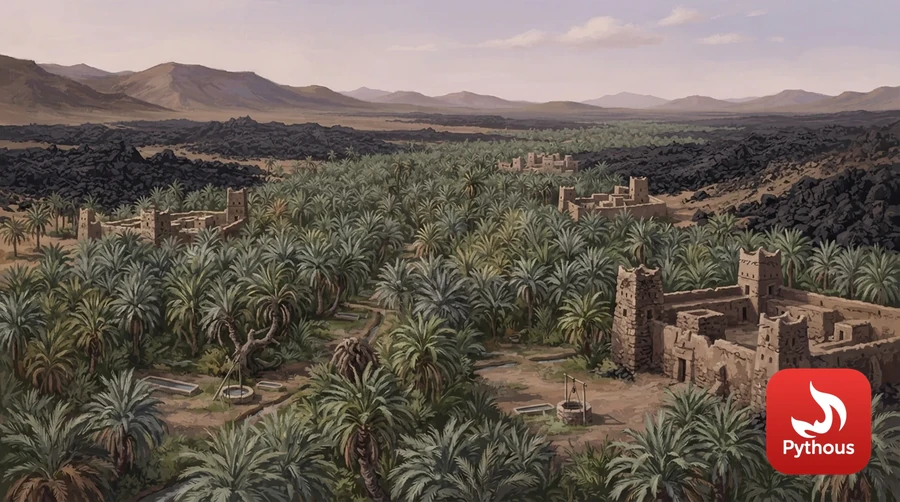
Illustration: the oasis of Yathrib (Medina) in the early 7th century.
The town before the document
Yathrib, as Medina was called before the migration, was not a city-state with a government. It was a cluster of fortified settlements and date palm groves held by competing kin groups. The two dominant Arab tribes, the Aws and the Khazraj, had been feuding for generations. Alongside them lived Jewish groups — some of them long established, some allied as clients to Arab clans — who owned land, practised crafts, and were entangled in the same web of alliances and blood debts as everyone else.
Roughly five years before the migration, the feud culminated in the Battle of Bu'ath, a bloodletting that left both tribes exhausted and neither dominant. The sources describe a town that had run out of ways to stop itself fighting. There was no arbitrator with standing over both sides, because in a society where every clan was its own final court, standing had to be borrowed from outside.
This is the context in which delegations from Yathrib met Muhammad at Aqaba during the pilgrimage seasons and invited him to relocate. He arrived not as a conqueror but as something closer to a neutral outsider with a claim to religious authority — a familiar role in Arabian dispute settlement, though the authority he claimed was of a different order.
Where the text comes from
The document is preserved most fully in the Sirat Rasul Allah of Ibn Ishaq (d. 767), which survives through the recension of Ibn Hisham (d. 833). A second, independent line of transmission appears in Kitab al-Amwal by Abu Ubayd al-Qasim ibn Sallam (d. 838), a work on taxation and public finance. Later compilers, including Ibn Kathir, reproduce it from these earlier sources.
Two features of that transmission matter. First, Ibn Ishaq gives the text without the chain of transmitters he usually supplies, presenting it as a document rather than as a report — which is how one would expect an archival copy to be handled. Second, the two independent versions differ in small details but agree on substance, which is what one expects of a real text copied twice, not of a later invention.
Scholars conventionally divide the text into clauses following the numbering introduced by Julius Wellhausen in the nineteenth century — usually given as forty-seven, though other divisions have been proposed. That numbering is a modern convenience and has no basis in the Arabic manuscript tradition.
What the document actually says
The text opens by defining the parties: the believers and Muslims of Quraysh and of Yathrib, together with those who follow them and fight alongside them. These, it says, form a single umma distinct from other people.
That word is doing a great deal of work, and it is worth resisting the urge to translate it too confidently. It has been rendered as "community," "nation," and "confederation." In the document itself, whatever it means, it is not simply a synonym for the Muslims — because the text goes on to include non-Muslims within it.
The bulk of the text is practical rather than declaratory. Its provisions fall into a few clear groups:
Blood money and ransom. Each clan is made responsible, as before, for paying the blood money owed by its own members and for ransoming its own captives. The document does not abolish the tribal system of collective liability; it preserves it and then binds the units together at a higher level. The migrants from Mecca, who had no clan structure in Yathrib, are treated as a clan for this purpose.
Mutual restraint. The believers are not to leave a member burdened by debt or blood money without assistance. They are to act together against anyone among them who commits a grave wrong, even if the offender is a close relative — a striking inversion of the usual obligation to back one's kin regardless of the merits.
Protection. The protection extended by God is described as one and indivisible; the humblest member of the community can extend a guarantee of safety that binds everyone else. In a society where protection was the currency of survival, this is a substantial redistribution of power.
The Jewish groups. The document names a series of Jewish groups attached to particular Arab clans — Banu 'Awf, Banu al-Najjar, Banu al-Harith, Banu Sa'ida, Banu Jusham, Banu al-Aws, Banu Tha'laba, and others. Of each it says, in a repeated formula, that they constitute an umma with the believers, that the Jews have their religion and the Muslims theirs, and that this extends to their clients and dependants. The obligations are reciprocal: shared expenses in war, mutual defence of Yathrib against outside attack, no separate peace, and no assistance to the enemies of the other party.
Territory and arbitration. The valley of Yathrib is declared inviolable for the parties to the agreement. Disputes that threaten to break the peace are to be referred to God and to Muhammad. The Quraysh of Mecca and those who assist them are explicitly excluded from protection.
The problems historians have raised
Almost every scholar who has examined the document accepts that it is early and substantially authentic. Wellhausen's argument for authenticity remains the most cited: the text is archaic, it uses terminology that fell out of use, and — most tellingly — it says things that a later forger with a settled theology would have had no reason to invent. A document produced in the ninth century to legitimise anything would not have preserved so much unreconstructed tribal machinery.
The disagreements are about composition and interpretation.
Is it one document? R. B. Serjeant argued that what Ibn Ishaq presents as a single text is in fact several separate agreements concluded at different moments and later copied together. The repetitions and the somewhat abrupt transitions in the Arabic support this reading. Michael Lecker's detailed study likewise treats the text as a composite requiring clause-by-clause dating.
When was it written? The traditional dating places it immediately after the migration. But some clauses appear to presuppose a state of open war with Mecca, which fits better with the period around or after the Battle of Badr in 624. If the text is composite, both datings can be partly right.
Which Jews? The three large Jewish tribes best known from the sira — the Qaynuqa, the Nadir, and the Qurayza — are not named in the document. The Jewish groups it does name are smaller and appear as clients of Arab clans. Explanations vary: that the large tribes had separate treaties, that they were parties under a general clause, or that they were never included at all. Nothing in the document settles it, and the question bears directly on how the later conflicts with those tribes are read.
Is "constitution" the right word? The document has no clauses on succession, no defined offices, no legislative procedure, and no mechanism for its own amendment. It looks less like a constitution than like a treaty — a hilf, in the Arabian idiom — between parties who remain internally autonomous. What is genuinely new is not the form but the scope: it binds together groups that had no prior basis for a common obligation, and it introduces an arbitrator whose authority is not derived from any of them.
Why it still matters
Since the twentieth century the document has been pressed into service in arguments about pluralism, citizenship, and the place of religious minorities in Muslim-majority states. Those readings are not baseless — the text really does bind adherents of different religions into a single defensive and legal order, and it really does say that each keeps its own religion. But they are easy to overstate. The document assumes a world of tribes, not of individuals; it distributes obligations between groups, not rights to persons; and its central provisions concern warfare, blood money, and the exclusion of a specific enemy.
The more durable significance is historical. In the Constitution of Medina we can watch, in the plain language of a working agreement, the moment at which a religious movement acquires a political form. Nothing in the text is theoretical. It solves particular problems: who pays for a killing, who fights when the oasis is attacked, who decides when two parties cannot agree. And in solving them it replaces the tribe with something larger as the final unit of loyalty — which turned out to be the most consequential thing about it.
Sources
- Ibn Ishaq, Sirat Rasul Allah, in the recension of Ibn Hisham; trans. A. Guillaume, The Life of Muhammad (Oxford, 1955).
- Abu Ubayd al-Qasim ibn Sallam, Kitab al-Amwal.
- Julius Wellhausen, Skizzen und Vorarbeiten, vol. IV (Berlin, 1889).
- W. Montgomery Watt, Muhammad at Medina (Oxford, 1956).
- R. B. Serjeant, "The Sunnah Jamiah, Pacts with the Yathrib Jews, and the Tahrim of Yathrib," BSOAS 41 (1978).
- Michael Lecker, The "Constitution of Medina": Muhammad's First Legal Document (Princeton, 2004).



Comments (0)
Leave a Reply
Log in to post a comment.