

 Sep 06, 2026
 10 min read
The Sultan Was Already Dead: The Siege of Szigetvár, 1566

In the first week of September 1566, the most powerful ruler on earth sat motionless inside a red silk tent in the marshes of southern Hungary. Officers arrived with reports on the siege. Servants brought food. Orders came back out, sealed and signed. The camp of perhaps a hundred thousand men went on functioning exactly as it had for a month.
Süleyman the Magnificent had been dead for two days.
His body had been embalmed, dressed, and kept upright in the lamplight by his Grand Vizier, who understood that an army standing deep in enemy country at the end of a long campaigning season would dissolve the moment it learned the sultan was gone. The deception is one of the most audacious in early modern history, and it succeeded — the news did not reach the wider army for weeks.
What is often lost behind that story is the reason Süleyman was there at all: a small, waterlogged fortress called Szigetvár, held by roughly two thousand three hundred men, which was supposed to fall in a week and instead held for thirty-three days.
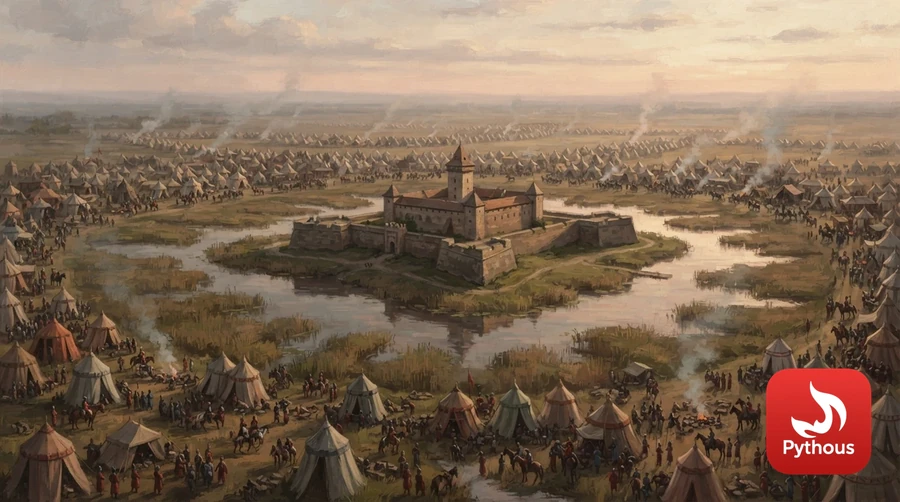
Illustration: the island fortress of Szigetvár under Ottoman siege, 1566.
An old man's last campaign
By the spring of 1566, Süleyman had reigned for forty-six years — longer than most of the soldiers in his army had been alive. He had taken Belgrade in 1521 and Rhodes in 1522. He had destroyed the medieval Kingdom of Hungary at Mohács in 1526 in a battle that lasted a couple of hours. He had also failed twice to take Vienna, in 1529 and again in the campaign of 1532.
He was now about seventy-one and in poor health. Gout had made walking difficult, and contemporary accounts suggest something more serious was also at work. He travelled north largely in a covered litter, and there are indications that his condition was deliberately concealed from the rank and file even before he died — a habit of secrecy that made the later cover-up easier to sustain.
The army he brought was very large. Contemporary chroniclers give figures of a hundred thousand men and three hundred guns. Modern historians generally treat such numbers as inflated, as they treat most sixteenth-century army figures, but even conservative estimates put the force well beyond anything a border fortress could resist. This was not a raid. It was a campaign intended to break the Habsburg position in Hungary, and possibly to try Vienna a third time.
The original target appears to have been Eger, further north. What redirected the campaign was a raid: Nikola Šubić Zrínyi, the Ban of Croatia and captain of Szigetvár, had ambushed and killed an Ottoman commander — by most accounts a sanjak-bey of Tirhala travelling with a substantial sum of money — near Siklós that summer. Whether this genuinely changed Süleyman's strategy or simply provided a convenient pretext, the immense army turned toward Szigetvár.
The island castle
The name Szigetvár means, roughly, "island castle," and that is what it was. Rather than a single ring of walls, it was a chain of three linked strongholds — an outer town, an old town, and an inner castle — built out into the marshes of the Almás stream and connected by causeways and bridges. Water was its main defence. Ottoman siege artillery was superb, but it had to be dragged into range first, and marshland is the worst possible ground for moving heavy guns.
Its defender, Nikola Šubić Zrínyi, was in his fifties and had spent his entire adult life on a frontier that moved regularly in the wrong direction. He had fought at the relief of Vienna in 1529 and had risen to be Ban of Croatia. He knew precisely what the arrival of a sultan's army meant.
Accounts of the siege — most importantly the eyewitness narrative of Ferenc Črnko, Zrínyi's chamberlain, who survived the fall and was later ransomed from captivity — describe him assembling the garrison and having them swear an oath. Notably, the oath as it comes down to us is not a promise to hold the castle. It is a promise not to surrender it, not to abandon it, and to meet the end together. Zrínyi then burned the outer bridge, removing his own line of retreat.
The garrison numbered somewhere between two thousand three hundred and three thousand, mostly Croatian and Hungarian troops, with civilians sheltering inside.
Thirty-three days
The siege opened on 6 August 1566, and it proceeded the way Ottoman sieges usually did: methodically, and by engineering rather than by frontal courage.
Ottoman sappers dammed and drained the marsh, laid causeways of earth and brushwood across the soft ground, and dragged the guns forward in stages until the walls were in range. Then came the mining — tunnels driven under the fortifications, packed with powder, and fired to bring down sections of wall for the assault parties.
The defence was conducted as a fighting retreat through the castle's own layered design. When the outer town became untenable, Zrínyi withdrew and burned it behind him. When the old town fell, he did the same. Each withdrawal cost the Ottomans time and casualties for ground that was worthless by the time they held it, and each one left the garrison with less space, fewer walls, and fewer men.
Sources differ on the number of general assaults — commonly given as seven or more — but agree that they were repulsed at heavy cost. At some point Süleyman is reported to have offered Zrínyi terms of remarkable generosity: rule over Croatia, and safety for his family, in exchange for the fortress. Zrínyi did not respond.
By early September, thirty-odd days into a siege the Ottoman command had expected to conclude in a fraction of that time, the defenders were confined to a burning inner castle and the Sultan was dying in his tent.
The death and the cover-up
Süleyman died on the night of 6–7 September 1566, roughly a kilometre from a fortress he had not taken.
The Grand Vizier, Sokollu Mehmed Pasha, made an immediate decision. The succession was not in doubt in principle — Selim was the surviving heir — but a sultan's death traditionally triggered a scramble, and an army in the field would fragment as commanders rode home to position themselves. So the Sultan would continue to live.
The body was embalmed and kept in the tent. Business went on around it. Orders continued to issue from it in the Vizier's hand under the imperial seal. Ottoman sources, including the historian Peçevi, describe the extraordinary lengths taken to preserve the fiction; later accounts add that the physicians who attended the death were killed, and that couriers carrying the news were intercepted. Some of these details may be embellishment, but the core of the story — that the death was concealed until Selim could reach the army — is well attested and was successful. Selim II was not publicly proclaimed until the army had withdrawn.
Two days after Süleyman died, the fortress he had come for finally fell.
The last charge
On the morning of 8 September, the inner castle was on fire, the walls were breached, and Zrínyi had perhaps six hundred men still able to fight.
What he did next is the reason Szigetvár is remembered rather than catalogued. According to Črnko's account and the tradition that grew from it, Zrínyi did not put on his armour. He dressed in a silk coat and a velvet cap with a jewelled feather. He put a hundred gold coins in his pocket — the explanation given is that whoever stripped his body should find something worth taking, and might therefore leave it some dignity. He hung the castle keys on his belt, had a large cannon loaded with scrap iron and aimed at the gate, and gave the order to open it.
The cannon fired into the men waiting outside. The garrison charged into the gap behind it. Zrínyi was hit almost immediately — the accounts describe two musket balls in the chest and one in the head — and the sortie was destroyed within minutes. Črnko was among a tiny number taken alive.
Ottoman troops poured through the open gate to loot the castle. The powder magazine had been left with a slow fuse burning. When it detonated, it took a large part of the courtyard and everyone in it. Chronicle figures of three thousand Ottoman dead in the explosion are almost certainly inflated; the effect on an army already exhausted by a month of siege was not.
What it cost, and what it bought
Szigetvár was taken. There was very little left of it to occupy.
Ottoman losses across the siege are usually estimated in the tens of thousands, including deaths from disease in the camp. Combined with the Sultan's death and the lateness of the season, this ended the campaign. The march on Vienna, if it had ever been seriously intended for that year, did not happen. The army withdrew to bury Süleyman and crown his son.
The mythology came later. Zrínyi's great-grandson, also named Nikola, wrote the epic Szigeti veszedelem ("The Peril of Sziget") in 1651, which fixed the last charge in Croatian and Hungarian national memory. Cardinal Richelieu is often quoted as calling Szigetvár "the battle that saved civilisation" — a line repeated constantly and sourced almost never, and one I would treat as tradition rather than evidence.
The most interesting modern footnote is archaeological. Süleyman's heart and internal organs were, by long tradition, buried where his tent had stood, and a türbe — a domed tomb — with a mosque and settlement grew around the site before being destroyed in the late seventeenth century and forgotten. In 2015–2016, a research team from the University of Pécs led by Norbert Pap identified remains at Zsibót-Szőlőhegy, in a vineyard just outside modern Szigetvár, that they argue is the lost complex. Excavation has continued since.
So the two men at the centre of the siege ended in roughly symmetrical obscurity. Zrínyi's head was cut off, sent to the Christian camp for identification, and buried. Süleyman's heart lay under a vineyard for four and a half centuries.
Why the story keeps its grip
Last stands are a genre, and the genre tends to flatten them. Szigetvár resists that, because the interesting part is not the courage — courage is common in these accounts — but the calculation.
Zrínyi burned his own bridge on day one. He traded ground for time in a sequence he had clearly worked out in advance. He rigged the magazine before he opened the gate, which means the final charge was not a gesture of despair but the first half of a two-part plan whose second half he did not live to see. Even the gold coins in his pocket were a decision about a body he expected to be looted.
And on the other side, a vizier looked at a corpse in a tent and decided that the empire's stability was worth a fortnight of theatre.
Neither man was performing for posterity. Both were solving a problem. That, more than the drama, is why the siege is worth reading closely.
Sources and further reading
Primary and near-contemporary
- Ferenc Črnko, eyewitness narrative of the siege (written after his release from Ottoman captivity) — the foundational account of the defence.
- İbrahim Peçevi, Tarih-i Peçevi — Ottoman history covering the campaign and the concealment of Süleyman's death.
- Selaniki Mustafa Efendi, Tarih-i Selaniki — contemporary Ottoman chronicle of the period.
Later literary treatment
- Miklós (Nikola) Zrínyi, Szigeti veszedelem (1651) — epic poem by the commander's great-grandson. Literature, not evidence, but central to the story's afterlife.
Modern scholarship
- Caroline Finkel, Osman's Dream: The History of the Ottoman Empire (2005) — on the reign, the final campaign, and the succession.
- Rhoads Murphey, Ottoman Warfare, 1500–1700 (1999) — on siege method, logistics, and the reliability of chronicle army figures.
- Géza Dávid and Pál Fodor (eds.), Ottomans, Hungarians and Habsburgs in Central Europe (2000) — on the frontier context.
- Norbert Pap et al., University of Pécs, published reports (2015 onward) on the identification of Süleyman's türbe site near Szigetvár.
A note on numbers: army sizes, assault counts, and casualty figures for this siege vary widely between sources and are frequently inflated in the chronicles. Where this article gives figures, they should be read as the range the sources support, not as settled fact.



Comments (0)
Leave a Reply
Log in to post a comment.