

 Aug 19, 2026
 9 min read
Kaunch Seeds (Kaunch Beej): The Ayurvedic "Man Power" Bean
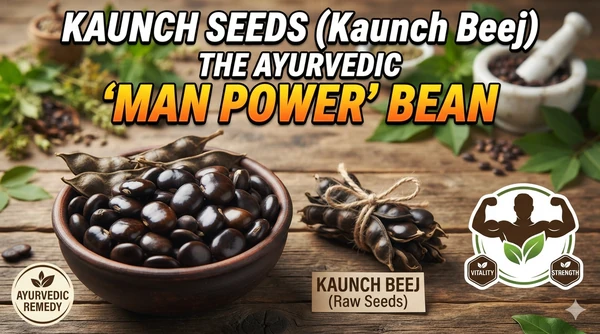
Walk into any pansaar shop or attari and ask for something to boost stamina, and there is a good chance the shopkeeper reaches for a jar of small, glossy, slate-grey beans. These are kaunch beej — the seeds of Mucuna pruriens, a climbing legume that has been in South Asian medicine cabinets for well over two thousand years.
The marketing around these seeds is loud, and a lot of it is nonsense. But underneath the hype there is something genuinely interesting: kaunch seeds contain one of the highest natural concentrations of L-DOPA, the direct chemical precursor to dopamine, of any plant on earth. That single fact explains almost everything about how the seed works, why it's studied seriously by neurologists, and why it deserves more respect — and more caution — than the average "herbal power booster."
What Exactly Are Kaunch Seeds?
| Botanical name | Mucuna pruriens |
| Family | Fabaceae (the bean and pea family) |
| Sanskrit / Ayurvedic | Kapikacchu, Atmagupta |
| Urdu / Hindi | Kaunch beej, Konch, Kiwanch |
| English | Velvet bean, cowitch, cowhage |
<cite index="4-1">Mucuna pruriens is a climbing annual legume, native to India and widespread across the tropics including Central and South America, and it is useful as a green manure and cover crop while also being grown for its pods and young leaves.</cite> The Sanskrit name Atmagupta translates roughly to "self-protected" — an excellent description, as you'll see in a moment.
The plant is a vigorous twining vine with three-part leaves and drooping clusters of dark purple flowers. <cite index="1-1">The pods are curved, longitudinally ribbed, contain four to six seeds, and are densely covered with brown or grey hairs that cause irritating blisters on contact. The seeds themselves are black, ovoid, and roughly 12 mm long.</cite>
Those hairs are the plant's defence system, and they are not a minor inconvenience — hence the English name cowitch. This matters enormously if you plan to grow it yourself.
The Active Ingredient: L-DOPA
Everything hinges on one molecule. <cite index="6-1">Mucuna seeds contain roughly 3–6% L-DOPA, and have been used in traditional Ayurvedic medicine to treat conditions resembling Parkinson's disease; pilot studies in Parkinson's patients show that mucuna seed powder produces effects similar to conventional levodopa/carbidopa medication.</cite>
L-DOPA crosses the blood–brain barrier and gets converted into dopamine — the neurotransmitter that governs motivation, reward, mood, movement, and (critically for the "man power" reputation) the regulation of prolactin and the hormonal cascade that controls testosterone.
Alongside L-DOPA, <cite index="1-1">the seeds also contain glutathione, lecithin, gallic acid, glycosides, and a dark viscous oil.</cite>
This is the key point most blogs skip: kaunch beej is not a gentle tonic herb like ashwagandha. It is closer to a low-dose pharmaceutical delivered in plant form. That's what makes it effective, and that's exactly why it needs to be treated with respect.
The Benefits — Separating Evidence From Marketing
1. Male fertility and semen quality — the strongest evidence
This is where kaunch beej has actual human clinical data behind it, not just tradition.
<cite index="12-1">A prospective study at C.S.M. Medical University in Lucknow examined 75 healthy fertile men and 75 men undergoing infertility screening, measuring testosterone, LH, FSH, prolactin, and dopamine in blood and seminal plasma before and after treatment.</cite> <cite index="10-1">Treatment with M. pruriens significantly improved testosterone, LH, dopamine, adrenaline and noradrenaline levels while reducing FSH and prolactin, and sperm count and motility were significantly recovered in the infertile men.</cite>
A separate study looked at seminal biochemistry: <cite index="13-1">treatment increased sperm concentration and motility across all the infertile groups, inhibited lipid peroxidation, and restored antioxidant vitamin and fructose levels in seminal plasma — though sperm motility was not fully restored to normal in asthenozoospermic men.</cite>
2. Stress-related decline in fertility
<cite index="9-1">In a study of 60 infertile men who were under psychological stress (confirmed by questionnaire and elevated serum cortisol), participants took 5 g per day of M. pruriens seed powder, with semen samples analysed before treatment and again after three months.</cite> The stressed men started with reduced sperm count and motility, elevated cortisol and lipid peroxides, and depleted glutathione and vitamin C — and the seed powder moved those markers in the right direction.
The honest caveat: almost all of this research was done on men who had a measurable problem — infertility, high cortisol, low baseline testosterone. There is very little good evidence that a healthy young man with normal hormones will get a dramatic boost. Kaunch beej looks like a corrective herb, not an amplifier.
3. Mood, motivation and neurological support
Because it raises dopamine availability, kaunch beej is used traditionally for low mood, apathy, and stress. It's also the reason it has been studied as an affordable alternative to levodopa medication in Parkinson's disease — though anyone with Parkinson's must only use it under a neurologist's supervision, never as a self-directed swap for their prescription.
4. Claims worth being sceptical about
- "Boosts human growth hormone and builds muscle" — this is repeated everywhere and rests on very thin evidence. Treat it as marketing.
- "Instant aphrodisiac" — the fertility research measures sperm and hormones over three months, not same-night performance.
- "Cures diabetes" — the seeds may modestly lower blood sugar, which is actually a warning for anyone on diabetes medication, not a selling point.
How to Use Kaunch Seeds
The processing step nobody should skip
Raw kaunch seeds contain anti-nutrients and are traditionally put through shodhana — purification. The classical method: soak the seeds in milk or water overnight, boil, then peel off the outer coat, dry the kernel, and grind. Commercially sold kaunch beej powder (churna) has already been through this. Do not grind up raw, unprocessed seeds and swallow them.
Typical forms and dosage
| FormTypical adult doseNotes | ||
| Seed powder (churna) | 1–5 g per day | The form used in most clinical studies |
| Standardised extract | 300–500 mg | Check the labelled L-DOPA % — potency varies wildly |
| Capsules | Follow label | Convenient, but verify the brand |
The classical way to take the powder is with warm milk, once or twice a day, often with a little honey or mixed with equal parts misri. Milk is not just tradition — it softens the effect on an empty stomach.
Timing: many people find it better in the morning or early evening, since the dopaminergic effect can interfere with sleep if taken late.
Cycling: don't take it indefinitely. A common approach is 8–12 weeks on, then a break of several weeks. Continuous high-dose dopaminergic stimulation is not something you want to run forever.
Potency varies enormously between brands. A study specifically examined <cite index="6-1">the L-DOPA content of six commercial mucuna products bought online, in order to test whether the label claims were accurate</cite> — and this is a real problem in the supplement market. Buy from a source that lab-tests, or you genuinely don't know what dose you're taking.
Side Effects and Who Should Avoid It
This section matters more than the benefits section. Because kaunch beej works on dopamine, it can interact seriously with medication.
Common side effects at higher doses: nausea, bloating, restlessness, insomnia, headache, and occasionally palpitations.
Do not use without a doctor if you are:
- Taking antidepressants, especially MAO inhibitors — this combination can be dangerous
- Taking antipsychotics or any dopamine-blocking drug (it works directly against them)
- On levodopa/carbidopa for Parkinson's — stacking them risks overdose
- On diabetes medication — kaunch beej can lower blood sugar further
- On blood pressure medication
- Living with schizophrenia, bipolar disorder, or a history of psychosis
- Living with liver or kidney disease
Absolute avoid: pregnancy and breastfeeding.
And a practical one: L-DOPA can turn urine or sweat darker. It's harmless, but it surprises people.
Can You Grow Kaunch at Home?
Yes — and in Pakistan and northern India the climate is close to ideal. But read the warning at the end of this section before you decide.
Conditions it needs
- Climate: warm and tropical/subtropical. It's frost-sensitive, so it needs to complete its cycle in the warm months.
- Soil: well-drained loam or even poor sandy soil. Being a legume, it fixes its own nitrogen — one reason farmers grow it as green manure.
- Sun: full sun.
- Support: this is essential. It's an aggressive climber that will run 5–15 metres. It needs a strong trellis, fence, or a tree to climb. A balcony pot will not do it justice.
Step by step
- Sowing time: just before or with the start of the monsoon — roughly June to July in the subcontinent.
- Prepare the seed: the seed coat is hard. Soak in water for 12–24 hours, or lightly nick the coat with sandpaper, to improve germination.
- Plant: 2–3 cm deep, spacing plants about 60–90 cm apart along the base of your support.
- Germination: usually 7–14 days in warm soil.
- Care: water regularly while young, then it's fairly drought-tolerant. It barely needs fertiliser — as a legume it makes its own nitrogen. Guide the vines onto the support early.
- Flowering: purple flower clusters appear in the cooler months, typically 3–5 months after sowing.
- Harvest: pods mature and dry on the vine over roughly 20–30 days after flowering. Pick when the pods are dry and brittle.
⚠️ The itch problem — take this seriously
Those velvety pod hairs are loaded with mucunain, a compound that causes intense, prolonged itching and blistering. It is not "a bit scratchy." It is a genuinely miserable experience, and the hairs blow around in the air during harvest.
If you harvest:
- Wear long sleeves, gloves, closed shoes, goggles and a mask
- Harvest on a still, windless day, ideally early morning
- Consider the traditional trick of putting the pods in a cloth bag and beating them, rather than handling them directly
- Do not grow it where small children or pets play
Honestly? Growing the vine is genuinely rewarding — it's beautiful, it improves your soil, and the young pods and leaves are edible as a vegetable in some regions. But if your only goal is to take the powder, buying lab-tested powder is cheaper, safer, and far less itchy than growing, harvesting, purifying and grinding your own.
Frequently Asked Questions
How long before I notice anything? The mood and alertness effect can appear within days. The fertility and hormone effects in the clinical studies took three months of daily use. Don't judge it in a week.
Can women take kaunch beej? Yes, it's used in Ayurveda for women too, particularly for stress and hormonal balance. But not during pregnancy or breastfeeding.
Is it the same as ashwagandha? No. Ashwagandha is an adaptogen that works mainly on cortisol and the stress axis, and it's gentle. Kaunch beej works on dopamine and is much more pharmacologically active. They're sometimes combined, but they are not interchangeable.
Can I just eat the raw seeds? No. They need purification first.
How should I store the powder? Airtight container, cool and dark, away from moisture. L-DOPA oxidises over time — powder that has gone brown and stale has lost potency.
The Bottom Line
Kaunch beej earns its reputation, but not in the way the marketing suggests. It is not a switch that turns an average man into a superman. What the evidence actually shows is a plant that restores something that has slipped — dopamine, testosterone, sperm quality, motivation — particularly in men worn down by chronic stress.
That's a more modest claim than the shop signboards make. It's also a far more useful one.
Start low, buy from a source you trust, give it three months, cycle off, and — this is the part that actually matters — check with a doctor first if you take any regular medication. A herb powerful enough to substitute for a Parkinson's drug is powerful enough to interact with yours.
This article is for general information only and is not medical advice. Kaunch beej has real pharmacological activity and can interact with prescription medication. Please consult a qualified doctor or registered Ayurvedic practitioner before starting it, especially if you have an existing health condition or are taking any medicine.



Comments (0)
Leave a Reply
Log in to post a comment.