

 Sep 04, 2026
 13 min read
Ja'far ibn Abi Talib: The Man Who Recited the Qur'an in the Palace of Najashi
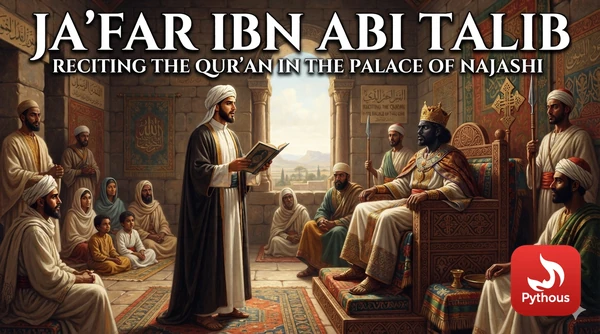
Around the year 615 CE, a small group of refugees stood in the court of a Christian king in Abyssinia. Behind them, a delegation from Mecca had arrived with gifts and a demand: hand these people back. In front of them sat a monarch who had every political reason to comply. The man who stepped forward to speak for the refugees was Ja'far ibn Abi Talib — a cousin of the Prophet Muhammad, roughly thirty years old, with no diplomatic training and nothing to offer but an explanation.
What he said that day, and what he recited afterwards, changed the outcome. It is one of the most vivid scenes in the early history of Islam, and it is preserved in enough independent detail — through Ibn Ishaq, Ibn Sa'd, al-Tabari, and the hadith collections — that we can reconstruct it with unusual confidence.
This is the story of the man who delivered it.

Illustration: the Red Sea crossing to Abyssinia.
Family and lineage
Ja'far was the son of Abu Talib ibn Abd al-Muttalib, the Hashimite chief who raised the Prophet Muhammad after the death of his grandfather. That makes Ja'far the Prophet's first cousin, and it places him inside the small circle of the clan of Hashim at exactly the moment that clan came under pressure.
Abu Talib had four sons. In order of age they were Talib, Aqil, Ja'far, and Ali. Ja'far was roughly ten years older than Ali and about ten years younger than the Prophet. The sources — Ibn Sa'd's Kitab al-Tabaqat al-Kabir is the most systematic on family detail — note a strong physical resemblance between Ja'far and the Prophet, something the Prophet himself is reported to have remarked on later in life.
His mother was Fatima bint Asad, a woman who occupies her own place in the early sources as one of the first Hashimite women to accept Islam. Ja'far married Asma bint Umays, a figure who will reappear repeatedly in this story and who outlived him by decades.
The family was noble but not wealthy. Abu Talib's finances were strained enough that the Prophet took Ali into his own household to ease the burden, and Ja'far was similarly taken in by his uncle Abbas. This detail matters for understanding the man: Ja'far grew up in a house that knew what it was to have status without money, and he is remembered afterwards for a specific kind of generosity that people who have been poor tend to have.
Among the first Muslims
Ja'far accepted Islam very early. The biographical compilers place him in the first thirty or so converts — some accounts put him immediately after Ali and Zayd ibn Haritha, within the earliest phase of the private call in Mecca. Asma bint Umays accepted Islam with him.
The early Meccan period was not a period of debate. It was a period of pressure. Converts without powerful tribal protection were beaten, starved, and in some cases killed. Converts with protection, like Ja'far, faced a slower form of coercion: social isolation, commercial boycott, and the constant threat that their clan's patience would run out.
By the fifth year of the prophetic mission, the Prophet concluded that some of his followers could not safely remain in Mecca at all.
Why Abyssinia
The choice of Abyssinia was deliberate and, on the evidence, well-informed.
Abyssinia — the Christian kingdom of Aksum, in what is now northern Ethiopia and Eritrea — sat directly across the Red Sea from the Hijaz. It was a trading partner Meccans knew well. Crucially, it was ruled by a king with a reputation for not tolerating injustice in his court. The Arabic sources call him al-Najashi, an Arabic rendering of the Aksumite royal title negus; his personal name is given as Ashama ibn Abjar.
The Prophet's instruction, as Ibn Ishaq records it, was that his followers should go to the land of a king under whom no one is wronged. That is a striking basis for a policy decision: not a military alliance, not a shared creed, but a specific reputation for justice.
A first, small group crossed in the fifth year of the mission — around a dozen men and a few women, including Uthman ibn Affan and his wife Ruqayya, the Prophet's daughter. They returned briefly on a false report that Mecca had reconciled with the Muslims. When that proved wrong, a second and much larger migration followed: something in the region of eighty-three men plus women and children, though the figures vary by source.
Ja'far ibn Abi Talib led this second group. Asma bint Umays travelled with him. They would remain in Abyssinia for roughly thirteen years, and their son Abdullah ibn Ja'far was born there — traditionally counted as the first Muslim child born in the land of the migration.
The Quraysh delegation
Mecca did not let the matter rest. The Quraysh understood the strategic problem clearly: a protected Muslim community abroad meant the movement could survive even if it were crushed at home.
They sent two envoys, chosen for skill rather than seniority. One was Amr ibn al-As — decades later a Muslim general and the conqueror of Egypt, but at this point one of the sharpest political operators in Mecca. The other was Abdullah ibn Abi Rabi'a. They arrived with substantial gifts, and Ibn Ishaq is explicit about their method: they worked the king's generals and courtiers first, distributing presents and building a bloc of opinion before they ever approached the throne.
Their argument to the Negus was framed to require no theological engagement at all. These are foolish young people, they said in substance, who have abandoned the religion of their own nation without entering yours. Their own families have sent us to bring them home. It was a pitch designed to make handing the refugees over look like a courtesy between neighbours rather than a judgment about religion.
The generals urged the king to accept. The Negus refused. He would not surrender people who had come to his land seeking his protection without hearing them speak.
That decision is the hinge of the entire episode.
The speech
The Muslims were summoned. They agreed among themselves to tell the king the plain truth regardless of consequence, and Ja'far spoke for them.
His speech, as transmitted by Ibn Ishaq and reproduced with minor variation in Ibn Sa'd and al-Tabari, is worth understanding structurally, because its construction is remarkably shrewd. Paraphrased, it runs roughly like this:
First, the diagnosis. We were a people of ignorance. We worshipped idols, ate carrion, committed indecencies, cut off ties of kinship, mistreated our neighbours, and the strong among us devoured the weak.
Second, the intervention. Then God sent us a messenger from among ourselves, whose lineage, honesty, and integrity we already knew.
Third, the content of the message. He called us to worship God alone and abandon the stones and idols our fathers had worshipped. He commanded truthful speech, keeping trusts, maintaining kinship ties, good treatment of neighbours, and refraining from bloodshed and from what is forbidden. He forbade indecency, false testimony, consuming the property of orphans, and slandering chaste women. He ordered prayer, charity, and fasting.
Fourth, the consequence. So we believed him. And for that our people turned on us, persecuted us, and tried to force us back to idolatry. When they overpowered us and blocked every path, we came to your land, and we chose you above others, and we hoped we would not be wronged in your presence.
Notice what Ja'far does not do. He does not attack Christianity. He does not flatter the king. He does not deny the charge that they left the religion of their fathers — he confirms it and reframes it as an escape rather than a defection. And he loads the middle of the speech with a list of ethical commitments that a Christian monarch could not possibly object to without objecting to his own scripture.
Then the king asked whether Ja'far had any of this revelation with him.
Surah Maryam
Ja'far recited from the opening of Surat Maryam — the nineteenth chapter of the Qur'an.
The choice was not accidental. Surat Maryam narrates the annunciation to Mary, the miraculous conception, the birth of Jesus, and the infant Jesus speaking from the cradle to defend his mother's honour. It affirms Jesus as a prophet and word of God, and Mary as a woman chosen and purified. To a Christian king, the passage would have been simultaneously familiar and startling: a text he had never heard, in a language he may not have spoken, describing figures at the centre of his own faith with unmistakable reverence.
The sources report that the Negus wept until his beard was wet, and that his bishops wept with him. He is then said to have declared that this and what Jesus brought came from a single source of light — and he refused, flatly, to hand the refugees over.
The second attempt
Amr ibn al-As had one more move, and it was a good one.
He returned the next day with a sharper accusation, one calculated to force a theological split: ask them what they say about Jesus, son of Mary.
This was a genuine trap. The Muslim position — that Jesus is a servant of God, His messenger, His word cast to Mary, and a spirit from Him — is not the Chalcedonian formula of the Aksumite church. Denying divine sonship in front of a Christian king and his bishops was, on the face of it, suicidal.
The Muslims consulted and decided they would say exactly what their revelation said, whatever followed. Ja'far gave the answer.
The Negus is reported to have picked up a stick or a straw from the ground and said that the difference between what Ja'far had described and what he himself believed was no wider than that. His bishops objected loudly. He overruled them, returned the Quraysh delegation's gifts, and dismissed the envoys.
Amr and Abdullah went back to Mecca with nothing.
The Muslim refugees remained in Abyssinia in security for years. Islamic tradition holds that the Negus himself accepted Islam privately, and reports in the hadith collections describe the Prophet performing the funeral prayer in absentia for him in Medina upon receiving news of his death.
The return
Ja'far did not come back for well over a decade. He and the remaining Abyssinian migrants returned in the seventh year after the Hijra — 629 CE — arriving in Medina at the time of the conquest of Khaybar.
The Prophet's reaction is one of the most frequently cited moments of affection in the sira literature. He embraced Ja'far, kissed him between the eyes, and said he did not know which he was more delighted by — the conquest of Khaybar or the arrival of Ja'far.
The nickname Ja'far carries in the sources from this period is Abu al-Masakin, "father of the poor." Abu Hurayra, who was among the poorest of the Prophet's companions, is reported in Bukhari as saying that Ja'far was the best of people towards the destitute, taking them into his house and feeding them from whatever he had, down to scraping out an empty butter skin for them to lick when there was nothing else.
He had, by then, spent thirteen years as a refugee. The generosity reads as earned.

Illustration: the plain near Mu'ta, in today's Jordan.
Mu'ta
Ja'far had about a year in Medina.
In Jumada al-Awwal of the eighth year after the Hijra — September 629 CE — the Prophet dispatched an expedition north to Mu'ta, in what is now Jordan, in response to the killing of an envoy. The force numbered three thousand. Facing them was a Byzantine and allied Arab army whose size the sources give as vastly greater; the traditional figure of a hundred thousand is almost certainly a literary magnification, but there is no dispute that the Muslims were overwhelmingly outnumbered.
The Prophet named the command in advance, and in sequence: Zayd ibn Haritha would lead; if Zayd fell, Ja'far ibn Abi Talib; if Ja'far fell, Abdullah ibn Rawaha. The fact that he named three commanders before the army left tells you what he expected.
Zayd was killed holding the banner. Ja'far took it.
The account preserved in Ibn Ishaq and Ibn Sa'd describes what followed: Ja'far dismounted and hamstrung his own horse — a deliberate act removing any possibility of retreat — and fought on foot. His right hand was severed; he took the banner in his left. His left hand was severed; he clasped the banner against his chest with his arms until he was killed. He was around forty-one years old.
Abdullah ibn Rawaha took the banner and was killed in turn. Khalid ibn al-Walid then assumed command and extracted the army — a withdrawal that is generally regarded as the beginning of his reputation as a commander.
Abdullah ibn Umar, who was present, is reported in Sahih al-Bukhari as having counted the wounds on Ja'far's body: more than fifty from sword and spear, and not one of them in his back.
Dhu'l-Janahayn
The Prophet announced the deaths in Medina before any messenger arrived. Bukhari records his words that God had replaced Ja'far's two severed hands with two wings, with which he flies in Paradise. From this comes the two names by which Ja'far is known in Islamic tradition: Ja'far al-Tayyar, the flyer, and Dhu'l-Janahayn, the one with two wings.
He then went to Ja'far's house. Asma bint Umays had been preparing dough and washing the children. The Prophet asked for the sons of Ja'far, gathered them, embraced them, and wept — and when Asma understood what had happened and cried out, he did not stop her.
He instructed the household of the family to prepare food for Ja'far's family, because, as the report in the Sunan collections has it, something had come upon them that would occupy them. It is the origin of a practice still followed across the Muslim world: you cook for the bereaved.
Afterwards
Asma bint Umays later married Abu Bakr, and after his death, Ali ibn Abi Talib — placing her at the centre of the political history of the next three decades.
Abdullah ibn Ja'far, the boy born in Abyssinia, grew up to be one of the most famously generous men of his generation, known by the epithet Bahr al-Jud, the sea of liberality. Two of Ja'far's other sons, Muhammad and Awn, were killed at the Battle of Siffin.
Ja'far's own reputation settled into something specific. He is not primarily remembered as a warrior, though he died as one. He is remembered as the man who could stand in a foreign court, under a hostile delegation's pressure, and describe what he believed without deforming it to fit the room — and who understood, when the king asked for evidence, precisely which passage to recite.
Sources
The core narrative of the Abyssinian migration and the speech before the Negus comes from Ibn Ishaq's Sirat Rasul Allah, surviving in the recension of Ibn Hisham. It is corroborated and expanded in Ibn Sa'd's Kitab al-Tabaqat al-Kabir and al-Tabari's Tarikh al-Rusul wa'l-Muluk, the latter of which preserves an isnad running back to Umm Salama, who was present in Abyssinia herself.
The Mu'ta material and the reports of the Prophet's response are found in Sahih al-Bukhari, principally in the books of expeditions and of virtues, and in Sahih Muslim. Ibn Hajar al-Asqalani's al-Isaba fi Tamyiz al-Sahaba collates the biographical reports and assesses their chains.
Where these sources disagree — on troop numbers at Mu'ta, on the exact count of the second migration, on the precise wording of the Negus's reply — the disagreement is noted above rather than smoothed over.



Comments (0)
Leave a Reply
Log in to post a comment.