

 Aug 30, 2026
 17 min read
Hazrat Hamza ibn Abd al-Muttalib (RA): The Life of the Lion of Allah
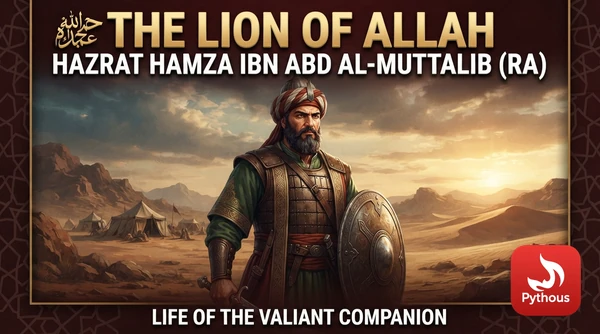
Among the companions of the Prophet Muhammad ﷺ, few figures occupy the imagination quite like Hamza ibn Abd al-Muttalib. He was an uncle by blood, a foster brother by nursing, a hunter and warrior by temperament, and — after one furious afternoon at the foot of Mount Safa — one of the most consequential converts of the early Meccan period. He died at Uhud in a manner so brutal that the Prophet ﷺ was said never to have grieved harder, and he was remembered afterwards with a title granted to almost no one else: Sayyid al-Shuhada, the master of martyrs.
This article traces his life in two halves: the man he was before Islam, and the man he became after it.
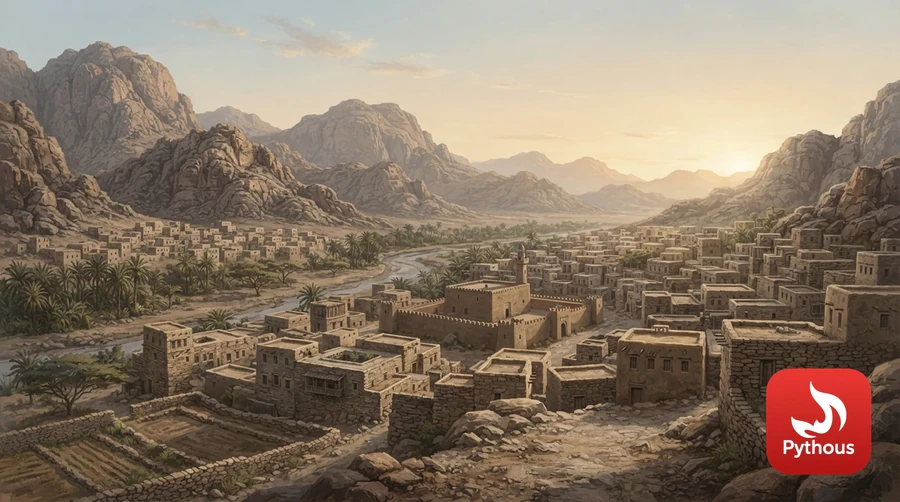
Illustration: the valley of Mecca as it might have looked in the 6th century.
1. Lineage and Birth
His full name was Hamza ibn Abd al-Muttalib ibn Hashim ibn Abd Manaf al-Qurashi al-Hashimi. He carried the kunyas Abu Umarah and Abu Ya'la.
His father, Abd al-Muttalib, was the custodian of the Zamzam well and the leading figure of Banu Hashim in the generation before the Prophet ﷺ. That placed Hamza inside the most prestigious clan of the Quraysh — a clan whose prestige rested less on wealth than on the hereditary honour of serving the pilgrims who came to the Kaaba.
His mother was Hala bint Wuhayb (Uhayb) ibn Abd Manaf ibn Zuhra, of Banu Zuhra. This detail matters more than it first appears. Hala was a close relative of Aminah bint Wahb, the Prophet's mother. So Hamza was linked to the Prophet ﷺ twice over — through the father's line as his paternal uncle, and through the mother's line as a kinsman of Banu Zuhra. His full sister by the same mother was Safiyyah bint Abd al-Muttalib, the mother of al-Zubayr ibn al-Awwam.
There is a third link, less commonly known. Both Hamza and the Prophet ﷺ were nursed in infancy by Thuwaybah, a freed slave woman of Abu Lahab. That made them milk brothers in addition to being uncle and nephew — a relationship of real legal and emotional weight in Arab society.
Most reports place his birth in Mecca about two years before the Prophet ﷺ, around 568–570 CE; some early biographers say four. Either way, the two grew up close in age and, by every indication, close in affection.
2. The Man Before Islam
A society built on strength and lineage
To understand Hamza in his youth, you have to understand what pre-Islamic Mecca valued. The city was a commercial and religious hub, prospering on the pilgrim trade and on caravans running north to Syria and south to Yemen. It had no king, no standing army, and no police. Order was held together by asabiyyah — clan solidarity — and by the reputation of individual men. A man's worth was measured in courage, generosity, endurance, skill in arms, and the willingness to defend his kin without hesitation.
Hamza excelled at exactly the qualities that society rewarded.
Hunter, wrestler, swordsman
The early biographers describe him as physically imposing and a natural athlete: a wrestler, an archer, and a hunter who spent long stretches in the hills and desert around Mecca chasing game. Hunting was not a hobby for the idle — it was training. It taught tracking, patience, marksmanship with the bow, and endurance in heat. Those were the same skills that made a man dangerous in a raid or a feud.
He was, in short, one of the young men of the Quraysh whose name carried weight in a gathering. When he returned from a hunt, his habit was to circle the Kaaba first, then stop at the assemblies of the Quraysh in the sanctuary, exchange news, and only then go home. That routine would eventually change the course of his life.
Family life
Hamza married Salma bint Umays al-Khath'amiyyah, a sister of Asma bint Umays (who was married to Ja'far ibn Abi Talib), and also Khawlah bint Qays of the Ansar. His daughter Umamah — named in some reports as Fatimah — would become the subject of a well-known custody dispute among the companions years after his death. His sons did not leave a surviving line, and the biographers note that his direct descent came to an end.
Where he stood in the first years of the message
When the revelation began in about 610 CE, Hamza did not immediately accept it. He was not hostile in the way Abu Jahl or Abu Lahab were hostile, but nor was he a believer. For roughly the first six years he stood where many of the Banu Hashim stood: bound by clan loyalty to protect his nephew from physical harm, but unpersuaded by his message and unwilling to break with the religion of his fathers.
This is worth pausing on. Hamza was not a young man searching for meaning. He was a settled, respected, middle-aged noble of the Quraysh with everything to lose and nothing obvious to gain.
3. The Turning Point: A Blow Struck in Anger
The most famous episode in Hamza's life is preserved in Ibn Ishaq's Sirah (as transmitted by Ibn Hisham) and repeated by Ibn Sa'd and al-Tabari. It is usually placed in the sixth year of prophethood, around 615–616 CE.
Abu Jahl — Amr ibn Hisham — came upon the Prophet ﷺ near al-Safa and abused him at length: insults, mockery, contempt for his religion. The Prophet ﷺ did not answer him. Abu Jahl then walked off and joined the Quraysh assembly at the Kaaba as if nothing had happened.
The whole exchange was witnessed by a freed slave woman of Abdullah ibn Jud'an, from a house nearby.
Hamza returned that evening from a hunt, bow slung over his shoulder, and stopped as usual at the sanctuary. The woman called out to him and told him plainly what Abu Jahl had done to his nephew, and that Muhammad ﷺ had borne it in silence.
Hamza said nothing. He walked straight into the assembly, found Abu Jahl among his people, raised his bow and struck him across the head with it, opening a serious wound. Then he said words to this effect: Do you insult him, when I follow his religion and say what he says? Answer me back if you can.
Men of Banu Makhzum rose to defend their chief. Abu Jahl waved them down. "Leave Abu Umarah alone," he said — because he knew he had abused Hamza's nephew savagely, and he understood better than anyone what a blood feud with Banu Hashim would now cost the Quraysh.
From tribal pride to conviction
The early biographers are honest about something modern retellings often smooth over: Hamza's first declaration was driven by tribal honour, not by belief. He said it in fury, defending his kinsman.
Afterwards, according to Ibn Ishaq, he went home and was troubled. He asked himself whether he had abandoned the religion of his forefathers over a moment of temper. He spent a difficult night, and then prayed — asking God for certainty, whichever way it lay. Then he went to the Prophet ﷺ, told him what had happened, and asked him to speak. The Prophet ﷺ reminded and admonished him, and Hamza's faith settled.
From that point, the sources describe a man of complete and unqualified conviction. It is a rare and very human sequence: an act of loyalty preceding an act of faith, and faith arriving afterwards to give the loyalty a foundation.
Why his conversion mattered
Two things changed at once.
First, the calculus of persecution shifted. Ibn Ishaq records that the Quraysh understood that the Prophet ﷺ was now protected in a new way, and they eased off some of the harassment. The Muslims were still weak, still poor, still vulnerable — but the sight of Hamza standing with them made casual street violence far more expensive.
Second, it broke a psychological seal. The Quraysh had told themselves that Islam was a religion for slaves, the young, and the marginal. The public conversion of one of their most admired fighting men made that story harder to sustain. Within a short period, Umar ibn al-Khattab also accepted Islam, and the two conversions together are treated by the sources as the moment the Muslim community in Mecca could finally pray openly at the Kaaba.
Hamza earned in this period the titles that outlived him: Asad Allah — the Lion of God — and Asad Rasulillah, the lion of God's Messenger.
4. The Boycott and the Years of Endurance
Between roughly 617 and 619 CE, the Quraysh imposed a total boycott on Banu Hashim and Banu al-Muttalib: no trade, no marriage, no dealings of any kind. The clans withdrew to the Shi'b Abi Talib, a narrow valley enclosure on the edge of Mecca, and endured close to three years of hunger and isolation.
Hamza was among them. This period is a useful corrective to the image of him as purely a man of action. His contribution here was not combat but endurance — sitting out three years of deliberate starvation with his clan rather than taking the easy exit that renouncing his nephew would have offered him.
The boycott collapsed when several Quraysh leaders repudiated it. Shortly afterwards came the Year of Sorrow: the deaths of Abu Talib and Khadijah (RA), and the loss of the Prophet's chief clan protector.
5. Medina: Standard-Bearer of the New Community
After the Hijrah in 622 CE, Hamza settled in Medina. The Prophet ﷺ established the mu'akhat — the pact of brotherhood — and Hamza was paired with Zayd ibn Harithah. The bond was serious enough that Hamza is reported to have entrusted Zayd with his will before Uhud.
The first banner in Islam
In Ramadan of 1 AH, the Prophet ﷺ tied a white standard and handed it to Hamza, sending him with about thirty Muhajirun toward Sif al-Bahr, on the coast near al-Is, to intercept a Quraysh caravan returning from Syria escorted by Abu Jahl with some three hundred men.
The two forces met but did not fight. Majdi ibn Amr al-Juhani, an ally of both sides, intervened and negotiated a withdrawal. No blood was spilled.
Militarily it achieved nothing. Symbolically it mattered a great deal: most of the early sources treat this as the first banner the Prophet ﷺ ever tied in Islam, and it was given to Hamza. (Some reports give that honour to Ubaydah ibn al-Harith's expedition instead; the biographers disagree.)
6. Badr: The Champion of the Muslims
At Badr, on 17 Ramadan 2 AH (March 624 CE), Hamza fought at the front of a Muslim force of roughly 313 against a Quraysh army of about a thousand. He is described as marking himself out with an ostrich feather on his chest so that both armies would know exactly who he was — a gesture straight out of the pre-Islamic warrior code, now employed in a new cause.
Battles then opened with single combat. The Quraysh sent forward three champions of Banu Abd Shams: Utbah ibn Rabi'ah, his brother Shaybah ibn Rabi'ah, and Utbah's son al-Walid ibn Utbah. The Prophet ﷺ sent out three of his own kin: Hamza, Ali ibn Abi Talib, and Ubaydah ibn al-Harith.
Hamza and Ali killed their opponents almost immediately. Ubaydah, the oldest of the three, exchanged blows with Utbah and was mortally wounded; Hamza and Ali turned and finished Utbah, then carried Ubaydah back to the Muslim lines, where he died of his wound. (The sources differ on which brother Hamza faced — most say Shaybah.)
Hamza fought on through the general engagement and is credited with killing several notables of the Quraysh. Among the dead was Tu'aymah ibn Adi, the uncle of Jubayr ibn Mut'im.
Badr was a decisive Muslim victory. It was also the event that sealed Hamza's death, because it created two people with an obsession: Jubayr ibn Mut'im, who lost his uncle, and Hind bint Utbah, who in a single afternoon lost her father Utbah, her uncle Shaybah, and her brother al-Walid.

Illustration: Mount Uhud, where Hamza was killed in 625.
7. Uhud: The Javelin
The contract
Jubayr ibn Mut'im owned an Abyssinian slave named Wahshi ibn Harb, who threw the short javelin — the harbah — in the Abyssinian manner, and threw it with lethal accuracy. Jubayr promised Wahshi his freedom if he killed Hamza. Hind bint Utbah, according to Ibn Ishaq, promised him further reward.
Wahshi was not sent to fight the battle. He was sent to perform one killing.
The account in Wahshi's own words
The most striking thing about Hamza's death is that we have the killer's own first-person narration, preserved in Sahih al-Bukhari (Kitab al-Maghazi), given years later after Wahshi himself had accepted Islam.
Wahshi described going out with the Quraysh at Uhud (Shawwal 3 AH / March 625 CE) with no interest in the outcome of the battle, watching only for Hamza. He found a position behind cover and waited.
He described Hamza cutting through men and killing everything in his path. Siba' ibn Abd al-Uzza came out before him and Hamza killed him at once. Then Hamza turned, and Wahshi threw. The javelin struck him in the lower abdomen and drove through. Hamza started toward Wahshi, then collapsed and died. Wahshi waited until it was over, went out to the body, recovered his javelin, and returned to the camp. He had no further business in the battle.
The sirah reports credit Hamza with killing a large number of the enemy at Uhud — Ibn Ishaq and al-Waqidi give figures around thirty — and describe him fighting with two swords. Uhud itself turned from a Muslim advantage into a disaster when the archers left their position on the hill, allowing Khalid ibn al-Walid's cavalry to strike the Muslim rear.
The mutilation
What followed is one of the ugliest scenes in the sirah. Hind bint Utbah and the women with her went among the Muslim dead and mutilated the bodies, cutting off noses and ears and stringing them into ornaments. Hind cut open Hamza's body and took his liver, biting into it — though the reports say she could not swallow it and spat it out. The epithet akilat al-akbad, liver-eater, followed her for the rest of her life.
The Prophet's grief
When the Prophet ﷺ came upon the body of his uncle and foster brother, the sources describe a grief unlike anything else recorded of him. A widely transmitted report has him saying that he had never been angrier than at that sight, and that he intended to answer the mutilation in kind — until the verse was recited:
"And if you punish, punish with an equivalent of that with which you were harmed. But if you are patient — it is better for those who are patient." — Surah al-Nahl 16:126
He refrained, made expiation, and thereafter forbade mutilation of the dead as a standing rule of Muslim warfare. (Some scholars have questioned this chain of events on the grounds that Surah al-Nahl is Meccan; the ruling against mutilation itself is firmly established regardless.)
His sister Safiyyah bint Abd al-Muttalib came looking for her brother's body. The Prophet ﷺ told al-Zubayr to turn her back so that she would not see what had been done. She refused, saying she had heard already, and that she would bear it with patience and seek reward from God. She saw him, said inna lillahi wa inna ilayhi raji'un, and asked forgiveness for him.
Burial
The martyrs of Uhud were buried where they fell, unwashed, in their clothes, without the usual funeral rites — the Prophet ﷺ said they would be raised as witnesses. Hamza was buried in the same grave as his nephew Abdullah ibn Jahsh, the son of his sister Umaymah.
In the days that followed, the Prophet ﷺ passed the houses of the Ansar and heard the women weeping for their own dead, and remarked that Hamza had no women to weep for him. The Ansar sent their women to mourn Hamza first. He thanked them — and then forbade formal wailing (niyahah) altogether.
Later, the Prophet ﷺ was reported to say:
"The master of martyrs is Hamza ibn Abd al-Muttalib, and a man who stands before a tyrannical ruler, commands him to good and forbids him evil, and is killed for it." — al-Hakim, al-Mustadrak
8. What Came Afterwards
Wahshi accepted Islam years later, coming to Medina after the conquest of Mecca. The Prophet ﷺ questioned him about how he had killed Hamza, listened to the account, and then asked him to keep his face out of his sight — a striking, entirely human boundary: forgiveness without forced intimacy. Wahshi went on to fight at Yamamah against Musaylimah the false prophet, and killed him with the same javelin. He used to say that he had killed the best of men and then the worst of men, and hoped the second would answer for the first.
Hind bint Utbah accepted Islam after the conquest of Mecca in 8 AH and came to give the pledge with the women of the Quraysh.
Hamza's daughter Umamah was brought out of Mecca during Umrat al-Qada in 7 AH, and three of the closest men in the community each claimed the right to raise her: Ali (her cousin), Ja'far ibn Abi Talib, and Zayd ibn Harithah (Hamza's brother in the pact of brotherhood). The Prophet ﷺ awarded her to Ja'far, because Ja'far's wife Asma bint Umays was the girl's maternal aunt — and he ruled that the maternal aunt holds the place of the mother.
His grave still lies at the foot of Mount Uhud, in the cemetery of the martyrs on the northern edge of Medina.
9. Why Hamza's Life Still Reads Well
Several things stand out when you look at the whole arc rather than the famous scenes.
His conversion began as loyalty and became belief. He did not arrive at Islam through argument. He arrived through indignation on behalf of someone he loved, and then did the harder work afterwards of deciding whether the thing he had defended was true. The sources do not hide this, and they are better for it.
He redirected an existing temperament rather than replacing it. Hamza was a fighter before Islam and a fighter after it. What changed was not the man's nature but what that nature was placed in service of — clan honour before, a moral community after.
He gave up more than most. He was not a marginal figure looking for status. He was a respected noble at the height of his standing, and he traded that for a boycott in a starvation valley and a grave at Uhud.
His death produced a law, not a vendetta. The most consequential outcome of the mutilation at Uhud was not revenge; it was a permanent prohibition on desecrating the bodies of the dead — a principle Muslim jurists have applied ever since.
A Note on Sources
The core of this account rests on the classical Islamic historiographical tradition: Ibn Ishaq's Sirat Rasul Allah as transmitted and edited by Ibn Hisham; Ibn Sa'd's Kitab al-Tabaqat al-Kabir; and al-Tabari's Tarikh al-Rusul wa'l-Muluk, with al-Waqidi's Kitab al-Maghazi supplying much of the battlefield detail.
Wahshi's account of the killing is from Sahih al-Bukhari, and is the highest-grade material in the article. The Sayyid al-Shuhada report comes from al-Hakim's al-Mustadrak. Where the sirah literature disagrees with itself — which champion Hamza faced at Badr, whether his was truly the first banner, the exact circumstances of Surah al-Nahl 16:126 — I have noted the disagreement rather than picking a side silently. Sirah material is historically valuable but was compiled generations after the events, and it does not carry the same evidentiary standard as the canonical hadith collections.



Comments (0)
Leave a Reply
Log in to post a comment.