

 Apr 06, 2026
 4 min read
Does Anything in the World Have No Taste?

Yes, a great many things. Lick a glass window, a gold ring or a non-stick frying pan and you taste nothing at all. The reason tells you a lot about how taste works.
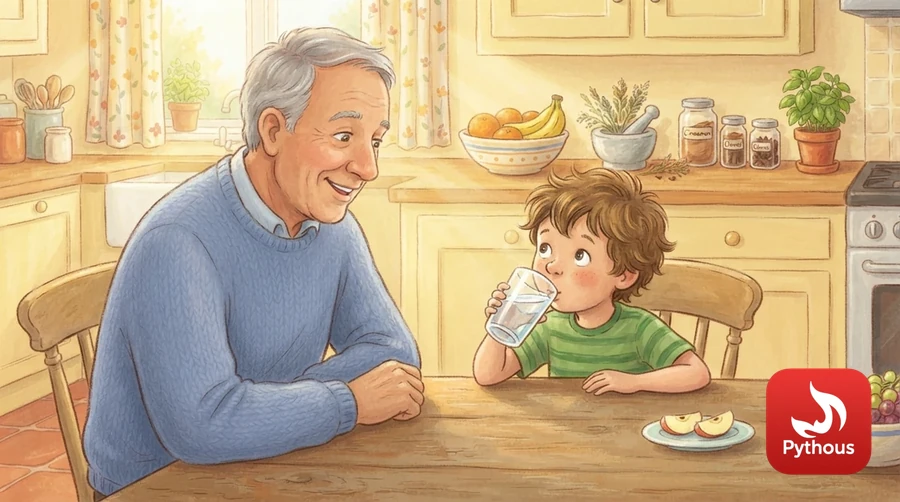
Illustration: Ayan and his grandfather.
Taste needs something to dissolve
Your tongue is covered in small bumps, and inside them sit taste buds, each a cluster of about 50 to 100 receptor cells. Those cells respond to particular molecules: sugars for sweet, salt for salty, acids for sour, a wide range of compounds for bitter, and glutamate, found in tomatoes, cheese and meat broth, for the savoury taste the Japanese chemist Kikunae Ikeda named umami in 1908. The laboratories of Charles Zuker and Nicholas Ryba in the United States identified the receptors for these five tastes in the late 1990s and 2000s.
To reach a receptor, a molecule has to be dissolved in saliva. Glass, gold, diamond, stainless steel and the plastic coating on a frying pan don't dissolve, so nothing from them gets to your taste cells. They have a temperature and a texture, but no taste.
Air has no taste for a different reason. It does touch your taste buds every time you breathe through your mouth, but the nitrogen, oxygen and other gases in it are not molecules your taste receptors respond to. What you sometimes notice in the air, such as the sea or smoke, reaches your nose, not your tongue.
What about water?
Most people would say water tastes of nothing, and in one sense that is right: there is no water receptor on the human tongue like the sweet or salty ones. But water is not quite neutral. Tap and bottled water contain dissolved minerals, which is why different waters taste different. And pure water can taste of something depending on what was in your mouth just before. In 1972 the psychologist Linda Bartoshuk and colleagues reported in Science that after eating globe artichoke, many people find that water tastes sweet. After a salty snack, water can taste faintly bitter or sour.
Animals may sense water more directly. In 2017 Yuki Oka's team at Caltech found that mice detect water with the same taste cells they use for sour. When water washes saliva off the tongue, it removes bicarbonate, and the change in acidity sets those cells off. Whether people's sour cells do the same is not yet known.
The same thing can taste different to different people
In 1931 Arthur Fox, a chemist at the DuPont company, was pouring a powder called phenylthiocarbamide, or PTC, when some of it blew into the air. A colleague nearby complained that it tasted very bitter. Fox, who had got just as much in his mouth, tasted nothing. He tested the chemical on other people and found the same split, which he reported in 1932. About a quarter to a third of people of European descent cannot taste PTC at all. In 2003 the geneticist Dennis Drayna and colleagues traced the difference mainly to one gene, TAS2R38, which codes for a bitter receptor. For non-tasters, PTC really has no taste.
This also explains why some people find raw broccoli, Brussels sprouts or dark beer unpleasantly bitter while others don't notice. Their receptors really are different.
Flavour is mostly smell
When people say food has "no taste" because of a cold, the taste buds are usually working fine. What has gone is smell. Aromas from food in your mouth travel up the back of the throat to the nose, and they supply most of what we call flavour: the difference between a strawberry and a raspberry is almost all smell. Pinch your nose and eat a jelly bean, and you'll notice it is sweet and perhaps a little sour, but you won't be able to tell which flavour it is until you let go.
So the answer has three parts. Things that don't dissolve in saliva, like glass and metal, have no taste for anyone. Things made of molecules our receptors ignore, like air, have no taste either. And some substances are tasteless to some people and strong to others, because of the genes they were born with.
Sources
- Jayaram Chandrashekar, Mark A. Hoon, Nicholas J. P. Ryba and Charles S. Zuker, "The receptors and cells for mammalian taste", Nature 444 (2006): 288–294. https://doi.org/10.1038/nature05401
- Kikunae Ikeda, "New seasonings" (English translation of the 1909 paper), Chemical Senses 27 (2002): 847–849. https://doi.org/10.1093/chemse/27.9.847
- Linda M. Bartoshuk, Chuan-Hsiung Lee and Roberta Scarpellino, "Sweet taste of water induced by artichoke (Cynara scolymus)", Science 178 (1972): 988–990. https://doi.org/10.1126/science.178.4064.988
- Dollada Zocchi, Gunther Wennemuth and Yuki Oka, "The cellular mechanism for water detection in the mammalian taste system", Nature Neuroscience 20 (2017): 927–933. https://doi.org/10.1038/nn.4575
- Arthur L. Fox, "The relationship between chemical constitution and taste", Proceedings of the National Academy of Sciences 18 (1932): 115–120. https://doi.org/10.1073/pnas.18.1.115
- Un-kyung Kim, Eric Jorgenson, Hilary Coon, Mark Leppert, Neil Risch and Dennis Drayna, "Positional cloning of the human quantitative trait locus underlying taste sensitivity to phenylthiocarbamide", Science 299 (2003): 1221–1225. https://doi.org/10.1126/science.1080190





Comments (0)
Leave a Reply
Comments are moderated. Please read our Comment Policy before posting.
Log in to post a comment.