

 Sep 16, 2026
 4 min read
How HTTPS Actually Keeps You Safe: TLS Explained
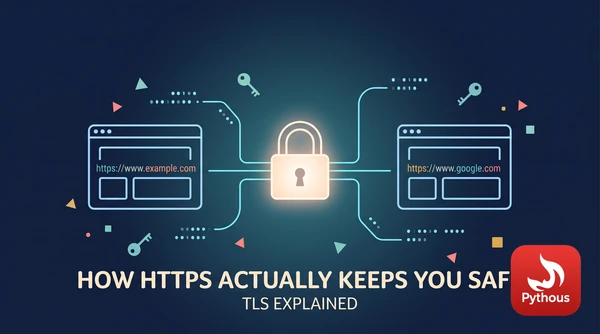
You've been trained to look for it: the little padlock icon next to a web address. See it, and the instinct is to relax — the site is "safe." But the padlock doesn't mean what most people think it means, and understanding what it actually does is one of the more useful pieces of technical literacy you can pick up.
What HTTP alone gets you into trouble
Plain HTTP sends everything — the page you requested, the form data you typed, your session cookies — as readable text across the network. Anyone sitting between you and the server (a stranger on the same coffee shop Wi-Fi, a compromised router, an ISP) can read or even quietly alter that traffic. This is called a man-in-the-middle position, and on plain HTTP it's trivial to exploit with widely available tools.
HTTPS is HTTP run inside TLS (Transport Layer Security, the modern successor to SSL). TLS doesn't change what data gets sent — it wraps the connection so that data is unreadable and untamperable to anyone except the two endpoints.
The three jobs TLS actually does
- Encryption — scrambles the data so an eavesdropper only sees ciphertext.
- Integrity — attaches a cryptographic check to every message, so any tampering in transit is detectable and the connection is dropped.
- Authentication — proves you're actually talking to the server you think you're talking to, not an impostor intercepting the connection.
That third one is where certificates come in, and it's the part people misunderstand most.
Why there's a "handshake" at all
Strong encryption for bulk data (like the actual page content) uses symmetric-key algorithms — the same key encrypts and decrypts, and it's fast. The catch: both sides need to agree on that key first, over a network an attacker can already see. You can't just send the key in the clear.
That's what asymmetric (public-key) cryptography solves: a key pair where anyone can encrypt with the public half, but only the holder of the private half can decrypt it. It's mathematically solid but too slow to encrypt an entire conversation. So TLS uses asymmetric crypto briefly, just to agree on a shared symmetric key — then switches to fast symmetric encryption for everything else. That brief negotiation is the handshake.
The handshake, in plain English
Older TLS versions took two round trips; TLS 1.3 (the current standard) trimmed it to roughly one. The gist:
- ClientHello — your browser says "here's what encryption methods I support" and sends some random data.
- ServerHello + certificate — the server picks a method, sends its own random data, and presents its certificate — a digitally signed document binding a public key to a domain name.
- Verification — your browser checks the certificate's signature against a chain of trusted Certificate Authorities (CAs) built into the OS/browser, confirming the cert really was issued to this domain by an authority your browser trusts.
- Key exchange — both sides use the exchanged public keys and random values (typically via Diffie-Hellman key exchange) to independently compute the same symmetric session key, without ever transmitting that key itself.
- Finished — both sides confirm, then switch to encrypted communication using the shared session key.
What the padlock actually promises — and what it doesn't
A valid certificate proves one specific thing: the entity that requested this certificate controls the domain it's issued for. That's it. Certificate Authorities issuing "Domain Validated" (DV) certificates — the overwhelming majority issued today, many free via services like Let's Encrypt — verify domain control automatically, not the reputation, identity, or honesty of whoever runs the site.
This means a convincing phishing site at paypa1-secure-login.com can have a perfectly valid, padlock-earning certificate. The padlock guarantees your connection to that domain is encrypted and not being eavesdropped on — it says nothing about whether the domain itself is trustworthy. Encrypted and legitimate are two different questions.
Practical takeaways
- The padlock means "this connection can't be casually eavesdropped on," not "this site is safe." Still check the actual domain name carefully.
- Public Wi-Fi is far less dangerous than it used to be specifically because HTTPS is now the default across almost the entire web — but any site that still loads over plain HTTP is exposing whatever you send it.
- If a certificate warning pops up (expired, wrong domain, untrusted issuer), that's your browser telling you the authentication step failed — take it seriously rather than clicking through.
Frequently Asked Questions
Is HTTPS the same as SSL? SSL is the predecessor protocol; TLS replaced it years ago and is what's actually in use today, though "SSL certificate" stuck around as the common name for TLS certificates.
Can HTTPS traffic ever be decrypted by a third party? Not without either the private key or a fundamental break in the underlying cryptography — which is why compromising the endpoints (malware, phishing, a stolen certificate) is a far more common attack path than trying to break the encryption itself.
Why do some sites still feel "slow" to load securely? With TLS 1.3, the handshake overhead is minimal — one extra round trip at connection start, then negligible cost per request. Modern HTTPS is close to indistinguishable from HTTP in speed.



Comments (0)
Leave a Reply
Log in to post a comment.