

 Aug 18, 2026
 5 min read
The Silent City: Why No One Has Ever Read a Word of the Indus Valley Civilization
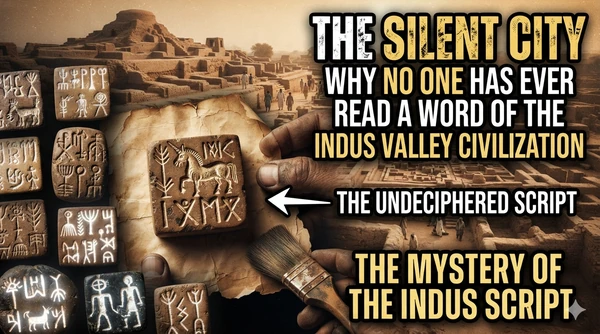
Somewhere on the banks of the Indus River, around 2600 BCE, a city rose that had no palace, no throne room, and — as far as anyone can tell — no king. Its streets ran in a precise grid. Its houses had private bathrooms connected to a covered civic drainage system that would not be matched in most of the world for another three thousand years. Its people used standardized weights accurate enough to shame a modern hardware store. And when they wanted to leave a mark, a name, a claim of ownership, they carved short strings of symbols onto small stone seals.
We have found over four thousand of those seals. We still cannot read a single one.
This is the mystery of the Indus Valley script — one of the last great undeciphered writing systems on Earth, and the quiet, nagging puzzle at the center of one of history's most advanced early civilizations.
A Civilization Discovered Backwards
The Indus Valley Civilization, also called the Harappan Civilization after one of its major sites, flourished across what is now Pakistan and northwest India from roughly 3300 to 1900 BCE — contemporary with, and arguably as sophisticated as, Old Kingdom Egypt and early Mesopotamia. Yet the world forgot it existed for nearly four thousand years. Mohenjo-daro and Harappa were only identified as ancient cities in the 1920s, when archaeologists working for the Archaeological Survey of India began excavating mounds that local farmers had walked over for generations.
What they found reshaped the timeline of South Asian history overnight: cities built to a shared plan across hundreds of kilometers, sophisticated water management, and a script that appeared on seals, pottery, and small copper tablets throughout the civilization's territory — yet nowhere near any royal tomb, temple, or monument, because none of those have ever been confidently identified either.
That absence is part of what makes the Indus script so hard to crack.
The Signs Nobody Can Read
Every other great decipherment success story — Egyptian hieroglyphs, Mesopotamian cuneiform, Mycenaean Linear B — had something the Indus script does not: either a bilingual key like the Rosetta Stone, a known descendant language to work backward from, or long enough inscriptions to find statistical patterns.
The Indus script has none of that. Its inscriptions average only about five symbols long, the longest known text runs to just a few dozen signs, and no bilingual artifact linking it to a known language has ever surfaced. Scholars aren't even certain it's writing in the full linguistic sense — some argue the roughly 400 recurring symbols represent full words or ideas rather than sounds, while others maintain it must be phonetic to function as a real script at all. Since the first Indus seal was documented in 1875, well over a hundred serious decipherment attempts have been published. None has won lasting scholarly consensus.
The candidates for what language might be hiding underneath the signs fall into a few competing camps:
- A Dravidian language. The Finnish scholar Asko Parpola has spent decades building the case that the script encodes an early form of Dravidian, the language family behind modern Tamil, Telugu, and Kannada, treating many signs as phonetic rebuses.
- An early form of Sanskrit or Indo-European speech. Other researchers have argued for a connection to Vedic-era language, a position that carries real weight in ongoing debates in South Asia about the civilization's cultural and religious legacy — a subject where the archaeology and the politics are not always easy to separate.
- Not a full language at all. A minority position, associated with researchers like Steve Farmer, holds that the symbols were a non-linguistic system of religious or clan emblems, more like heraldry than an alphabet — a claim that remains hotly contested.
In just the last few years, the puzzle has picked up new energy from an unexpected direction: machine learning. Computer vision models are now being trained to catalogue and compare the seals at a scale no human epigrapher could match, and in 2025 an Indian state government put up a substantial cash prize for anyone who can convincingly crack the code — a sign of how much cultural weight still rides on four thousand short inscriptions that have outlasted the empire that carved them.
A City That Simply Emptied Out
The script isn't the only mystery. Around 1900 BCE, after roughly a thousand years of remarkable stability, the great cities of the Indus began to empty. There's no clear evidence of the war and conquest that once dominated the explanation — the older "Aryan invasion" theory, proposed by archaeologist Mortimer Wheeler based on scattered skeletons found in the upper layers of Mohenjo-daro, has largely fallen out of favor as later analysis suggested those deaths weren't a single violent event at all.
The picture that has emerged instead, reinforced by recent paleoclimate research, points to water. Studies combining cave mineral deposits, lake sediments, and climate modeling now suggest the region endured centuries of weakening monsoons and prolonged drought, with river flow near some major urban centers dropping sharply. Rather than a single catastrophe, it looks more like a slow unraveling: harvests shrank, trade networks that once reached as far as Mesopotamia thinned out, and populations drifted east toward the more reliable rainfall of the Ganges plains, trading city life for smaller villages. The great cities weren't destroyed. They were, in a sense, outlived by their own climate.
Why the Silence Still Matters
There's something almost unsettling about a civilization this advanced — one that mastered urban sanitation before Rome existed — leaving behind a message we simply cannot open. No epic poem, no king's name, no prayer, no complaint about taxes. Just seals, and the quiet certainty that someone, somewhere along the Indus, once had something to say.
Until that script finally gives up its secrets, the Indus Valley Civilization remains one of history's strangest kinds of ruin: not lost to fire or war, but lost to silence.
Sources & further reading: research from Asko Parpola on the Dravidian hypothesis; Mortimer Wheeler's excavation reports on Mohenjo-daro; recent paleoclimate studies published in Communications Earth & Environment on Indus basin drought; and ongoing computational decipherment work summarized in Language Log and the History Guild.


Comments (0)
Leave a Reply
Log in to post a comment.